Space Travel
Senior 6 · English
Space Travel
Lesson 4 of 4
25 min
Let's begin
In lesson 2 you gave a talk about a planet. A talk can repeat itself, wave its hands and rely on your voice; a composition cannot. On the page your reader has only your words, so each paragraph must earn its place. In this lesson you study a model composition about Mars, take it apart, and then plan and write your own about the planet you chose.
Definition
Terms for planning a composition
A composition is a short essay with a clear point of view. Each paragraph does one job, and the reader should be able to say what that job is from its first sentence.
Worked example
Model composition: "The Planet Next Door" (345 words)
Task: Write a composition of about 300 words on the topic "My favourite planet".
[1] Ask people to name their favourite planet and most will choose Saturn for its rings or Jupiter for its size. My choice is smaller and, at first sight, plainer: Mars. It is a cold, dusty desert about half as wide as the Earth, yet no other planet tells us so much about the past or offers so much hope for the future. Three things make it special to me: its extraordinary landscape, the story of its water, and the chance that people will one day walk on it.
[2] First, Mars has some of the most dramatic scenery in the solar system. Its volcano Olympus Mons is the largest in the solar system and towers over Mount Everest, while Valles Marineris, a system of canyons thousands of kilometres long, makes the Grand Canyon look small. Even its colour has a story: iron minerals in the soil have rusted, which is why Mars shines red in the night sky.
[3] Second, Mars has a history that we can read. NASA missions have found strong evidence that, billions of years ago, it was warmer and wetter, with a thicker atmosphere. NASA's Perseverance rover landed on 18 February 2021 in Jezero Crater, which once held a lake fed by a river, and it has since collected rock samples that may contain signs of ancient life.
[4] Third, Mars is the planet people are most likely to visit after the Moon. However, the difficulties are enormous. The journey would take months, the thin air is mostly carbon dioxide, and the average temperature is about −65 °C. No space agency has yet fixed a date for a crewed landing. Yet if engineers solve these problems, someone who is at school today may be among the first people to stand on another planet.
[5] Mars is not the biggest, the hottest or the most beautiful planet. It is, however, the most human one: a world we have mapped, driven across and may one day visit. When I see that small red light in the sky, I am looking at the next chapter of our story.

| ¶ | Its job | Language from lesson 3 |
|---|---|---|
| 1 | Introduction: hook (what most people choose), background, thesis naming three reasons | about half as wide as (fraction + as … as) |
| 2 | Landscape: topic sentence, two facts with comparisons, a comment | some of the most dramatic, the largest in the solar system |
| 3 | Water: the planet's story, told in order | past simple for finished events: was, landed, held; present perfect for findings that matter now: have found, has collected |
| 4 | The future: a balanced view: problems first, then hope | is most likely to visit; first conditional with a modal: if engineers solve …, someone … may be |
| 5 | Conclusion: sums up the three reasons in new words; ends on an image | three superlatives in a row, then a contrast with however |
Notice what the writer does not do: there is no "In this composition I am going to talk about", no list of every fact about Mars, and no number that the writer could not check. Paragraph 4 is honest that no landing date exists; a weaker writer would have invented one.
| Job | Linking words | Example |
|---|---|---|
| adding a point | first, second, in addition, moreover, furthermore, what is more | In addition, Mars has two small moons. |
| contrasting | however, yet, although, whereas, nevertheless, on the other hand | Venus is closer to us, whereas Mars is easier to explore. |
| giving a result | therefore, as a result, consequently, so, which is why | The air is thin; as a result, it cannot hold much heat. |
| giving an example | for example, for instance, such as | Robots such as Perseverance do the work for now. |
| concluding | in conclusion, to sum up, overall | To sum up, Mars rewards our curiosity. |
Punctuation matters: however, therefore and moreover begin a new sentence or follow a semicolon, and take a comma after them. Although and whereas join two clauses inside one sentence.

Worked example
From notes to a body paragraph
Notes on Venus, from the planet table: 464 °C, hottest planet · farther from the Sun than Mercury (167 °C) · thick atmosphere, mostly carbon dioxide, traps heat.
Tip
Plan for five minutes, write for twenty-five, check for five. In an examination, a composition planned in five lines is almost always better organised than one written straight away. Write your thesis and three topic sentences first; the rest of the composition is then a matter of filling in the support.
Warning
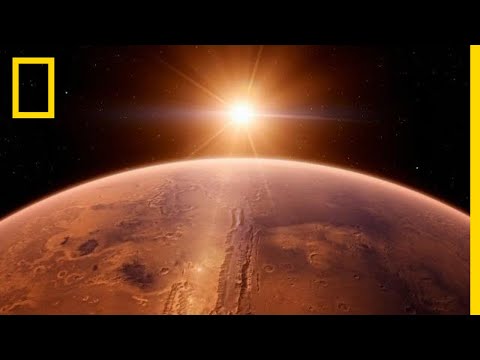
Mars 101, from National Geographic's YouTube channel (about 4 minutes, 2018): how the red planet formed and what its polar ice caps may tell us. Note two facts that the model composition does not use, then decide which paragraph of the model each one could strengthen.
Practice
Further reading
Sources and credits