Asexual and Sexual Reproduction in Plants and Microorganisms
Senior 3 · Biology
Asexual and Sexual Reproduction in Plants and Microorganisms
Lesson 1 of 5
25 min
A pot of cooked beans is left on the table on a warm evening. In the morning it smells sour, and it could make anyone who eats it ill. No one added anything to it. A few bacteria that landed on the food have been dividing, again and again, all night: each one splitting into two, those two into four, and so on. That is asexual reproduction, and in the right conditions it can turn one cell into millions in a single night.
Definition
Asexual reproduction: the production of new individuals from one parent, without gametes or fertilisation. The offspring are genetically identical to the parent and to each other (unless a mutation occurs). Example: a bacterium splitting into two.
Sexual reproduction: the production of new individuals by the fusion of two gametes (sex cells), usually from two parents, to form a zygote. The offspring show variation. Example: a bean plant growing from a seed.
Clone: a group of genetically identical individuals produced asexually from one parent.
Spore: a small reproductive cell, usually with a tough wall, that can grow into a new individual without fusing with another cell. Example: the spores of the bread mould Rhizopus.
| Feature | Asexual reproduction | Sexual reproduction |
|---|---|---|
| Number of parents | One | Usually two |
| Gametes and fertilisation | None | Two gametes fuse at fertilisation |
| Cell division involved | Mitosis | Meiosis to make gametes; mitosis to grow the zygote (Unit 5) |
| Offspring | Genetically identical: a clone | Genetically different: variation |
| Speed and numbers | Fast; many offspring | Slower; fewer offspring |
Figure 1: simplified; not to scale. A bacterium is typically about 1 to 5 micrometres long; a yeast cell about 5 to 10 micrometres across; a Rhizopus sporangium is just visible to the naked eye as a black dot.
Binary fission ("splitting in two") is how bacteria reproduce. The loop of DNA is copied, the cell grows longer, and a new wall forms across the middle, making two identical cells. In good conditions (warmth, moisture and food) some bacteria can divide as often as every 20 minutes. The single-celled Amoeba also reproduces by binary fission: its nucleus divides by mitosis, then its cytoplasm divides.
Budding happens in yeast, the single-celled fungus used in baking and brewing (Unit 8). A small outgrowth, the bud, forms on the parent cell; the nucleus divides and one nucleus moves into the bud; the bud grows and breaks off, or stays attached so that chains of cells form.
Spore formation happens in many fungi. In the bread mould Rhizopus, thread-like hyphae spread through the food and digest it. Upright stalks grow up, each carrying a round, black sporangium containing thousands of tiny spores. When it bursts, the light spores are carried by air; any that land on damp food grow into new moulds. Mushrooms release spores from the gills under their caps. Some bacteria form tough endospores, but these are for surviving bad conditions, not for reproducing: one bacterium forms one endospore.
Worked example 1: how fast can bacteria multiply?
One bacterium lands on cooked food at room temperature and divides every 20 minutes. Assuming nothing limits its growth, how many bacteria are there after 4 hours, and after 8 hours?
Worked example 2: why a fridge keeps food safe for longer
Suppose that at 30 °C a type of bacterium divides every 20 minutes, but at 4 °C, in a refrigerator, it divides only every 4 hours (illustrative figures). Starting from 100 bacteria, compare the numbers after 8 hours.
Warning
Common mistakes. (1) Saying asexual reproduction uses meiosis: it uses mitosis, which is why the offspring are identical. (2) Thinking a bacterial endospore is a way of reproducing: it is a resting stage for survival. (3) Writing that budding gives two equal cells: the bud starts much smaller than the parent.
Safety. If you grow moulds on bread for observation, keep the bread sealed in a clear bag, look through the bag, never open or sniff it, and give it to your teacher to dispose of: mould spores can cause allergies and breathing problems.
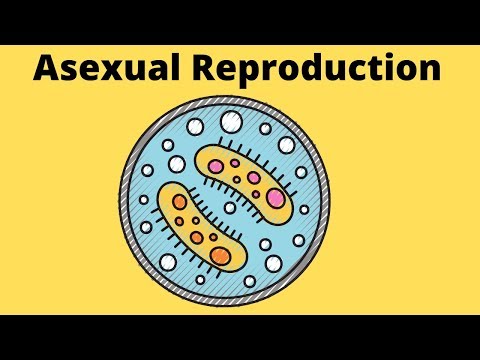
Asexual Reproduction: Fission, Budding, Fragmentation, Spores, MooMooMath and Science. Watch for the difference between fission, budding and spores, and compare them with Figure 1.
Tip
Memory hook: "Bacteria Break, Yeast Yields buds, Fungi Fling spores". Binary fission in bacteria, budding in yeast, spores in moulds and mushrooms.
Practice: reproduction in microorganisms
Key points
Sources and credits
Written by Ganzaa: the text, Figure 1, the tables, the worked examples (Worked example 2 uses illustrative figures) and the practice questions.