Asexual and Sexual Reproduction in Plants and Microorganisms
Senior 3 · Biology
Asexual and Sexual Reproduction in Plants and Microorganisms
Lesson 2 of 5
25 min
When a farmer starts a new banana plantation, she does not plant seeds: the bananas we eat have no seeds that can grow. Instead she digs up young shoots, called suckers, that have grown up around an older plant, and plants them in new holes. Cassava is planted from pieces of stem, sweet potatoes from pieces of vine, and Irish potatoes from small tubers. Every one of these new plants is a clone of its parent. This is vegetative reproduction, and much of Rwanda's food grows from it.
Definition
Vegetative reproduction (vegetative propagation): asexual reproduction in which a new plant grows from part of the stem, root or leaf of the parent, not from a seed.
Artificial propagation: vegetative reproduction carried out by people, e.g. cuttings, grafting, layering and tissue culture.
Grafting: joining a shoot (the scion) from one plant onto the rooted stem (the rootstock) of another, so that they grow together as one plant.
Tissue culture (micropropagation): growing many new plants from tiny pieces of tissue on a sterile nutrient jelly containing plant hormones.
| Organ | What it is | Example |
|---|---|---|
| Sucker | A shoot that grows up from a bud on the underground stem (corm) of the parent | Banana |
| Stem tuber | A swollen underground stem tip storing starch; its "eyes" are buds that grow into new shoots | Irish potato |
| Root tuber | A swollen root storing food, which can produce shoots | Sweet potato |
| Rhizome | An underground stem growing horizontally, with buds along it | Ginger, couch grass |
| Bulb | A short stem with fleshy leaf bases storing food, and buds | Onion, garlic |
| Runner (stolon) | A stem growing along the ground that roots at its nodes | Strawberry, some grasses |
| Leaf plantlets | Tiny plants that form along the edges of a leaf | Bryophyllum |
Each organ contains buds (which grow into shoots) and usually a food store, which lets the new plant grow quickly at first.
Figure 1: simplified. The cambium, a thin layer of dividing cells just under the bark, must line up on at least one side so that the two parts can grow together.
| Advantages of vegetative reproduction | Disadvantages |
|---|---|
| Offspring are identical to a parent with good qualities (yield, taste, disease resistance) | No variation: if a disease attacks one plant, all may be susceptible |
| The food store gives a quick start; crops mature sooner than from seed | Diseases are carried in the planting material, e.g. banana Xanthomonas wilt in suckers, cassava mosaic disease in cuttings |
| No need for pollination, flowers or seeds: seedless bananas can still be grown | No dispersal: offspring crowd round the parent and compete |
| Grafting combines a good fruiting variety with a strong rootstock | Planting material is bulky and spoils quickly compared with seed |
Worked example 1: planting a cassava field
A farmer has 40 mature cassava stems. From each he can use 1.0 m of healthy stem, and he cuts it into cuttings 25 cm long (a typical length). He plants them 1 m apart in rows 1 m apart. How many cuttings does he get, and how much land can he plant?
Worked example 2: seed or graft?
A school wants to plant avocado trees. A teacher suggests sowing the stones of the best fruit from the market; the agriculture club suggests buying grafted seedlings. Evaluate both choices.
Warning
Common mistakes. (1) Calling an Irish potato a root: it is a stem tuber, because it has buds (eyes). A sweet potato is a root tuber. (2) Saying vegetative reproduction gives variation: the offspring are clones. (3) Thinking grafting changes the scion's genes: the fruit is that of the scion's variety.
Safety. When taking cuttings or grafting, use a sharp knife and cut away from your body, with an adult supervising. Clean the knife with disinfectant between plants, so that you do not carry diseases such as banana Xanthomonas wilt from one plant to the next.
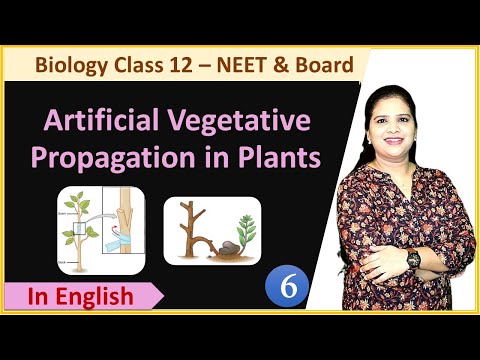
Artificial Vegetative Propagation in Plants, NEET Biology Expert. Watch for how cutting, layering and grafting are done, and compare grafting with Figure 1.
Tip
Memory hook: "the scion is on top, the stock is in the soil". The scion gives the shoots and fruit; the stock gives the roots.
Practice: vegetative reproduction
Key points
Sources and credits
Written by Ganzaa: the text, Figure 1, the tables, the worked examples (Worked example 1 uses typical figures) and the practice questions.