Asexual and Sexual Reproduction in Plants and Microorganisms
Senior 3 · Biology
Asexual and Sexual Reproduction in Plants and Microorganisms
Lesson 3 of 5
25 min
Walk past a maize field in flower on a breezy day and you may see a faint yellow haze drifting from the tops of the plants. Brush your hand along a tassel and it comes away dusted with yellow. Each grain of that dust is a pollen grain, carrying a male nucleus, and almost all of it will be wasted: only the few grains that land on a maize silk can fertilise an ovule. A bean flower, in contrast, makes far less pollen, and a bee carries it straight to where it is needed. In Senior 1 you named the parts of a flower; this lesson explains how their shapes suit two ways of moving pollen.
Definition
Pollination: the transfer of pollen grains from an anther to a stigma.
Self-pollination: transfer of pollen from an anther to a stigma of the same flower, or of another flower on the same plant. Cross-pollination: transfer of pollen to a stigma of a flower on a different plant of the same species.
Stamen: the male part of a flower: an anther, which makes pollen, on a stalk, the filament. Carpel (pistil): the female part: the stigma, which receives pollen, the style, and the ovary, which contains the ovules.
Nectary: a gland at the base of the petals that makes nectar, a sugary liquid that attracts insects.
Figure 1: a simplified flower; real flowers have several stamens and may have many carpels. Paired parts are labelled on both sides.
| Part | Function |
|---|---|
| Sepals | Protect the flower while it is a bud |
| Petals | In insect-pollinated flowers, coloured and often scented to attract insects |
| Anther | Makes pollen grains, which contain the male gametes |
| Filament | Holds the anther in a position where pollen will be picked up |
| Stigma | Receives pollen; sticky or feathery |
| Style | Holds up the stigma; the pollen tube grows down through it |
| Ovary | Contains ovules; becomes the fruit |
| Ovule | Contains the female gamete (egg cell); becomes the seed |
| Receptacle | The top of the flower stalk, which bears the other parts |
| Feature | Insect-pollinated (e.g. bean, passion fruit, avocado) | Wind-pollinated (e.g. maize, sorghum, grasses) |
|---|---|---|
| Petals | Large, brightly coloured, often scented | Small, green or dull, or absent |
| Nectaries | Present | Absent |
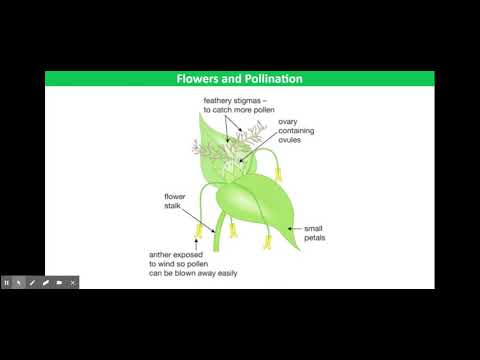
| Anthers | Inside the flower, firmly attached, so insects brush against them | Hang outside the flower on long filaments, loosely attached, so wind shakes them |
| Stigmas | Inside the flower; sticky | Hang outside; large and feathery, to catch pollen from the air |
| Pollen | Less of it; larger, sticky or spiky grains that cling to insects | Huge amounts; small, light, smooth grains |
In maize the male flowers are in the tassel at the top of the plant, and the female flowers are on the young cob lower down; each long silk is a style with a stigma along it. Because the tassel usually sheds its pollen a little before the silks of the same plant are ready, much of the pollination is cross-pollination.
Cross-pollination combines genes from two plants, so the offspring vary, and some may be better suited to new conditions; but it depends on insects or wind, and much pollen is wasted. Self-pollination is more reliable, because only one plant is needed, but it gives less variation. Many crops depend on insects: spraying insecticides while crops are flowering kills the bees that pollinate them (Unit 4).

Worked example 1: comparing pollen numbers
A class counts the pollen in single anthers (illustrative data): a bean anther has about 1500 grains; a maize anther about 2500. A bean flower has 10 anthers; a maize tassel has about 2000 flowers, each with 3 anthers.
Worked example 2: which way is it pollinated?
A plant has small green flowers with no scent. Its anthers dangle on long thin filaments, and its two stigmas are large and feathery, hanging outside the flower. Its pollen is light and smooth.
Warning
Common mistakes. (1) Confusing pollination with fertilisation: pollination is only the transfer of pollen; fertilisation is the fusion of gametes, which comes later (Lesson 4). (2) Saying pollen is the male gamete: the pollen grain contains the male gametes. (3) Writing that cross-pollination is between two different species: it is between two plants of the same species.
Safety. When you dissect flowers, use a sharp blade carefully on a tile, cutting away from your fingers. Some people are allergic to pollen: avoid shaking tassels near your face if you are.
Insect and Wind Pollination, BiologyWithNewhouse. Watch for the features of each kind of flower, and check them against the table.
Tip
Memory hook: "wind flowers hang it all out". In wind-pollinated flowers both the anthers and the stigmas hang outside the flower; in insect-pollinated flowers they are kept inside, where the insect must push past them.
Practice: flowers and pollination
Key points
Sources and credits
Written by Ganzaa: the text, Figure 1, the tables, the worked examples (Worked example 1 uses illustrative data) and the practice questions. This lesson adapts CC BY-SA material and is shared under CC BY-SA 4.0.