Human Rights
Senior 3 · English
Human Rights
Lesson 5 of 5
25 min
Let's begin
A play is written to be performed, not only read. Its script therefore holds two kinds of writing: the words the characters speak, and the stage directions that tell actors and directors where to stand, how to move and what the audience should see and hear. Read this one-scene play on the unit's theme, then learn the language of the stage so that you could perform it.
A short play written for this lesson. The characters and the job offer are imagined.
THE LETTER
A play in one scene
CHARACTERS
UWASE, fifteen, a Senior 3 student
AUNT KABANDA, her aunt and guardian
MR GASANA, Uwase's class teacher
The yard in front of a small house in a village, early evening. Upstage centre, the door of the house. Downstage right, a low bench. Downstage left, a gate to the road. An empty cooking pot stands on three stones beside the bench. Somewhere offstage, a cock crows.
(AUNT KABANDA sits on the bench, reading a letter. UWASE enters through the gate, downstage left, carrying her school bag.)
AUNT: (without looking up) You're late.
UWASE: Debate Club. We won, Auntie! They said I was the best speaker.
AUNT: (folding the letter carefully) Sit down. I have news too.
(UWASE sits on the edge of the bench, her bag still on her knees.)
AUNT: Mrs Umutoni has written from Kigali. She needs a girl to look after her children and the house. Fifteen thousand francs a month, food and a bed. You leave on Saturday.
UWASE: (jumping up) Saturday? But the exams are in November.
AUNT: Exams don't put food in the pot. (She points at the empty pot.) Look at it. Since your uncle broke his leg, nothing comes into this house.
UWASE: (moving away to downstage centre; to herself) Fifteen thousand francs. For my whole future.
AUNT: What did you say?
UWASE: (turning to face her) I said I don't want to go.
(Pause. AUNT KABANDA stands up slowly, the letter in her hand.)
AUNT: (quietly, which is worse than shouting) And who will pay for your exercise books? Your debate club?
(A knock at the gate. MR GASANA enters, downstage left, holding an exercise book.)
MR GASANA: Good evening, Madam. Excuse me. Uwase left her book in the classroom, and she has a test tomorrow.
AUNT: (stiffly) She will not need it, teacher. She is going to work in Kigali.
MR GASANA: (looking from one to the other) In Kigali? As a house-girl? (He puts the book down on the bench.) May I sit, Madam? (He sits.) I know times are hard. But a girl of fifteen belongs in school, and the law protects her right to be there. If she leaves now, she earns fifteen thousand francs. If she finishes, she can earn far more, for the rest of her life.
AUNT: (sitting down heavily) And until then? We eat stories?
MR GASANA: Until then, you are not alone. Tomorrow, come with me to the sector office. There is support for families like yours. I will go with you myself.
(Silence. AUNT KABANDA looks at the letter for a long moment. Then she folds it in half, and in half again, and puts it into the pocket of her apron.)
AUNT: (to UWASE, gruffly) Well? Your test won't study itself.
(UWASE picks up the exercise book and holds it tightly. She crosses upstage to the door, then stops and turns.)
UWASE: Thank you, Auntie.
(She exits into the house. The light fades slowly on AUNT KABANDA and MR GASANA, sitting side by side on the bench.)
END OF SCENE
Definition
stage directions: the instructions in a play script, usually in italics and brackets, that describe the setting, the characters' movements and actions, how lines are spoken, and the lighting and sound.
set: the scenery and furniture on stage that show where the action takes place. props (properties): objects the actors use, such as the letter and the exercise book.
enter / exit: to come onto / go off the stage. Exit is also a noun: Uwase's exit.
upstage / downstage: the part of the stage furthest from / nearest to the audience.
Stage areas are named from the actor's point of view, facing the audience. Upstage and downstage come from old theatres where the stage floor sloped upwards away from the audience, so an actor walking away from the audience really did walk up.
| Kind | Audience | What it means for actors |
|---|---|---|
| proscenium | on one side, looking through a frame | The audience sees one picture; actors mostly face forward. |
| thrust | on three sides | Actors must turn, so that each side sees their faces in turn. |
| in the round | all around | Someone always sees an actor's back, so movement never stops. |
Many school plays and community performances use an open space such as a hall, a yard or a courtyard. The same names for areas still work there: decide where the audience is, and "downstage" is the side nearest to it.
| Purpose | Example from "The Letter" |
|---|---|
| describe the setting and the time | The yard in front of a small house in a village, early evening. |
| place the set and props | Downstage right, a low bench. An empty cooking pot … |
| bring characters on and off | UWASE enters through the gate, downstage left. · She exits into the house. |
| show movement | moving away to downstage centre · She crosses upstage to the door. |
| show how a line is spoken | without looking up · stiffly · gruffly · to herself |
| show actions that carry meaning | She folds it in half, and in half again … |
| give sound and light | a cock crows · The light fades slowly … |
Conventions. Stage directions are written in the present tense, in italics and usually in brackets; character names inside them are often in CAPITALS. They are not spoken aloud in performance.
Worked example
Reading a stage direction as a director
Direction: (UWASE enters through the gate, downstage left.)
Worked example
Writing a stage direction
Moment: the aunt has just heard Uwase say "I don't want to go."
Tip
Face the audience, then raise your right hand. That hand points to stage right. Upstage is behind you, and downstage is where you are looking.
Warning
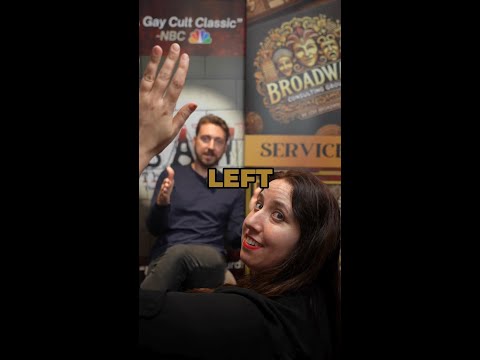
Stage Directions Explained: Upstage vs. Downstage, from Stephanie Rosenberg (about 2 minutes). After watching, stand in the classroom and move to each of the nine areas as a partner calls them out.
Practice
Further reading
Sources and credits
Written by Ganzaa.