Radioactivity
Senior 6 · Chemistry
Radioactivity
Lesson 5 of 5
25 min
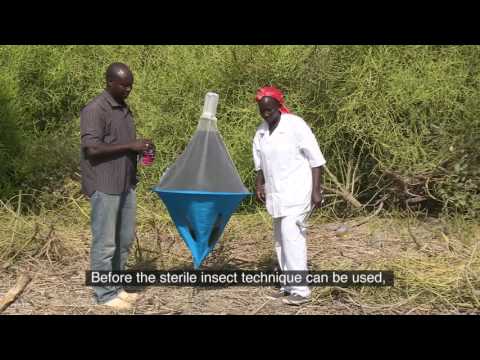
Tsetse flies carry the parasites that cause sleeping sickness in people and nagana in cattle across much of tropical Africa. On Unguja, the main island of Zanzibar, they were wiped out in the 1990s without spraying the whole island: millions of male flies were bred, sterilised with gamma radiation and released. Wild females that mated with them produced no offspring (a tsetse female usually mates only once, and gives birth to one larva at a time), and within a few years the population collapsed. This sterile insect technique is promoted by the International Atomic Energy Agency (IAEA) with the Food and Agriculture Organization.
The same property that sterilised those flies, the ability of ionising radiation to damage the DNA of living cells, makes radioisotopes dangerous to the people who use them. This lesson covers both sides: the hazards and how to control them, and the uses that make radioisotopes worth the trouble. In Rwanda, the Rwanda Atomic Energy Board (RAEB) has the mission to "promote peaceful use of atomic energy for sustainable socio-economic development".

Definition
Ionising radiation: radiation with enough energy to remove electrons from atoms and molecules, forming ions. Example: α, β and γ radiation and X-rays.
Absorbed dose: the energy absorbed per kilogram of tissue; unit the gray, .
Equivalent (and effective) dose: the absorbed dose multiplied by a weighting factor for the type of radiation (1 for β and γ, 20 for α), and, for the effective dose, for the sensitivity of each tissue; unit the sievert (Sv). It measures the risk of harm. Example: 1 mSv is the yearly limit for members of the public.
Tracer: a small amount of a radioisotope added to a system so that the path or fate of an element can be followed by detecting its radiation. Example: phosphorus-32 in fertiliser.
Ionising radiation knocks electrons out of the molecules it passes through. Most of a cell is water, and ionising water produces highly reactive free radicals such as the hydroxyl radical, , which attack DNA and proteins. Damaged DNA may be repaired, may kill the cell, or may be copied wrongly, giving a mutation.
The World Health Organization (WHO) describes two kinds of effect:
Where the source is matters. Outside the body, γ and β radiation are the main hazard because α cannot get through the dead outer layer of the skin. Inside the body, α emitters are the most dangerous, because all their energy is deposited in a few cells. Radon-222, an α-emitting gas from uranium in rocks and soil, collects indoors; WHO lists it among the leading causes of lung cancer. Chemistry decides where a swallowed or inhaled radioisotope goes: iodine-131 concentrates in the thyroid gland, and strontium-90, chemically like calcium, in bone.
| Quantity | Effective dose |
|---|---|
| Average natural background, worldwide (UNSCEAR) | about 2.4 mSv per year |
| IAEA dose limit for members of the public (from regulated sources) | 1 mSv per year |
| IAEA dose limit for radiation workers | 20 mSv per year averaged over 5 years, and no more than 50 mSv in any one year |
| Threshold for acute radiation syndrome (WHO) | about 1000 mSv in a short time |
The IAEA's safety standards rest on three principles: every use of radiation must be justified (do more good than harm); protection must be optimised, keeping exposures as low as reasonably achievable (ALARA); and individual doses must stay below the dose limits. For an external source, three rules follow (Figure 5.1).
Figure 5.1: The radiation warning sign, and time, distance and shielding.
For open (unsealed) radioactive materials, such as tracer solutions, add the rules that stop them getting inside the body: wear a laboratory coat and disposable gloves; never eat, drink or apply cosmetics in the laboratory; never pipette by mouth; work over a spill tray; label and store sources in shielded containers marked with the warning sign; wear a personal dosimeter; and dispose of radioactive waste only as the regulations require. In a school, sources are small and sealed, and must be handled only by or under the supervision of the teacher, with tongs, and returned to their lead-lined store after use.
Warning
Never pick up or open an unknown metal object or container that carries the radiation warning sign; keep away from it and report it to the authorities. In Goiânia, Brazil, in 1987, people opened a caesium-137 source taken from an abandoned radiotherapy machine, shared the glowing powder, and four people died (IAEA report "The Radiological Accident in Goiânia", 1988).
In a nuclear emergency, take potassium iodide tablets only when public health authorities tell you to: they protect the thyroid from radioactive iodine and nothing else, and they carry their own side effects.
Each use matches a radioisotope's emission, half-life and chemistry to the job.
| Radioisotope | Emission, half-life | Use | Why it suits |
|---|---|---|---|
| carbon-14 | β⁻, 5730 y | dating once-living material (Lesson 3); labelling organic compounds to follow metabolic pathways | carbon is in all living matter; long half-life suits archaeological times |
| phosphorus-32 | β⁻, 14.3 d | tracer in agriculture: how much of a crop's phosphorus comes from a fertiliser; studies of DNA | phosphorus is taken up as phosphate; β⁻ easy to count in plant samples; decays away within months |
| cobalt-60 | β⁻ and penetrating γ, 5.27 y | external-beam radiotherapy of tumours; sterilising syringes, gloves and dressings; irradiating food; radiography of welds | strong γ passes through packaging and the body; source lasts years |
| iodine-131 | β⁻ and γ, 8.02 d | treating an overactive thyroid and thyroid cancer; diagnosis | the thyroid takes up iodide, so the β⁻ dose is delivered where it is needed; short half-life |
| technetium-99m | γ only, 6.01 h | imaging bones, heart, kidneys | γ escapes the body to the camera; no particles; very short half-life |
| americium-241 | α, 432 y | smoke detectors | α ionises air in a small chamber; smoke absorbs the ions; long-lived |
Worked example 1: a phosphorus-32 tracer in a field trial
Problem. A fertiliser is labelled with phosphorus-32 so that it has an activity of per milligram of phosphorus. Weeks later, phosphorus extracted from a bean crop grown with it has per milligram of phosphorus, both values corrected for decay to the same date. What percentage of the plant's phosphorus came from the fertiliser? Why must the decay correction be made?
Solution. Phosphorus from the soil is not radioactive, so it dilutes the label. The fraction from the fertiliser is the ratio of the two specific activities:
The remaining 76 % came from phosphorus already in the soil. With d, the activity of the fertiliser falls by about 4.7 % a day, so values measured on different dates are comparable only after correcting them to one date.
Worked example 2: absorbed and equivalent dose
Problem. A 70 kg worker absorbs 1.4 mJ of energy from gamma radiation during a task. Calculate the absorbed dose and the equivalent dose, and compare it with the annual limit for workers. What would the equivalent dose be if the same energy came from α particles inside the body?
Solution.
For γ the weighting factor is 1: equivalent dose , one thousandth of the 20 mSv annual limit. For α (factor 20): , twenty times the risk from the same energy.
Worked example 3: an iodine-131 treatment
Problem. A patient is treated with 3.7 GBq of iodine-131 ( d). Considering radioactive decay alone, how long until the activity has fallen below 400 MBq? Why is the real time shorter?
Solution.
The body also excretes iodide not taken up by the thyroid, mainly in urine, so the activity in the body falls faster than by decay alone. Until it is low, patients follow instructions that limit close contact with others, especially children and pregnant women.
Tip
To judge whether a radioisotope suits a job, check three things: emission (does it need to get out of the body, or stay in the tissue?), half-life (long enough to do the job, short enough not to linger), and chemistry (will the element go where it is needed?).
IAEA: The IAEA and Food, Tsetse Fly Eradication in Senegal. Watch how sterile male flies are reared, sterilised with radiation and released, and why the wild population then declines.
Practice
Further reading
Sources and credits