Radioactivity
Senior 6 · Chemistry
Radioactivity
Lesson 1 of 5
25 min
In February 1896 the French physicist Henri Becquerel laid crystals of a uranium salt on a photographic plate wrapped in thick black paper. When he developed the plate it was fogged in the shape of the crystals, even though no light had reached it. The uranium was giving out a penetrating radiation of its own, all the time, with no energy put in.
Two years later Marie and Pierre Curie showed that the strength of the radiation depended only on the amount of uranium, not on which compound it was in or whether it was hot or cold. Marie Curie called the property radioactivity and concluded that it came from inside the atom itself. The Curies went on to discover two new, far more radioactive elements, polonium and radium. That insight, a property of the nucleus that chemistry cannot touch, is the starting point of this unit. In Senior 6 Physics you studied the nucleus and its radiations as physics; here you look at them as chemistry: what changes, how to write the equations, and how radioisotopes are used.

Definition
Radioactivity: the spontaneous emission of radiation (particles or high-energy photons) by unstable atomic nuclei, which change as a result. Example: radium-226 emits alpha particles and becomes radon-222.
Nuclide: an atom with a particular number of protons and neutrons , written , where the mass number . Example: has 6 protons and 8 neutrons.
Radioisotope (radionuclide): a radioactive isotope of an element. Example: carbon-12 and carbon-13 are stable, but carbon-14 is a radioisotope.
Nuclear reaction: a change in the composition of a nucleus, by decay or by bombardment with particles. Example: .

| Chemical reaction | Nuclear reaction | |
|---|---|---|
| Particles involved | outer electrons; nuclei unchanged | protons and neutrons in the nucleus |
| Elements | the same elements before and after | one element can become another |
| Isotopes of an element | react in the same way | behave quite differently (C-12 stable, C-14 radioactive) |
| Energy change | about to | about to |
| Mass change | far too small to measure | measurable () |
| Effect of temperature, pressure, catalysts, chemical state | change the rate | almost no effect on the rate of decay |
| Emission | Symbol | What it is | Change in the nucleus | Effect on and |
|---|---|---|---|---|
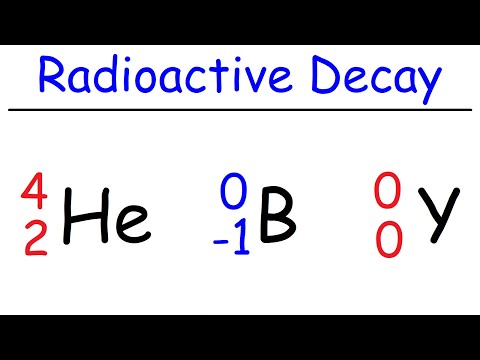
| Alpha (α) | or | helium nucleus, charge +2 | loses 2 protons and 2 neutrons | , |
| Beta-minus (β⁻) | or | fast electron made in the nucleus | (+ antineutrino) | same, |
| Positron (β⁺) | or | positive electron (antimatter) | (+ neutrino) | same, |
| Electron capture (EC) | on the left | nucleus captures an inner-shell electron; X-rays follow | same, | |
| Gamma (γ) | high-energy photon | excited nucleus loses energy | no change |
Alpha particles are slow and heavy and ionise strongly, so a sheet of paper or a few centimetres of air stops them. Beta particles go a few millimetres into aluminium; gamma rays are reduced only by thick lead or concrete. In an electric field (Figure 1.1) the charged emissions bend: β⁻ strongly towards the positive plate because it is so light, α a little towards the negative plate, and γ not at all.
Figure 1.1: Alpha, beta-minus and gamma radiation in an electric field (not to scale).
Worked example 1: which emission?
Problem. Identify the emission in each change: (a) ; (b) ; (c) , with no X-rays given off; (d) .
Solution.
(a) unchanged, up by 1: a neutron became a proton: β⁻.
(b) down by 4, down by 2: α.
(c) unchanged, down by 1: a proton became a neutron. Both β⁺ emission and electron capture do this; the absence of the X-rays that follow capture points to positron emission.
(d) Neither nor changes; "m" means metastable (excited): γ emission. This is why technetium-99m is used in medical imaging: it gives gamma rays but no particles.
Worked example 2: how big is a nuclear energy change?
Problem. Each alpha decay of radium-226 releases 4.87 MeV. Express this per mole and compare it with the enthalpy of combustion of methane, . (, )
Solution.
Ratio: . One mole of radium decaying releases over half a million times more energy than one mole of methane burning. The difference comes from the strength of the forces involved: nuclear forces hold protons and neutrons together far more tightly than electrons hold atoms together.
Warning
Common mistakes
Tip
For any emission, ask "what happened to one nucleon?": α, four nucleons leave together; β⁻, n → p; β⁺ and EC, p → n; γ, nothing, just energy. Then follows: −2, +1, −1, 0.
The Organic Chemistry Tutor: Alpha Decay, Beta Decay, Gamma Decay, Electron Capture, Positron Production. Watch how each emission changes the mass number and atomic number, and how the equations are written.
Practice
Sources and credits