Radioactivity
Senior 6 · Chemistry
Radioactivity
Lesson 2 of 5
25 min
A piece of uraninite, the black ore from which uranium is mined, is a slow chemical factory. Each uranium-238 nucleus in it will, eventually, become a nucleus of lead-206, but not in one jump. It passes through thirteen radioactive nuclides on the way, including radium, which the Curies extracted from tonnes of such ore, and radon, a gas that seeps out of uranium-bearing rocks. To follow such changes you need to write nuclear equations, and to understand why some nuclei are stable and others are not.

Definition
Nuclear equation: an equation showing the nuclides and particles before and after a nuclear reaction, in which the total mass number and the total atomic number (charge) are the same on both sides. Example: .
Decay series: a chain of successive decays by which a heavy radioactive nuclide changes, through a series of radioactive daughters, into a stable nuclide. Example: the uranium-238 series ends at lead-206.
Artificial transmutation: changing one element into another by bombarding its nuclei with particles. Example: (Rutherford, 1919).
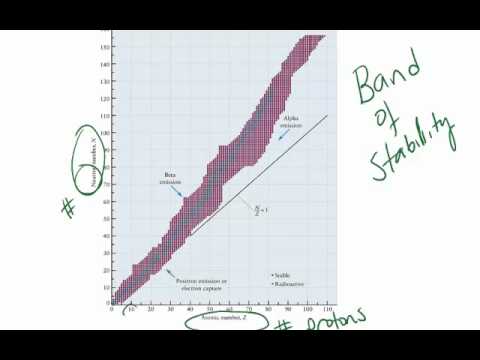
Band (belt) of stability: the narrow region of a plot of neutron number against proton number in which the stable nuclides lie.
Two totals must balance: the mass numbers (top) and the atomic numbers or charges (bottom). Electrons in the shells are ignored. Use these symbols:
| Particle | proton | neutron | electron (β⁻) | positron (β⁺) | alpha | deuteron | gamma |
|---|---|---|---|---|---|---|---|
| Symbol | or |
Artificial transmutation is how most radioisotopes used in medicine and industry are made, usually by bombarding a stable nuclide with neutrons in a reactor:
Worked example 1: completing nuclear equations
Problem. Identify X in each equation. (a) ; (b) ; (c) ; (d) .
Solution. Balance top and bottom separately.
(a) : , so ; : , so . X is , a β⁻ particle.
(b) ; : .
(c) ; : a neutron, . (This is how Irène Joliot-Curie and Frédéric Joliot made the first artificial radioisotope in 1934.)
(d) ; : , a positron. Fluorine-18 is the positron emitter used in PET scans.
Figure 2.1 plots each member of the series by its atomic number and mass number. Every α decay moves the nuclide 2 to the left and 4 down; every β⁻ decay moves it 1 to the right. The chain ends at lead-206, whose nucleus is stable.
Figure 2.1: The uranium-238 decay series (gamma emissions not shown).
Worked example 2: counting the steps in a series
Problem. Thorium-232 decays through a series to lead-208. How many α and how many β⁻ particles are emitted per nucleus?
Solution. Only α decay changes , by 4 each time: α particles. Six α decays would lower from 90 to , but lead has , so β⁻ decays must have raised it. Overall: . Check: : ; : . ✓
Protons repel each other electrically; the strong nuclear force, which acts between all nucleons but only over very short distances, holds the nucleus together. Neutrons add to the strong force without adding repulsion. In light nuclei about one neutron per proton is enough (, e.g. , ). In heavier nuclei the repulsion grows faster, so more neutrons are needed: rises to about 1.5 at lead-208 (). Beyond bismuth () no number of neutrons is enough, and every nuclide is radioactive.
Figure 2.2: The band of stability (sketch).
The position of an unstable nuclide relative to the band predicts how it decays, because each decay moves it towards the band:
Two further patterns: nuclides with even numbers of both protons and neutrons are the most common stable nuclides, while only a handful with odd Z and odd N are stable (such as and ); and nuclei with 2, 8, 20, 28, 50, 82 or 126 protons or neutrons (the magic numbers) are especially stable. Lead-208, with 82 protons and 126 neutrons, is "doubly magic".
Worked example 3: predicting the mode of decay
Problem. Predict the most likely mode of decay of (a) , (b) , (c) , (d) , and write the equation for (a).
Solution.
(a) , : , above the value of about 1 for a light nucleus: β⁻. .
(b) , : , below the band: β⁺ or electron capture (it is in fact a positron emitter).
(c) , : ; the stable strontium isotopes have 46 to 50 neutrons, so strontium-90 is neutron-rich: β⁻.
(d) : α emission.
Warning
Common mistakes
Tip
For any series question: α = ΔA ÷ 4, then β⁻ = Z(final) − Z(start) + 2α. For Th-232 → Pb-208: α = 6, β⁻ = 82 − 90 + 12 = 4.
ChemistryUTAustin: Nuclear Stability, Band of Stability. Watch how the neutron-to-proton ratio of the stable nuclides rises with atomic number, and how a nuclide's position above or below the band predicts its decay.
Practice
Sources and credits