Evolution and Speciation
Senior 6 · Biology
Evolution and Speciation
Lesson 1 of 5
30 min
For more than two thousand years many people believed that living things could arise directly from non-living matter: maggots from rotting meat, mice from stored grain, microbes from broth. In the 1860s Louis Pasteur boiled broth in flasks whose long necks he had bent into an S shape. Air could reach the broth, but dust and microbes settled in the bend. The broth stayed clear for months. Only when he broke a neck off did the broth cloud with life. Pasteur had shown that life comes from life. But that raised a deeper question: if life always comes from life, where did the first life come from? This lesson compares the main hypotheses and then traces how simple cells became the multicellular organisms of today.
Definition
Spontaneous generation: the old idea that living things regularly arise from non-living matter; disproved by experiment.
Biogenesis: the principle that living things come only from other living things.
Abiogenesis (chemical evolution): the scientific hypothesis that the first life arose, once, from non-living chemicals through a long series of chemical steps on the early Earth.
Panspermia (cosmozoic theory): the hypothesis that life, or its building blocks, reached Earth from space.
Protocell: a hypothetical early structure, a membrane-bound droplet of organic molecules, that may have led to the first cells.
Endosymbiotic theory: the theory that mitochondria and chloroplasts evolved from prokaryotes that were engulfed by, and came to live inside, another cell.
| Hypothesis | Main idea | Status |
|---|---|---|
| Special creation | Life was created by God. Christianity and Islam both teach that God is the creator of the heavens, the earth and all living things, as do many other faiths. | A belief held by faith. It is not a scientific hypothesis, because it cannot be tested by experiment. Many religious people also accept the scientific account of how life developed. |
| Spontaneous generation | Life arises regularly from non-living matter. | Disproved: Francesco Redi (1668) showed that maggots appear in meat only if flies can lay eggs on it; Pasteur (1860s) showed the same for microbes. |
| Panspermia | Life or its building blocks came from space, for example on meteorites. | Amino acids have been found in some meteorites, so the building blocks can form in space; but the hypothesis only moves the question of how life began somewhere else. |
| Abiogenesis (biochemical evolution) | Life arose from simple chemicals on the early Earth, through a series of natural chemical steps. | The main scientific hypothesis; supported by laboratory experiments, though many steps are still unknown. |
In the 1920s Alexander Oparin in Russia and J. B. S. Haldane in Britain independently proposed that the early Earth's atmosphere contained little or no free oxygen. Energy from lightning, ultraviolet light and volcanic heat could then have driven reactions between simple gases to make organic molecules, which collected in the oceans as a "primordial soup". Without oxygen, and with no living things to eat them, such molecules would not have been broken down.
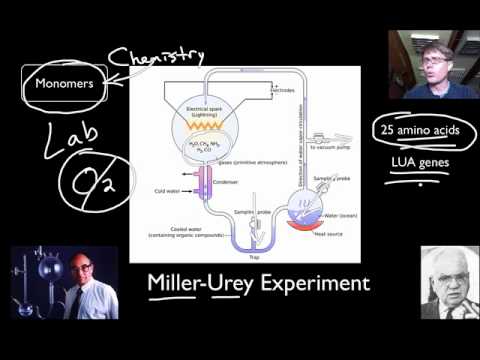
In 1953 Stanley Miller, working with Harold Urey, tested the idea:
After a week of sparking, up to 15% of the carbon had been turned into organic compounds, including several amino acids, the building blocks of proteins. Later experiments with different gases, including the carbon dioxide and nitrogen that many scientists now think were more abundant in the early atmosphere, also produced amino acids, sugars and the bases of nucleotides, especially around hot volcanic springs.
Several further steps are needed, and each has been partly reproduced in the laboratory:
Worked example 1: evaluating Pasteur's experiment
Pasteur boiled broth in swan-necked flasks. The broth stayed clear while the neck was intact, but became cloudy with microbes within days when the neck was broken off, or when the flask was tipped so that broth touched the dust in the bend. (a) Why did he boil the broth? (b) Why was a swan neck better than a sealed flask? (c) What do the two kinds of control show? (d) What does the experiment not show?
The Earth formed about 4.6 billion years ago. Chemical traces in ancient rocks, and fossil stromatolites, layered mounds built by mats of microbes, show that prokaryotic life existed by about 3.5 billion years ago. The main stages that followed were:

Worked example 2: the history of life as one day
Imagine the 4.6 billion years of Earth's history squeezed into 24 hours, with the Earth forming at midnight. At what time does each event happen: (a) first cells, 3.5 billion years ago; (b) eukaryotes, 2.0 billion years ago; (c) the Cambrian explosion, 538 million years ago; (d) modern humans, 300 000 years ago?
Interpretation. For more than half the "day" all life was single-celled, and the animals we usually think of appear only in the last three hours. Humans arrive in the last six seconds.
Warning
Common mistakes
Bozeman Science: "Abiogenesis". Paul Andersen explains the steps from monomers to polymers to protocells, and the Miller-Urey experiment.
Practice: the origin of life
Key points
Sources and credits
Figures 1 and 2, the table, the worked examples and the practice questions were written by Ganzaa.
This lesson adapts CC BY-SA material and is shared under CC BY-SA 4.0.