Environmental Conservation and Tourism
Senior 6 · Geography
Environmental Conservation and Tourism
Lesson 2 of 5
45 min
The World Health Organization (WHO) estimates that outdoor (ambient) air pollution caused about 4.2 million premature deaths worldwide in 2019, and that smoke from cooking with wood, charcoal, dung and kerosene in poorly ventilated homes caused about 3.2 million deaths a year in 2020. Most of these deaths are from stroke, heart disease, lung cancer and chronic lung disease, and most occur in low- and middle-income countries. Plastic is the other pollutant everyone can see: the UN Environment Programme reports that the world produces about 430 million tonnes of plastic a year, much of it used once and thrown away.
Rwanda acted early on the second problem, banning plastic carry bags in 2008 and most single-use plastics in 2019. This lesson asks what pollution is, where it comes from, what it does, and how it can be reduced.
Definition
Pollution: the introduction into the environment of substances or energy (such as heat or noise) that harm living things or damage resources.
Pollutant: a substance or form of energy that causes pollution. Example: sulphur dioxide (SO₂) from burning coal.
Point source: pollution from one identifiable place, such as a factory pipe. Non-point (diffuse) source: pollution from many scattered places, such as fertiliser washed off farms.
Eutrophication: the over-enrichment of a lake or river with nutrients (nitrates, phosphates), causing algae and weeds to grow rapidly; when they die and decay, oxygen is used up and fish die.
PM2.5: fine particles less than 2.5 micrometres across, small enough to reach deep into the lungs. The WHO guideline is an annual mean of 5 µg per m³ and a 24-hour mean of 15 µg per m³ (2021).
| Type | Main causes | Effects | Solutions |
|---|---|---|---|
| Air pollution | Burning fossil fuels in vehicles, power stations and factories; cooking with wood and charcoal; burning waste; dust from roads and quarries | Lung and heart disease; smog; acid rain; global warming from CO₂ and methane | Cleaner fuels and engines, vehicle inspection, public transport and car-free days, clean cooking (gas, electricity, improved stoves), filters on chimneys |
| Water pollution | Untreated sewage, industrial waste, fertilisers and pesticides washed off farms, mining waste, oil spills, plastics | Water-borne diseases (cholera, typhoid), eutrophication and fish deaths, poisoning by heavy metals | Sewage treatment, buffer zones along rivers, controlled use of fertiliser, laws on industrial discharge |
| Land (soil) pollution | Dumping of solid waste and plastics, mining, excessive agrochemicals, electronic waste | Poisoned soils and crops, blocked drains and floods, breeding sites for mosquitoes | Waste sorting, recycling and composting, sanitary landfills, plastics bans, safe disposal of e-waste |
| Noise pollution | Traffic, aircraft, industry, loudspeakers, construction | Hearing loss, stress, poor sleep and concentration | Noise limits in law, zoning of industry, quieter machines |
| Radioactive and thermal pollution | Nuclear accidents (Chernobyl 1986, Fukushima 2011); hot water from power-station cooling | Cancers and birth defects; less oxygen in warm water | Strict safety rules; cooling ponds and towers |
Figure 1. How acid rain forms and what it damages. Drawn by Ganzaa.
Clean rain is naturally slightly acidic, with a pH of about 5.6, because carbon dioxide dissolves in it. Sulphur dioxide and nitrogen oxides make it far more acidic. Because the gases travel with the wind, the country that emits them is often not the one that suffers: in the 1970s and 1980s, emissions from power stations in Britain and central Europe fell as acid rain on the lakes and forests of Scandinavia, which led to the 1979 Convention on Long-Range Transboundary Air Pollution and later agreements to cut emissions.

Worked example 1: how acidic is acid rain?
Problem. The pH scale is logarithmic: each fall of 1 unit means 10 times more acidic. Clean rain has a pH of about 5.6. A sample of rain downwind of a coal-burning power station has a pH of 4.2. How many times more acidic is it?
Solution.
Interpretation. The polluted rain is about 25 times more acidic than clean rain. A pH difference that looks small on paper is large in reality, which is why lakes can lose their fish after years of acid rain.
Worked example 2: comparing air quality with the WHO guideline
Problem. Illustrative daily PM2.5 readings at a busy junction for one week were 22, 18, 35, 12, 28, 40 and 15 µg per m³. (a) Find the mean. (b) On how many days was the WHO 24-hour guideline of 15 µg per m³ exceeded? (c) How many times the WHO annual guideline (5 µg per m³) is the mean?
Solution.
(b) 22, 18, 35, 28 and 40 are above 15, so the guideline was exceeded on 5 days (15 equals the guideline, so it does not exceed it).
Interpretation. Even a week with some clean days can average far above the guideline. Monitoring stations, such as those REMA runs in Kigali, let authorities see where and when air is worst, and target traffic, burning and dust.

Warning
Common mistakes
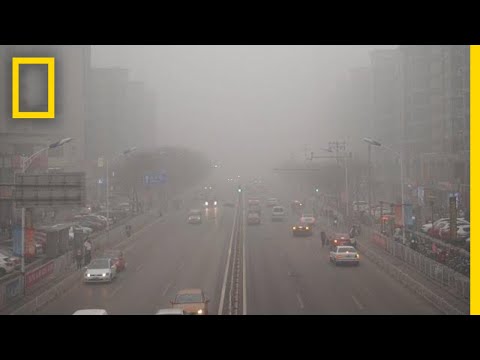
National Geographic: "What is Acid Rain?". As you watch, follow the steps of Figure 1 and note one example of damage the video shows that is not in the figure.
Practice
Summary
Sources and credits
Photos: Smog in the skies of Delhi, India (wili hybrid, CC BY 2.0) and A little river in Freetown, flooding with trash and plastic waste (ODC-Sierra-Leone, CC BY-SA 4.0), via Wikimedia Commons.
Video: "What is Acid Rain?", National Geographic, embedded from YouTube.
Figure 1, the worked examples and the exercises were drawn and written by Ganzaa.
This lesson adapts CC BY-SA material and is shared under CC BY-SA 4.0.