European Literary Traditions Two
Senior 6 · Literature in English
European Literary Traditions Two
Lesson 3 of 5
25 min
In "The Tables Turned" Wordsworth's evening sun spreads "His first sweet evening yellow" over green fields. In 1915 a young American poet living in London, T. S. Eliot, began a poem with a very different evening:
Let us go then, you and I,
When the evening is spread out against the sky
Like a patient etherized upon a table;
Let us go, through certain half-deserted streets,
The muttering retreats
Of restless nights in one-night cheap hotels
And sawdust restaurants with oyster-shells:
Streets that follow like a tedious argument
Of insidious intent
To lead you to an overwhelming question ...
Oh, do not ask, "What is it?"
Let us go and make our visit.T. S. Eliot, "The Love Song of J. Alfred Prufrock" (1915), lines 1–12
A sunset compared to an unconscious body on an operating table: that simile announces a new movement. Modernism set out to find forms for a world that seemed to have lost its centre.
| Word | Meaning |
|---|---|
| etherized | made unconscious with ether, an early anaesthetic used in surgery |
| retreats | places where people hide away |
| sawdust restaurants | cheap eating places with sawdust on the floor |
| tedious | long and boring |
| insidious | harmful in a slow, hidden way |
Definition
Why did writers feel that the old forms no longer worked? Some reasons:
The Irish poet W. B. Yeats caught this mood in "The Second Coming", written in 1919:
Turning and turning in the widening gyre
The falcon cannot hear the falconer;
Things fall apart; the centre cannot hold;
Mere anarchy is loosed upon the world,
The blood-dimmed tide is loosed, and everywhere
The ceremony of innocence is drowned;
The best lack all conviction, while the worst
Are full of passionate intensity.W. B. Yeats, "The Second Coming" (1920), lines 1–8
The falcon circles further and further from its handler until it can no longer hear him: control is lost. Thirty-eight years later Chinua Achebe took the words "Things Fall Apart" as the title of his novel and placed this poem at its front as an epigraph. The borrowing turns Yeats's European crisis into an African one: in Achebe's novel it is the Igbo world whose centre cannot hold when colonial rule arrives.

The novelist Virginia Woolf argued that the realist novel, with its careful plot and solid detail, missed what life actually feels like. In her essay "Modern Fiction" (1925) she wrote:
Life is not a series of gig lamps symmetrically arranged; life is a luminous halo, a semi-transparent envelope surrounding us from the beginning of consciousness to the end.
"Gig lamps" were the paired lamps on a horse-drawn carriage: neat, evenly spaced, one after another, like the events of a well-made plot. Woolf replaces that image with a glowing "halo" that surrounds us: experience is continuous, blurred and inward. Modernist novelists such as Woolf, James Joyce (Ulysses, 1922) and William Faulkner followed the flow of characters' thoughts, broke up chronology and left endings open. You will study their main technique, stream of consciousness, in Unit 2.
| Realism | Modernism |
|---|---|
| Orderly plot, cause and effect | Fragments, gaps, jumps in time |
| Outer world described in detail | Inner world of thought and feeling |
| A reliable, often all-knowing narrator | Limited, shifting or unreliable points of view |
| Clear endings | Open or unresolved endings |
| Regular verse forms in poetry | Free verse, collage, allusion |
| Confidence that the world can be known | Doubt, irony, alienation |
Africa in Modernism, and Modernism in Africa. The traffic went both ways. European modernist painters, Picasso among them, took ideas from West and Central African sculpture and masks. Later, African poets such as Christopher Okigbo of Nigeria wrote dense, allusive, modernist poetry that blended Igbo ritual with European models.
Worked example
A model comparative paragraph
Question: Compare the way the evening is presented by Wordsworth and by Eliot.
Both poets open with an invitation at evening, but they use the evening to opposite ends. Wordsworth's sun spreads "His first sweet evening yellow" over "long green fields": the light is warm, the landscape open, and nature offers wisdom to anyone who will "Come forth". Eliot's evening, by contrast, is "spread out against the sky / Like a patient etherized upon a table", a clinical simile that makes the sky look unconscious and helpless. Where Wordsworth's friend is led outdoors into health and "cheerfulness", Eliot's companion is led through "half-deserted streets" of "cheap hotels" towards a question that is never asked. The contrast captures the shift between the movements: the Romantic finds meaning waiting in nature, while the Modernist finds the modern city numb, shabby and unable to answer.
Tip
Use the movements as a ladder. Each movement answered the one before. When you describe a Modernist text, say what it rejects ("unlike the orderly plots of Realism …"). Comparison makes your description sharper and earns analysis marks.
Warning
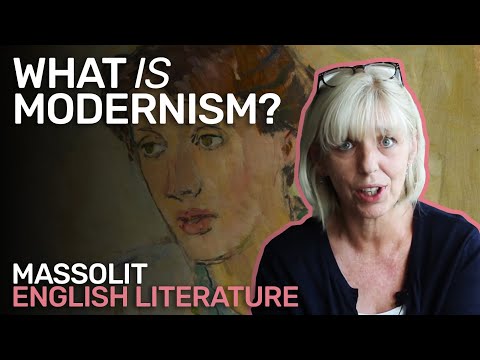
"Literary Modernism", a lecture from MASSOLIT, a channel of short lectures by university academics. Listen for the reasons it gives for the break with nineteenth-century forms, and for the writers it names.
Practice
Sources and credits