European Literary Traditions Two
Senior 6 · Literature in English
European Literary Traditions Two
Lesson 1 of 5
25 min
In 1798 two young English poets, William Wordsworth and Samuel Taylor Coleridge, published a slim book without their names on it: Lyrical Ballads. Its poems were about shepherds, a mad mother, an old huntsman and a sailor cursed for shooting a bird, written in the plain words of ordinary speech. Many reviewers were puzzled. Two years later Wordsworth added a Preface that explained the experiment, and English literature turned a corner.
This unit follows four turns of that kind. Each European literary movement grew out of the history around it, and each was partly a quarrel with the movement before it. Romanticism rebelled against the cool reason of the eighteenth-century Enlightenment; Realism rebelled against Romantic dreaming; Modernism broke the Realist novel apart; Postmodernism played with the pieces. You met the earlier traditions, from the classical writers to the Enlightenment, in Senior 5. Here you take the story from about 1790 to today.
Definition
Read this poem from Lyrical Ballads aloud. The speaker is calling a friend away from his studies. Notice how many sentences are commands or exclamations.
The Tables Turned
An Evening Scene on the Same Subject
William Wordsworth (1798)Up! up! my Friend, and quit your books;
Or surely you'll grow double:
Up! up! my Friend, and clear your looks;
Why all this toil and trouble?The sun above the mountain's head,
A freshening lustre mellow
Through all the long green fields has spread,
His first sweet evening yellow.Books! 'tis a dull and endless strife:
Come, hear the woodland linnet,
How sweet his music! on my life,
There's more of wisdom in it.And hark! how blithe the throstle sings!
He, too, is no mean preacher:
Come forth into the light of things,
Let Nature be your teacher.She has a world of ready wealth,
Our minds and hearts to bless—
Spontaneous wisdom breathed by health,
Truth breathed by cheerfulness.One impulse from a vernal wood
May teach you more of man,
Of moral evil and of good,
Than all the sages can.Sweet is the lore which Nature brings;
Our meddling intellect
Mis-shapes the beauteous forms of things:—
We murder to dissect.Enough of Science and of Art;
Close up those barren leaves;
Come forth, and bring with you a heart
That watches and receives.
| Word | Meaning in the poem |
|---|---|
| grow double | become bent over, stooped from leaning over books |
| lustre | soft shining light |
| linnet, throstle | small songbirds; the throstle is the song thrush |
| blithe | cheerful, carefree |
| no mean preacher | a good preacher (an understatement) |
| vernal | of spring |
| sages, lore | wise men; knowledge handed down |
| dissect | cut up a dead body in order to study it |
| barren leaves | pages of a book, which the speaker calls lifeless |
Who speaks, to whom? The speaker addresses a "Friend" buried in books. The poem is a gentle argument, and its title tells us the speaker is turning the tables: the student who thinks he is learning is told he is wasting his time.
How does it persuade? Through imperatives ("Up!", "quit", "Come forth", "Close up"), exclamations ("How sweet his music!") and a steady contrast between two worlds:
| Books, Science and Art | Nature |
|---|---|
| "toil and trouble", "dull and endless strife" | "sweet evening yellow", "ready wealth" |
| the "sages", the "meddling intellect" | the linnet and the throstle as "preacher" and "teacher" |
| "barren leaves": dead paper | "vernal wood": living, growing things |
| knowledge gained by cutting up: "We murder to dissect" | knowledge received by "a heart / That watches and receives" |
The key line. "We murder to dissect" compresses the whole argument into four words. To study a living thing scientifically, the anatomist must first kill it; the speaker suggests that cold analysis kills the beauty and life of what it studies. The verb "murder" is shockingly strong for a gentle poem, and that shock is the point.
Form and language. The poem uses simple four-line stanzas rhyming ABAB, the plain rhythm of a song or ballad, and everyday words. That is itself a Romantic statement: in the 1800 Preface Wordsworth said he wanted "a selection of language really used by men", and he described good poetry as "the spontaneous overflow of powerful feelings".
A fair reader's doubt. The poem attacks books, yet it is a book, written by a highly educated man. Is the speaker serious, or half-joking with a friend? Strong answers notice this tension rather than taking the poem's claims at face value.
Romanticism was not only daffodils and birdsong. The movement was born in the shadow of the French Revolution of 1789, with its cry of liberty, and of the Industrial Revolution, which was filling British cities with factories, smoke and poor workers. William Blake's "London" (1794) walks through those streets:
I wander thro' each charter'd street,
Near where the charter'd Thames does flow.
And mark in every face I meet
Marks of weakness, marks of woe.In every cry of every Man,
In every Infants cry of fear,
In every voice: in every ban,
The mind-forg'd manacles I hearWilliam Blake, "London", Songs of Experience (1794), first two stanzas
"Charter'd" means owned and controlled by legal charters: even the river has been bought. "Mind-forg'd manacles" are chains people make in their own minds, through fear and habit. The repeated "every" makes the misery universal. The individual imagination, here, is a tool for seeing what is wrong with society.
| Feature | What it means | Where you see it |
|---|---|---|
| Feeling and imagination over reason | Truth is felt as much as proved | "a heart / That watches and receives" |
| Nature as teacher and healer | The natural world has moral and spiritual power | "Let Nature be your teacher" |
| The ordinary person and plain speech | Poetry about and in the language of common people | The ballad form of Lyrical Ballads |
| The individual and liberty | The lonely, rebellious self; sympathy with revolution | Byron's restless heroes; Blake's "manacles" |
| The sublime and the supernatural | Awe before vast nature; strange, haunted tales | Coleridge's "The Rime of the Ancient Mariner"; Mary Shelley's Frankenstein (1818) |
| Protest against industry and the city | Machines and money destroy human life | "London" |

About a century later, in Paris in the 1930s, three Black students and writers, Aimé Césaire of Martinique, Léopold Sédar Senghor of Senegal and Léon-Gontran Damas of French Guiana, began the movement called Négritude. Like the Romantics, its poets rejected the cold rationalism of the culture that ruled them (here, French colonialism), celebrated feeling, rhythm and the body, praised a rural homeland and an idealised past, and treated the poet as the voice of a whole people. Senghor later became the first President of independent Senegal.
The likeness is real but not complete. The English Romantics rebelled against their own society's values; Négritude writers were reclaiming a culture that colonial rule had despised. Critics such as the Nigerian dramatist Wole Soyinka later argued that Négritude had accepted the colonial idea that reason belonged to Europe and emotion to Africa. A good comparison names both the likeness and the difference.
Worked example
A model analytical paragraph
Question: How does Wordsworth present the value of nature in "The Tables Turned"?
Wordsworth presents nature as a better teacher than books by turning the language of education upside down. The birds become the real instructors: the throstle is "no mean preacher", and the speaker urges his friend to "Let Nature be your teacher". Learning from books, by contrast, is "a dull and endless strife", and its pages are "barren leaves", a pun that sets the dead leaves of paper against the living leaves of the "vernal wood". The argument peaks in the blunt line "We murder to dissect", where the violent verb suggests that analysis destroys the very life it claims to study. Written in 1798, when Enlightenment thinkers prized reason and scientific method, the poem is a typical Romantic protest that the heart, which "watches and receives", reaches truths the intellect cannot.
Why it works: a clear point in the first sentence; short quotations woven into the writer's own sentences; analysis of particular words ("barren", "murder"); and context used to support the argument, in one sentence, at the end.
Tip
Context earns marks only when it explains the text. "The French Revolution happened in 1789" earns nothing on its own. "Blake's image of chains made in the mind reflects a decade in which liberty was being fought for in France" links the history to the words on the page.
Warning
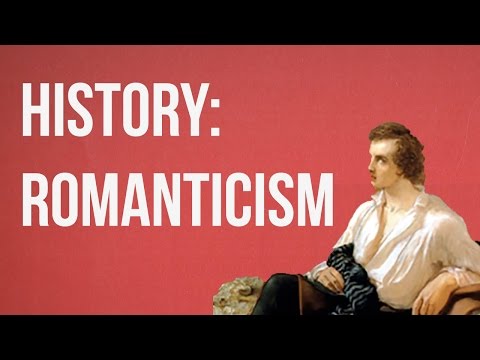
"History of Ideas: Romanticism" from The School of Life. Note the Romantic attitudes it describes (trust in feeling, love of nature, nostalgia for the past) and compare them with the features table above. The channel presents opinions as well as history, so test each claim against the poems.
Practice
Sources and credits