Structure in Modern Prose
Senior 6 · Literature in English
Structure in Modern Prose
Lesson 2 of 5
25 min
The same small event, written for this lesson, is told below in five ways. Read them all before reading any notes.
| Point of view | The passage |
|---|---|
| A | I saw the boy's hand before I saw his face. It hovered over my avocados as if they were hot. I thought of my own son at school in Musanze, and I said nothing. |
| B | You see the boy's hand before you see his face. It hovers over your avocados. You think of your own son, and you say nothing. |
| C | Nyiraneza saw the boy's hand before she saw his face. It hovered over her avocados as if they were hot. She thought of her own son at school, and said nothing. |
| D | Nyiraneza saw the boy's hand before she saw his face. The boy, Gatete, had eaten nothing since the morning before and was sure that she had not noticed him. Neither of them knew that, a week later, they would meet again in the headteacher's office. |
| E | The boy's hand moved towards the pile of avocados. The woman looked up. "Three hundred francs each," she said. The boy put his hand in his pocket. |
Each version gives you different knowledge and a different feeling. A is intimate; B pulls you into the woman's place; C stays with her but in the third person; D sees into both minds and even into the future; E shows only what a camera would record, and leaves the thinking to you.
Definition
| Point of view | Gains | Loses | Examples |
|---|---|---|---|
| First person | Intimacy, voice, the chance of an unreliable narrator | Cannot know other minds or events the narrator missed | Pip in Dickens's Great Expectations; Ramatoulaye writing her long letter in Mariama Bâ's So Long a Letter |
| Third limited | Closeness to one mind with some distance for irony | Other characters stay mysterious | Mrs Mallard in Kate Chopin's "The Story of an Hour" |
| Omniscient | Wide view, many minds, the narrator's judgement | Can feel distant or controlling | George Eliot's Middlemarch |
| Objective | Suspense, subtext; the reader must infer | No direct access to feeling | Ernest Hemingway's short stories of the 1920s |
Achebe's Things Fall Apart mixes modes. The narrator often speaks with the shared voice of the clan, explaining customs as a respected elder might, and then moves close to Okonkwo's thoughts, and at the very end jumps into the mind of the District Commissioner. That final shift is a structural shock: after a whole novel spent inside Igbo life, we suddenly see Okonkwo through the eyes of a colonial officer who thinks his life deserves a paragraph.
Modernist novelists wanted to go further inside: to show thought as it actually moves, jumping by association from one thing to another. Here is Clarissa Dalloway, a London hostess in her early fifties, stepping out into a June morning in London. The fresh air makes her remember a morning at Bourton, the country house of her youth:
What a lark! What a plunge! For so it had always seemed to her, when, with a little squeak of the hinges, which she could hear now, she had burst open the French windows and plunged at Bourton into the open air. How fresh, how calm, stiller than this of course, the air was in the early morning; like the flap of a wave; the kiss of a wave; chill and sharp and yet (for a girl of eighteen as she then was) solemn, feeling as she did, standing there at the open window, that something awful was about to happen …
Virginia Woolf, Mrs Dalloway (1925)
Definition
Worked example
A model analytical paragraph
Question: How does Woolf use stream of consciousness in this passage?
Woolf uses stream of consciousness to show that, for Clarissa, the past is alive inside the present. The passage moves without warning from a London morning to Bourton: the exclamations "What a lark! What a plunge!" belong to both mornings at once, and the clause "which she could hear now" lets a sound from decades earlier enter the present tense of her mind. The sentence imitates the movement of memory, adding phrase after phrase with semicolons and correcting itself, "like the flap of a wave; the kiss of a wave", as if Clarissa were searching for the exact sensation. Even the bracket "(for a girl of eighteen as she then was)" reads like a thought that arrives in the middle of another. Instead of telling us that Clarissa is nostalgic, Woolf makes us experience her nostalgia as she does, all at once and out of order.
Tip
Ask two questions of any narrator: Who knows? Who sees? The person telling the story and the person through whose eyes we see it are not always the same. In passage C, the narrator tells but Nyiraneza sees.
Warning
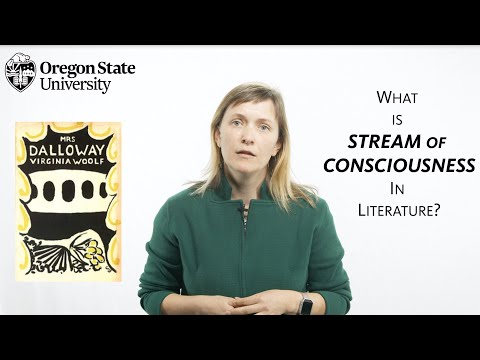
"What is Stream of Consciousness?", from the Oregon State Guide to Literary Terms. Listen for the link to the psychologist William James, who first described thought as a "stream", and for the writers it names.
Practice
Sources and credits