Tie and Dye a Fabric
Senior 3 · Fine Arts
Tie and Dye a Fabric
Lesson 1 of 4
20 min
Every orange or red dot on the cloth below began as a pinch of fabric, pulled up and wound tightly with thread before the cloth went into the dye. There are thousands of them, arranged in curves and diamonds. When the threads were cut, each tied point had stayed the colour the cloth was before dyeing. This is bandhani, a tie-dye tradition from western India. Communities in West Africa, Japan and many other places developed their own ways of making patterns by stopping dye from reaching parts of the cloth. In this unit you will learn the science behind it and make your own tie-dyed fabric.

Definition
Resist dyeing: making a pattern by stopping dye from reaching parts of a fabric. The resist may be a binding, stitching, a clamp, wax or paste.
Tie and dye (tie-dye): resist dyeing in which the fabric is folded, twisted, tied or stitched before dyeing.
Fibre: the fine thread-like units that yarn and fabric are made from. Natural fibres come from plants (cotton, linen) or animals (silk, wool); synthetic fibres, such as polyester, are made from chemicals.
Dye fixative: a substance that helps a dye bond to the fibre so it does not wash out, such as soda ash (sodium carbonate) for many cotton dyes.
Mordant: a substance, such as alum, used with many natural dyes to fix the colour to the fibre.
| Tradition | Where | How the resist is made | Look |
|---|---|---|---|
| Adire | Yoruba people, south-west Nigeria, especially Abeokuta | cloth tied with raffia (adire oniko), stitched (adire alabere) or painted with cassava-starch paste (adire eleko), then dyed in indigo | deep blue with pale circles, lines and painted motifs |
| Bandhani | western India (Gujarat and Rajasthan) | thousands of tiny pinches tied with thread | fields of small dots in curves and diamonds |
| Shibori | Japan | tying, stitching, folding and clamping, or wrapping cloth round a pole | dots, stripes, diagonal "rain" lines, grids |
| Tritik (stitch resist) | Indonesia, West Africa and elsewhere | running stitches pulled tight before dyeing | fine dotted lines and outlines |
The Yoruba word adire is usually explained as "tie and dye", from adi (to tie) and re (to dye). The Japanese word shibori comes from a verb meaning to wring or squeeze. Both names describe the same idea: pressing the cloth so the dye cannot enter.
Dye is a coloured substance dissolved in water. It colours fabric by soaking into the fibres and, with a fixative, bonding to them. Wherever a binding squeezes layers of cloth tightly together, the dye solution cannot flow in, so those parts stay undyed. Looser bindings let a little dye creep in, which gives the soft, feathered edges typical of tie-dye.
| Fibre | Type | Takes cold-water tie-dye? |
|---|---|---|
| Cotton, linen, viscose | plant (cellulose) | yes: best with fibre-reactive dye and soda ash |
| Silk, wool | animal (protein) | yes, with suitable dyes (often acid dyes); handle gently |
| Polyester, nylon | synthetic | hardly at all: the colour washes out or stays pale |
| Cotton–polyester mix | mixed | partly: colours come out paler |
Use 100% cotton for your first piece: an old white T-shirt, a pillowcase or new calico. Wash it first with soap to remove the starch-like finish (sizing) that new fabric carries, because sizing stops dye soaking in evenly. Dye the fabric while it is still damp.
Indigo, the dye of adire, works differently from most dyes. It does not dissolve in plain water. Dyers prepare it in an alkaline vat where it changes into a soluble, yellow-green form. Cloth dipped in the vat comes out yellow-green and turns blue in the air as the indigo reacts with oxygen. Repeated dips build up deeper blues.
Worked example 1: choosing fabric
Uwamahoro has three white T-shirts. Their labels say: (a) 100% cotton; (b) 100% polyester; (c) 50% cotton, 50% polyester. She will use a cold-water fibre-reactive dye. Predict the results.
(a) Bright, strong colours: cotton is cellulose, which bonds with fibre-reactive dye.
(b) Almost no colour: polyester does not take this dye; it washes out.
(c) About half as strong: only the cotton half takes the dye, so the colours look paler, a "heathered" effect.
She should use shirt (a) for her main piece.
Worked example 2: mixing the fixative
A dye kit says: dissolve 1 cup of soda ash in 4 litres of warm water, and soak the fabric for 20 minutes before dyeing. Kalisa needs only 1 litre. How much soda ash should he use?
Keep the same ratio: , so cup.
Always follow the instructions on the dye you actually have, and add soda ash to water, not water to soda ash.
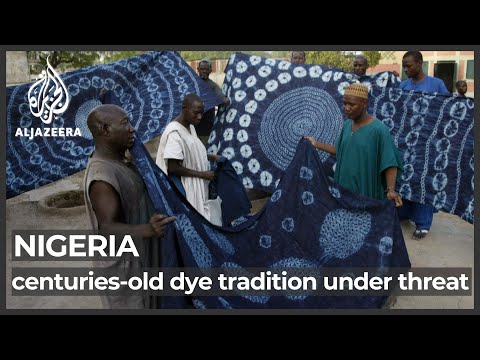
<em>Nigeria's centuries-old dye tradition under threat</em>, from Al Jazeera English. Watch for how the cloth is prepared and dyed, and what the dyers say about keeping the tradition alive.
Warning
Dye safety. Wear rubber gloves and an apron; wear a dust mask when measuring dye powder or soda ash, which irritate the skin, eyes and lungs. Work in a ventilated space. Never use kitchen pots, cups or spoons for dye, and never eat or drink near dyes. Wash any splash off skin at once with plenty of water.
Tip
Natural fibre, washed, damp, tight. Use 100% cotton, wash out the sizing, dye it damp, and bind tightly where you want white.
Practice
What is resist dyeing? Name three kinds of resist.
Name the tie-dye tradition of the Yoruba, and explain what its name means.
Why should new cotton fabric be washed before dyeing?
Why does a polyester shirt stay pale in a cold-water cotton dye?
A recipe uses 3 tablespoons of dye in 1 litre of water. How much dye is needed for 2.5 litres?
Compare bandhani and adire oniko: how are they similar, and how do they differ?
Research task. Find out about one resist-dyeing tradition not covered in detail here (for example Japanese arashi shibori or Indonesian plangi). Describe its resist, its colours and one way you could adapt it.
1. Making a pattern by stopping dye from reaching parts of a fabric. Resists include bindings (string, raffia, thread), stitching, clamps, wax and paste.
2. Adire, usually explained as "tie and dye", from adi (to tie) and re (to dye).
3. To remove the sizing (finish) that stops dye soaking in evenly.
4. Polyester is synthetic and does not bond with dyes made for cellulose fibres such as cotton, so the colour washes out.
5. tablespoons.
6. Similar: both tie the cloth before dyeing, so tied areas stay undyed. Different: bandhani ties thousands of tiny pinches with thread to make fields of dots in many colours; adire oniko ties larger areas with raffia and is dyed in indigo, giving blue cloth with pale circles.
7. Answers vary; check that the resist, colours and an adaptation are described.
Many traditions found the same idea, pressing cloth so dye cannot enter, independently. Why do you think resist dyeing developed in so many places?
Sources and credits