Introduction to Health Psychology
Senior 6 · Psychology
Introduction to Health Psychology
Lesson 4 of 5
25 min
From 1967 the epidemiologist Michael Marmot and colleagues followed more than 17,000 men working in the British civil service in London (the Whitehall study). None of them was poor, and all had access to free health care. Yet the lower a man's grade of employment, the higher his risk of dying from heart disease. Messengers and doorkeepers died at much higher rates than senior administrators, and differences in smoking, blood pressure and cholesterol explained only part of the gap (Marmot and colleagues, 1978).
Health, then, does not depend only on germs and genes, or even only on personal habits. It follows a social gradient. This lesson sorts the many influences on health into groups and weighs the evidence for each.
Definition
Determinants of health: the range of personal, social, economic and environmental factors that influence the health of individuals and populations.
Risk factor: a characteristic or exposure that increases the likelihood of developing a disease, such as tobacco use.
Protective factor: a characteristic or condition that lowers that likelihood, such as strong social support.
Social gradient in health: the pattern in which health improves step by step with each rise in social and economic position.
Göran Dahlgren and Margaret Whitehead (1991) drew the determinants of health as layers around the individual (Figure 1). The inner layers are closest to the person; the outer layers shape everything inside them.
The layer of living and working conditions includes education, work, water and sanitation, housing, food and health services.
Age, sex and genes set the starting point. Some conditions, such as sickle-cell disease, are inherited; others, such as type 2 diabetes and high blood pressure, involve genetic risk that lifestyle can raise or lower. Biology is not destiny: genes usually load the gun, behaviour and environment pull the trigger.
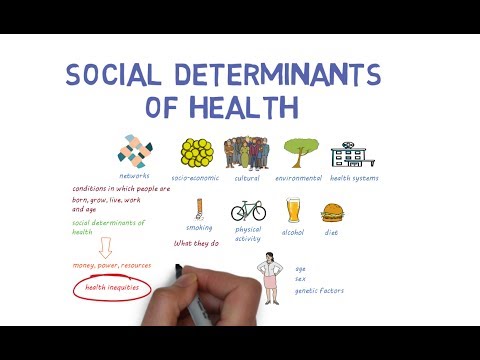
The WHO identifies four main behavioural risk factors for non-communicable diseases: tobacco use, physical inactivity, harmful use of alcohol and unhealthy diet. Others include poor sleep, unsafe sex and poor hygiene. Most behaviours are learned and maintained in social settings (Unit 2), which is why the models in Lesson 3 matter.
Julianne Holt-Lunstad, Timothy Smith and Bradley Layton (2010) combined 148 studies of more than 300,000 people followed for an average of seven and a half years. People with stronger social relationships had a 50% greater likelihood of survival over the study period than those with weaker relationships, an effect comparable to that of well-known risk factors such as smoking. Support from family and friends can buffer stress, encourage healthy behaviour and help people follow treatment. Norms matter too: whether peers smoke, drink or exercise shapes what young people do.
Income, education, housing, work and safety shape health, as the Whitehall gradient shows. Environmental factors include clean water and sanitation, air quality (smoke from cooking with wood or charcoal indoors damages the lungs), road safety and exposure to disease-carrying mosquitoes.
Health services are a determinant too. In Rwanda, most people are covered by community-based health insurance (Mutuelle de santé), managed since July 2015 by the Rwanda Social Security Board (RSSB). In every village, residents elect three community health workers, a male and female pair and one responsible for maternal health, who are trained to give basic care, treat common childhood illnesses, follow up pregnant women and refer people to health centres. Bringing care close to home lowers the barriers that models such as the HBM describe.
Let's Learn Public Health: "What Makes Us Healthy? Understanding the Social Determinants of Health". Watch for the difference between individual behaviours and the conditions in which people are born, grow, live and work.
Warning
Avoid blaming individuals for everything. Behaviour matters, but people's choices are shaped by income, education, environment and access to services. An answer that says only "people should live healthier lives" ignores most of the layers in Figure 1.
Tip
"B-B-P-S-E": Biological, Behavioural, Psychological, Social, Economic-environmental. Use these five headings to plan any essay on the factors that influence health, and give one study or example under each.
Important
Discuss. Choose one health problem common among young people in your district. Place its causes in the layers of Figure 1. Which layer would a school be best placed to change?
Practice
Sources and credits
Written by Ganzaa: the text, the diagram (Figure 1) and the exercises.