Polynomial, Rational and Irrational Functions
Senior 4 · Mathematics
Polynomial, Rational and Irrational Functions
Lesson 4 of 5
25 min
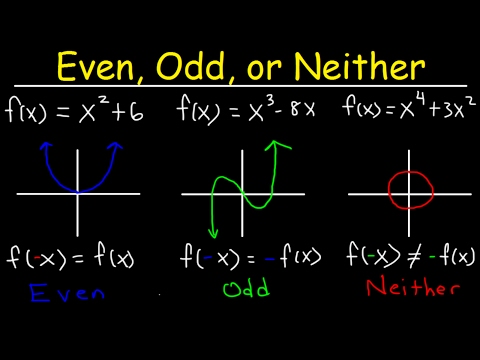
Fold the graph of along the -axis and the two halves match. Turn the graph of through half a turn about the origin and it lands on itself. Recognising these symmetries from the formula, before plotting a single point, halves the work of drawing a graph or making a table. The second half of this lesson puts rational and irrational functions to work in models from economics and physics.
Definition
A set is symmetric about 0 if . Let have such a domain.
The parity of is whether it is even, odd or neither.
Example: , and are even; , and are odd.
Important
Useful facts about parity
Worked example 1: test the parity
Study the parity of (a) (b) (c) (d) .
Solution
Worked example 2: using parity
(a) is odd and . Find and , given that is defined at 0. (b) Write as the sum of an even and an odd polynomial.
Solution
Warning
To show that a function is not even or odd, one counter-example is enough (as in part (c)). To show that it is even or odd, you must check for a general : a few numerical values prove nothing.
A rational function is a quotient of two polynomials; an irrational function contains the variable under a root sign. Both appear wherever a quantity is "shared out" (a division) or found from a square (a root).
Worked example 3: average cost (illustrative figures)
A small workshop pays 200 000 Frw a month in fixed costs, and each chair costs 1 500 Frw in materials. The total cost of chairs is , and the average cost per chair is
(a) Find and . (b) How many chairs must be made for the average cost to fall below 2 000 Frw? (c) What happens to for very large ?
Solution

Worked example 4: the period of a pendulum
For small swings, the period (time for one full swing, there and back) of a pendulum of length metres is
(a) Find for and for Foucault's . (b) Find the inverse function , and the length that gives . (c) What happens to when is multiplied by 4?
Solution
Worked example 5: a lens (rational function)
For a converging lens of focal length , an object at distance gives an image at distance with (real-is-positive convention). Express as a function of , find for , and describe what happens as approaches 10 cm from above.
Solution , so for . Then . As gets close to 10, the denominator gets close to 0 while the numerator is close to 100, so becomes very large: the image moves far away. Unit 7 describes this with limits.
Tip
In a model, the domain comes from the situation as well as from the formula: a number of chairs is a positive whole number, a length is positive, and a real image needs . State these conditions before you calculate.
The Organic Chemistry Tutor: Even, odd or neither functions (about 18 min). Watch how f(−x) is simplified and compared with f(x) and with −f(x), and how the result shows up as symmetry in the graph.
Practice
For questions 1 to 4, justify your answer algebraically.
Key points
Sources and credits
Quick check
Match each function with its parity.
Tap one on the left, then its partner on the right.