Formation of Covalent Bonds
Senior 4 · Chemistry
Formation of Covalent Bonds
Lesson 5 of 5
25 min
Hydrogen sulfide, , the gas that smells of bad eggs, has molecules almost twice as heavy as water's, and it boils at −60 °C. By that trend, water would boil far below zero and Lake Kivu would be a cloud of vapour. Instead water boils at 100 °C, insects can walk on its surface, and ice floats on it. None of this comes from the strong covalent bonds inside each molecule. It comes from weaker forces between molecules, which in turn come from how unequally the electrons in a bond are shared.

Definition
Intramolecular forces: the forces within a molecule, the covalent bonds that hold its atoms together. Intermolecular forces: the much weaker attractions between separate molecules. Melting and boiling a molecular substance overcome intermolecular forces; the covalent bonds stay intact.
Electronegativity: the ability of an atom to attract the shared pair of electrons in a covalent bond towards itself. On the Pauling scale it runs from about 0.8 (caesium) to 4.0 (fluorine).
Table 5.1: Pauling electronegativities
| H | C | N | O | F | Na | Mg | P | S | Cl | Br | I |
|---|---|---|---|---|---|---|---|---|---|---|---|
| 2.2 | 2.6 | 3.0 | 3.4 | 4.0 | 0.9 | 1.3 | 2.2 | 2.6 | 3.2 | 3.0 | 2.7 |
Electronegativity increases across a period (greater nuclear charge, same shielding, smaller atom) and decreases down a group (more shells, more shielding). Fluorine, oxygen and nitrogen are the most electronegative elements.
When two identical atoms share electrons (H–H, Cl–Cl) the pair is shared equally: a non-polar bond. When the atoms differ, the more electronegative atom pulls the pair towards itself and gains a small negative charge, δ−, leaving the other atom δ+. This is a polar covalent bond, with a bond dipole: . The bigger the difference in electronegativity, the more polar the bond; when the difference is very large (roughly 1.8 or more), electron transfer is nearly complete and the bonding is mainly ionic. Covalent and ionic bonding are two ends of one scale.
A molecule is polar (has a permanent dipole) if its bond dipoles do not cancel. That depends on its shape (Lesson 4). In a symmetrical molecule the dipoles cancel, even if every bond is polar.
You can see the difference: hold a rubbed plastic rod near a thin stream of water from a burette and the stream bends towards the rod. A stream of hexane, a non-polar liquid, is hardly affected.
Worked example 1: polar or non-polar?
Decide whether each molecule is polar: (a) ; (b) ; (c) .
Solution.
1. London (dispersion) forces act between all molecules, polar or not. Electrons are always moving, so at any instant the electron cloud of a molecule may be slightly uneven: an instantaneous dipole. It distorts the electron cloud of a neighbour, inducing a dipole there, and the two attract. London forces are stronger when a molecule has more electrons (the halogens: and are gases, a liquid, a solid) and when molecules have more surface contact: straight-chain pentane boils at 36 °C, its compact isomer 2,2-dimethylpropane at 10 °C.
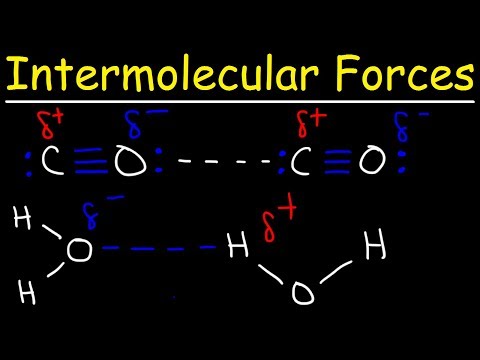
2. Permanent dipole–dipole forces act between polar molecules: the δ+ end of one attracts the δ− end of another, in addition to London forces. Propanone, (, polar C=O), boils at 56 °C; butane (, non-polar) boils at −1 °C.
3. Hydrogen bonds are the strongest intermolecular force. A hydrogen bond forms between a hydrogen atom bonded to N, O or F in one molecule and a lone pair on N, O or F in another. These three atoms are very electronegative and small, so the H atom is strongly δ+ (almost a bare proton) and can come very close to the lone pair.

In Group 14 the boiling points rise smoothly down the group: the molecules are non-polar, and London forces grow with the number of electrons. In Groups 15, 16 and 17 the trend is the same from Period 3 to Period 5, but , and HF are far above it. Only these three have H bonded to N, O or F, so only they form hydrogen bonds. Water is highest of all because each molecule has two δ+ hydrogens and two lone pairs, so it can form up to four hydrogen bonds.
Hydrogen bonding also explains why ice floats: in ice each molecule is hydrogen-bonded to four others in an open, tetrahedral lattice with a lot of empty space, so ice is less dense than liquid water. It explains why ethanol and sugar dissolve in water (they form hydrogen bonds with it), the surface tension of water, and the pairing of bases that holds the two strands of DNA together.
Worked example 2: comparing boiling points
Ethanol, , and methoxymethane, , have the same formula, (). Ethanol boils at 78 °C and methoxymethane at −24 °C. Explain the difference.
Solution. Both have the same number of electrons, so their London forces are similar, and both are polar. But ethanol has an O–H group: its δ+ hydrogen forms hydrogen bonds with the lone pairs on the oxygen atoms of neighbouring molecules. In methoxymethane every hydrogen is bonded to carbon, which is not electronegative enough, so it cannot form hydrogen bonds between its own molecules. Much more energy is needed to separate ethanol molecules.
Answer: hydrogen bonding between ethanol molecules, absent in methoxymethane, raises ethanol's boiling point by about 100 °C.
Warning
Common mistakes. (1) Saying a substance boils when its covalent bonds break: boiling separates molecules; the bonds inside them stay. (2) Calling the O–H bond in water a hydrogen bond: a hydrogen bond is between molecules. (3) Saying any molecule with H forms hydrogen bonds: the H must be bonded to N, O or F. (4) Ignoring London forces: they act in every molecular substance and can be larger than dipole–dipole forces in big molecules.
Safety. In the charged-rod demonstration, hexane is highly flammable: no flames anywhere in the room, small volumes only, and work in a fume cupboard.
Tip
To compare boiling points, ask three questions in order: (1) Does it form hydrogen bonds (H on N, O or F)? (2) Is it polar (permanent dipole)? (3) How many electrons and how much surface contact (London forces)? The answers usually decide the order.
The Organic Chemistry Tutor: Intermolecular Forces - Hydrogen Bonding, Dipole Dipole Interactions - Boiling Point and Solubility (11 min). Watch how the type of force is identified for each molecule and then used to rank boiling points.
Practice
Key points
Further reading
Sources and credits
Quick check
Which of these molecules is polar?