Formation of Covalent Bonds
Senior 4 · Chemistry
Formation of Covalent Bonds
Lesson 4 of 5
25 min
Carbon dioxide, O=C=O, is a straight molecule. Water, H–O–H, has the same pattern of three atoms, yet it is bent, with an angle of 104.5° between its bonds. That bend is why water molecules have positive and negative ends, why water dissolves salt and sugar, and why ice floats. Chemists predict shapes like this with a simple model based on one idea: electron pairs repel each other. You can check every prediction with a model kit, and you should, because these are three-dimensional objects.

Definition
VSEPR theory (valence shell electron pair repulsion): the pairs of electrons in the outer shell of the central atom, bonding pairs and lone pairs, repel one another and arrange themselves as far apart as possible. The positions of the atoms then give the shape of the molecule.
Bond angle: the angle between two bonds that meet at the same atom.
To find the number of pairs: take the central atom's outer electrons, add one for each atom bonded to it by a single bond, add one for each negative charge (subtract one for each positive charge), and divide by two. The number of bonding pairs is the number of atoms bonded; the rest are lone pairs.
Table 4.1: Shapes from electron pairs
| Pairs | Bonding | Lone | Shape | Bond angle | Example |
|---|---|---|---|---|---|
| 2 | 2 | 0 | linear | 180° | , |
| 3 | 3 | 0 | trigonal planar | 120° | |
| 3 | 2 | 1 | bent | about 119° | |
| 4 | 4 | 0 | tetrahedral | 109.5° | , |
| 4 | 3 | 1 | trigonal pyramidal | 107° | |
| 4 | 2 | 2 | bent (V-shaped) | 104.5° | |
| 5 | 5 | 0 | trigonal bipyramidal | 90° and 120° | |
| 5 | 4 | 1 | see-saw | about 87° and 102° | |
| 5 | 3 | 2 | T-shaped | about 87.5° | |
| 6 | 6 | 0 | octahedral | 90° | |
| 6 | 5 | 1 | square pyramidal | about 85° | |
| 6 | 4 | 2 | square planar | 90° |
In the trigonal bipyramid, lone pairs go in the equatorial positions, where they have more room (only two neighbours at 90° instead of three). In the octahedron, two lone pairs go opposite each other.
Worked example 1: methane, ammonia and water
Use VSEPR to explain why the bond angles are 109.5°, 107° and 104.5°.
Solution.
Worked example 2: the ions in solid phosphorus pentachloride
In the solid state, phosphorus pentachloride exists as . Predict the shape and bond angles of each ion.
Solution.
Answer: a tetrahedral cation and an octahedral anion, while the gaseous molecule is trigonal bipyramidal.
Worked example 3: chlorine trifluoride and the amide ion
Predict the shapes of and .
Solution. : pairs, 3 bonding and 2 lone. Five pairs form a trigonal bipyramid; the two lone pairs take equatorial positions, leaving the three F atoms in a T shape, with F–Cl–F angles a little under 90°. : pairs, 2 bonding and 2 lone → bent, about 104.5°, like water.
Warning
Common mistakes. (1) Naming the shape from all the electron pairs: has four pairs but its shape is trigonal pyramidal, not tetrahedral. (2) Forgetting the charge on an ion when counting electrons. (3) Counting a double bond as two pairs for the shape: has two regions, so it is linear. (4) Drawing a 3D shape flat: use wedges and dashes, and give the angle.
Tip
Set out every shape answer in four lines: pairs around the central atom → bonding and lone pairs → shape (atoms only) → angle, and why it is reduced ("lone pairs repel more than bonding pairs"). This earns all the marks in most exam questions.
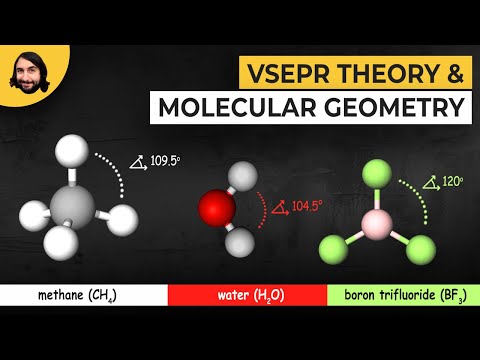
Professor Dave Explains: VSEPR Theory and Molecular Geometry (7 min). Watch how the number of electron domains sets the arrangement, and how lone pairs change the shape's name and shrink the angles.
Practice
Key points
Sources and credits
Quick check
What is the shape of an ammonia molecule, NH₃?