Formation of Covalent Bonds
Senior 4 · Chemistry
Formation of Covalent Bonds
Lesson 3 of 5
25 min
Write the configuration of carbon: . Its outer shell has only two unpaired electrons, in two p orbitals at 90° to each other. If bonds formed only from unpaired electrons in these orbitals, carbon would make a compound with a 90° angle. In fact the simplest stable hydride is methane, : four identical C–H bonds, each the same length and strength, pointing to the corners of a tetrahedron at 109.5°. To explain this, Linus Pauling added two ideas to the theory of bonding by overlap: promotion and hybridisation.
Definition
Valence bond theory: a covalent bond forms when a half-filled orbital on one atom overlaps a half-filled orbital on another, and the two electrons pair with opposite spins. The number of bonds an atom forms equals its number of unpaired electrons.
Hybridisation: the mixing of atomic orbitals of similar energy on the same atom to form an equal number of new, identical hybrid orbitals, which point in definite directions.
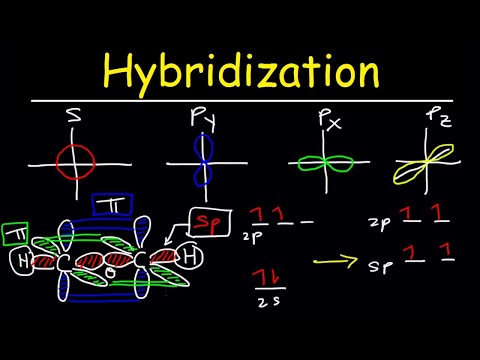
First, one 2s electron of carbon is promoted into the empty 2p orbital. This needs energy, but it gives four unpaired electrons and so four bonds instead of two; the energy released by the two extra bonds more than repays the cost. Second, the 2s and the three 2p orbitals mix to form four identical orbitals. They repel one another and point as far apart as possible: towards the corners of a tetrahedron, 109.5° apart. Each overlaps the 1s orbital of a hydrogen atom to form a σ bond, and the four C–H bonds are identical.
Carbon need not mix all three p orbitals. Mixing the s with two p orbitals gives three orbitals, and mixing it with one p gives two orbitals. The p orbitals left over are used for π bonds.
Table 3.1: Types of hybridisation
| Hybridisation | Orbitals mixed | Hybrid orbitals | Arrangement and angle | Examples |
|---|---|---|---|---|
| s + p | 2 | linear, 180° | ; C in and | |
| s + 2p | 3 | trigonal planar, 120° | ; C in | |
| s + 3p | 4 | tetrahedral, 109.5° | ; N in ; O in | |
| s + 3p + d | 5 | trigonal bipyramidal, 90° and 120° | ||
| s + 3p + 2d | 6 | octahedral, 90° |
A quick rule: count the σ bonds plus lone pairs on the atom (π bonds do not count). Two gives , three , four , five , six .
In ethene, , each carbon is hybridised. Its three orbitals form σ bonds to the other carbon and to two hydrogen atoms, all in one plane at about 120°. The fourth electron is in the unhybridised 2p orbital, perpendicular to that plane. The two p orbitals overlap sideways to form the π bond. Because the π overlap would be broken by twisting, there is no free rotation about a C=C bond.
In ethyne, , each carbon is hybridised: two σ bonds in a straight line (H–C and C–C) and two unhybridised p orbitals at right angles to each other and to the axis. They overlap with those of the other carbon to form two π bonds, which surround the axis like a cylinder. The molecule is linear.
Worked example 1: hybridisation of each atom
State the hybridisation of each carbon atom, and of the oxygen atom, in ethanal, , and give the approximate bond angles around each carbon.
Solution. Count σ bonds + lone pairs on each atom.
Worked example 2: phosphorus pentachloride
Explain how phosphorus () forms five equivalent-type bonds in , and name the hybridisation.
Solution. Ground state: three unpaired 3p electrons, enough for only . Promote one 3s electron into an empty 3d orbital: , five unpaired electrons. Mix the 3s, three 3p and one 3d orbital: five hybrid orbitals, pointing to the corners of a trigonal bipyramid. Each overlaps a 3p orbital of a chlorine atom to form a σ bond.
Answer: ; trigonal bipyramidal, with bond angles of 120° (in the triangle) and 90° (to the two axial chlorines).
Warning
Common mistakes. (1) Counting π bonds when deciding the hybridisation: only σ bonds and lone pairs count. (2) Saying a hybrid orbital is "between an s and a p": it is a new orbital, and the number of hybrids always equals the number of orbitals mixed. (3) Forgetting the leftover p orbitals in and atoms: they are where π bonds come from. (4) Hybridisation explains a shape that is already known; to predict a shape, use VSEPR (Lesson 4).
Tip
Learn the ladder: 2 → sp → 180°; 3 → sp² → 120°; 4 → sp³ → 109.5°; 5 → sp³d → 90° and 120°; 6 → sp³d² → 90°, where the number is σ bonds + lone pairs.
The Organic Chemistry Tutor: Hybridization of Atomic Orbitals - Sigma and Pi Bonds - sp, sp2, sp3 (11 min). Watch how the number of groups around an atom gives its hybridisation, and how σ and π bonds are counted in each example.
Practice
Key points
Sources and credits
Quick check
What is the hybridisation of each carbon atom in ethene, C₂H₄?