Moments and Equilibrium of Bodies
Senior 4 · Physics
Moments and Equilibrium of Bodies
Lesson 3 of 4
25 min
In the Matobo hills of Zimbabwe, huge granite boulders sit stacked on top of one another, some on bases far narrower than themselves, and have stood that way for thousands of years. A minibus with sacks piled high on its roof, on the other hand, can roll over on a bend that an empty one takes easily. Both come down to one point in each body, its centre of gravity, and to where the vertical line through that point falls.
Every particle of a body is pulled down by gravity. In a uniform gravitational field, all these small weights add up to one total weight that acts at a single point, the centre of gravity (G). For a uniform body with a centre of symmetry (a rod, a rectangle, a sphere) G is at that centre. G need not lie inside the material: the centre of gravity of a ring is at the empty centre.
Combining parts. The total weight must have the same moment about any point as all the separate weights together. Taking moments about an origin O for parts of weight whose centres of gravity are at :
and similarly for . Because , you may use masses (or, for a flat card of uniform thickness, areas) instead of weights.
Apparatus: a piece of stiff card of irregular shape with three small holes near its edge, a pin held in a clamp, a plumb line (a thread with a small weight), a pencil.
Figure 3.1: The plumb-line method. A freely hanging body comes to rest with G vertically below the point of suspension.
Why it works: a hanging body is in equilibrium only when its weight has no moment about the pin, that is when G lies on the vertical line through the pin.
Definition
The centre of gravity of a body is the point through which the whole weight of the body appears to act, whatever the body's orientation. For a system of parts, . The centre of mass is defined in the same way with masses; in a uniform field the two points coincide. Example: a uniform metre rule has its centre of gravity at the 50 cm mark.
Worked example 1: a rod with a load
A uniform rod 2.0 m long and weighing 20 N carries a 30 N weight at one end. Where is the centre of gravity of the whole?
The rod balances on a support 1.6 m from the unloaded end, closer to the heavy end.
Worked example 2: an L-shaped plate
A uniform L-shaped metal plate is made of a rectangle 40 cm × 10 cm lying along the axis from the origin, and a rectangle 10 cm × 30 cm standing on its left end (from cm to cm). Find G.
Areas and centres: at (20, 5); at (5, 25).
G is at (13.6 cm, 13.6 cm), which lies outside the metal, in the corner of the L.
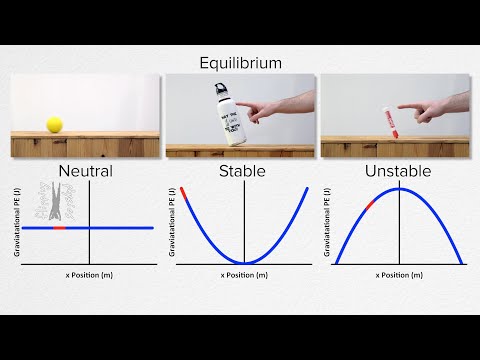
A body in equilibrium may react to a small push in three ways (Figure 3.2).
Figure 3.2: The three kinds of equilibrium, shown by a cone. The dashed line is the vertical through G.
| Kind | After a small displacement… | Centre of gravity | Example |
|---|---|---|---|
| stable | the weight produces a moment that returns the body | rises when displaced | a cone on its base; a ball in a bowl |
| unstable | the weight produces a moment that moves it further | falls when displaced | a cone on its tip; a pencil on its point |
| neutral | the weight produces no moment; it stays in its new position | stays at the same height | a cone on its side; a ball on a level floor |
In energy terms, a body in stable equilibrium sits at a minimum of gravitational potential energy, and one in unstable equilibrium at a maximum.
Tilt a box about one bottom edge (Figure 3.3). As long as the vertical line through G falls inside the base, the weight's moment about the edge turns the box back. When the line passes outside the base, the moment turns the other way and the box topples. At the critical angle the line passes exactly through the edge; for a uniform box of base width with G at height ,
Figure 3.3: Toppling happens when the vertical through G passes outside the base.
So a body is more stable when its centre of gravity is low and its base is wide. Racing cars are built low and wide; a loaded lorry should carry its heaviest goods at the bottom; a mug with a wide base is hard to knock over; you stand with your feet apart on a moving bus.
Worked example 3: how far can a bus lean?
A bus is 2.5 m wide with its centre of gravity 1.2 m above the road. (a) Through what angle can it be tilted sideways before it topples? (b) Passengers' luggage on the roof raises G to 1.6 m. Find the new angle.
Raising the load reduces the margin of safety by 8°. On a bend, the sideways friction from the road adds a toppling moment, so a top-heavy vehicle overturns at a lower speed.


Warning
Common mistakes. (1) Thinking the centre of gravity must be inside the material. (2) Saying a body topples when G is "too high": it topples when the vertical through G passes outside the base; height only changes the angle at which that happens. (3) Adding positions without weighting them: uses , not just . Safety: heavy furniture such as bookshelves can topple onto children; fix tall shelves to the wall and keep heavy items on the lowest shelves.
Tip
For any toppling question, draw the vertical line through G. Inside the base: safe. Through the edge: critical. Outside: it falls.
Stable, unstable and neutral equilibrium (Flipping Physics). Watch how a ball, a bottle and a marker show the three kinds of equilibrium, and how the change in gravitational potential energy tells them apart.
Practice
Key points
Sources and credits
The experiment, the three diagrams, the worked examples and the practice exercises are written by Ganzaa.
Quick check
A box stands on a level floor and is tilted about one edge. When does it topple?