Moments and Equilibrium of Bodies
Senior 4 · Physics
Moments and Equilibrium of Bodies
Lesson 4 of 4
25 min
Every concrete column and beam in a modern building is reinforced with steel bars, because concrete is strong when squeezed but cracks easily when stretched. The lift cables in a tall building and the wire ropes of a crane carry tonnes. Engineers must know how much each of these stretches under load, and at what load it will be permanently bent or snap. To compare a thin wire with a thick bar, they use quantities that do not depend on the size of the sample: stress, strain and Young's modulus.
Hang loads on a wire or spring and the extension grows in proportion to the load, up to a point. This is Hooke's law:
where is the stiffness (spring constant) in . But depends on the sample: a wire twice as long stretches twice as much under the same load, and one with twice the cross-sectional area stretches half as much. Dividing out the size gives quantities that describe the material:
Comparing with Hooke's law, : a stiffer sample is one made of a material with a large , thick and short.
Definition
Tensile stress is the force per unit cross-sectional area (unit: pascal, ). Tensile strain is the extension per unit original length; it has no unit. The Young modulus is the ratio of stress to strain within the limit of proportionality (unit: Pa). Example: steel has (210 GPa).
| Material | Young modulus () |
|---|---|
| steel | 210 |
| cast iron | 100 |
| brass | 90 |
| aluminium | 70 |
| glass | 70 |
| concrete | 20 |
| bone (in tension) | 16 |
| hardwood | 15 |
| nylon | 5 |
Table 4.1: Young moduli of some materials (values from OpenStax College Physics, Table 5.3).
Worked example 1: stretching a steel wire
A steel wire 2.00 m long and 0.50 mm in diameter carries a load of 50 N. Find the stress, strain and extension ().
Worked example 2: a reinforcing bar
A steel reinforcing bar 3.0 m long and 12 mm in diameter carries a tension of 20 kN. By how much does it stretch?
Only 2.5 mm over 3 m, a strain of less than 0.1%. Steel's large Young modulus is why a thin bar can carry the tension that would crack plain concrete.
Figure 4.1: Stress against strain for a ductile metal (solid) and a brittle material (dashed).
A ductile material (copper, mild steel) has a large plastic region and can be drawn into wires; a brittle material (glass, cast iron, concrete in tension) breaks with almost no plastic deformation.
The work done in stretching is the area under the force–extension graph. Within Hooke's law the graph is a straight line, so
Apparatus: two long, identical wires hung from a rigid support, a vernier scale joining them (Figure 4.2), a micrometer screw gauge, a metre rule, slotted 1.0 kg masses, safety goggles.
Figure 4.2: A test wire and a reference wire. The reference wire cancels the sag of the support and changes of temperature.
| (N) | 10 | 20 | 30 | 40 | 50 |
|---|---|---|---|---|---|
| (mm) | 0.79 | 1.60 | 2.39 | 3.21 | 3.98 |
Table 4.2: Illustrative results for a wire with and .
Figure 4.3: Load against extension for Table 4.2. The shaded area is the energy stored at 50 N.
Warning
Safety. Wear goggles: a stretched wire that snaps whips back and can blind. Put a box of sand or a soft mat under the load so that falling masses cannot land on feet, and stand to one side. Do not load the wire beyond the planned maximum.
Worked example 3: analysing the experiment
From Figure 4.3 the gradient is . With :
The energy stored at 50 N is . The largest uncertainty comes from the diameter: it is squared in , so a 2% error in gives a 4% error in . That is why the diameter is measured many times with a micrometer.


Warning
Common mistakes. (1) Using the diameter instead of the radius in , which makes four times too big. (2) Forgetting to convert mm to m and to (). (3) Calling the elastic limit and the limit of proportionality the same point. (4) Saying a material with a high Young modulus is necessarily strong: measures stiffness; strength is the ultimate tensile stress. Glass is stiff but brittle.
Tip
: "Full Load over Area times stretch". Check the order of magnitude: metals to ; plastics about .
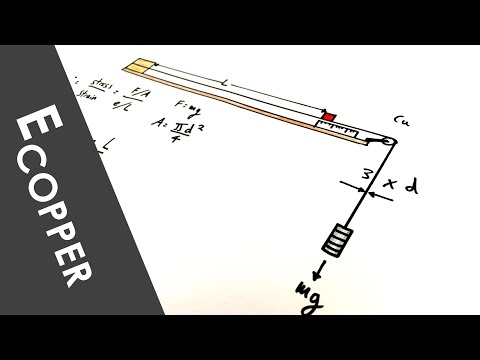
Young's modulus of copper, a practical (Physics Online). Watch how the wire's diameter is measured with a micrometer, how the extension is read as loads are added, and how the Young modulus is found from the gradient of the graph.
Practice
Key points
Further reading
Sources and credits
The three diagrams, the experiment and its illustrative results, the worked examples and the practice exercises are written by Ganzaa.
Quick check