Production Theory
Senior 4 · Economics
Production Theory
Lesson 4 of 5
30 min
In lesson 1 you saw dozens of people building terraces with hoes. On a road site in Kigali you may see the opposite: one bulldozer and a handful of workers moving the same amount of earth in a day. Both methods "work". In the long run a producer can change every input, so two new questions arise. If a firm doubles all its inputs, does output double? And of all the mixes of labour and capital that can produce a given output, which should it choose?
This lesson answers the first question with returns to scale, and draws the menu of mixes with isoquants. Lesson 5 adds costs to choose from the menu.

Definition
Returns to scale: how output responds when all inputs are increased in the same proportion, in the long run.
Example: a bakery doubles its bakers, ovens, flour and floor space. If it now bakes 2.5 times as much bread, it has increasing returns to scale.
Multiply every input by a number and compare the new output with times the old:
A common form of production function is the Cobb–Douglas function . Multiplying both inputs by multiplies output by , so:
| Returns to scale | Doubling all inputs multiplies output by | |
|---|---|---|
| greater than 1 | Increasing | more than 2 |
| equal to 1 | Constant | exactly 2 |
| less than 1 | Decreasing | less than 2 |
Why returns change with scale. As a firm grows from small to medium, it can divide labour more finely, use large machines that a small firm cannot fill (an indivisibility), and buy in bulk: increasing returns. At some size these gains run out (constant returns). Beyond it, the firm becomes hard to manage: decisions are slow, information is lost between layers of managers, and workers are harder to supervise: decreasing returns. Unit 7 turns these ideas into economies and diseconomies of scale, which are about costs.
Worked example 1: testing three production functions
Start from , and double both to , .
| Function | Output at (4, 9) | Output at (8, 18) | Ratio | Returns |
|---|---|---|---|---|
| 2 | Constant () | |||
| Increasing (1.5) | ||||
| Decreasing (0.5) |
Note: the second and third functions give the same output at (4, 9); what separates them is how output responds to scale.
Definition
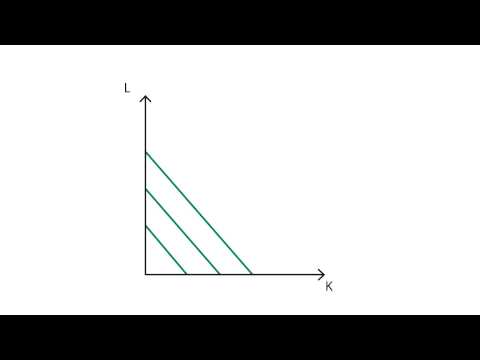
Isoquant ("equal quantity"): a curve showing all the combinations of two inputs that can produce the same level of output, with given technology.
Isoquant map: a set of isoquants; one further from the origin shows a higher output.
Marginal rate of technical substitution (MRTS) of labour for capital: the amount of capital that can be given up when one more worker is employed, keeping output unchanged:
Example: if a firm can replace 3 machine-hours with 1 worker and still produce the same output, its MRTS is 3.
A workshop's output follows , with K in machine-hours a day and L in workers (illustrative). Every combination with gives 60 units:
| Combination | A | C | D | E | F | G | B |
|---|---|---|---|---|---|---|---|
| Labour, L | 2 | 3 | 4 | 6 | 9 | 12 | 18 |
| Capital, K | 18 | 12 | 9 | 6 | 4 | 3 | 2 |
| – | 6 | 3 | 1.5 | 0.67 | 0.33 | 0.17 |
Reading the diagram. Each curve is one level of output. Moving down an isoquant, the firm swaps capital for labour. Near A, capital is plentiful and one extra worker replaces 6 machine-hours; near B, labour is plentiful and one extra worker replaces only a fraction of a machine-hour. This diminishing MRTS makes isoquants convex. Along the ray, the isoquants for 60, 120 and 180 units are equally spaced: doubling and tripling both inputs doubles and triples output. With increasing returns they would get closer together along the ray; with decreasing returns, further apart.
Properties of isoquants. (1) They slope downwards: to keep output constant, less of one input needs more of the other. (2) They are convex to the origin, because the MRTS diminishes. (3) A higher isoquant shows a larger output. (4) Isoquants never cross: one combination cannot give two different maximum outputs. (5) Unlike indifference curves, they carry real, measurable output numbers.
Special cases. If two inputs are perfect substitutes (two brands of fertiliser with the same nutrients), the isoquants are straight lines. If they must be used in fixed proportions (one driver per lorry), the isoquants are L-shaped.
Worked example 2: the MRTS from the production function
For , using calculus:
(a) At D (4, 9): : one more worker can replace about 2.25 machine-hours.
(b) At F (9, 4): . The MRTS has fallen as labour replaced capital, which is why the isoquant is convex.
(c) How much capital is needed to produce 80 units with 16 workers? machine-hours.
Warning
Returns to scale are not returns to a factor. Diminishing marginal returns (lesson 3) happen in the short run when ONE input grows and another is fixed. Returns to scale describe the long run, when ALL inputs grow together. A firm can have diminishing returns to labour and constant returns to scale at the same time, as does.
Tip
"Along the ray, count the gaps." Draw a straight line from the origin through an isoquant map whose curves are numbered at equal steps (60, 120, 180). Shrinking gaps mean increasing returns; equal gaps, constant; widening gaps, decreasing.
Important
Discuss. The terraces in lesson 1 were built by hand under a public works programme that aims to give poor households paid work. A private contractor might use machines instead. Both methods lie on the same isoquant. What, besides output, might a government consider when choosing between them?
Policonomics, "B.2 Isoquants | Production - Microeconomics". Watch how an isoquant is drawn from combinations of capital and labour giving the same output, and how its slope, the marginal rate of technical substitution, falls along the curve.
Practice
Key points
Sources and credits
Written by Ganzaa: the text, the isoquant map (drawn to scale from ), the tables, the worked examples and the practice items. All production figures are illustrative.
This lesson adapts CC BY-SA material and is shared under CC BY-SA 4.0.
Quick check
A firm doubles all its inputs and its output rises from 500 to 1,300 units. This shows…