Equations and Inequalities
Senior 4 · Basic Mathematics
Equations and Inequalities
Lesson 1 of 5
25 min
Suppose a motorcycle-taxi fare is worked out as a fixed charge of 300 Frw plus 150 Frw for every kilometre (illustrative rates). A passenger pays 1 950 Frw. How far did she ride? Call the distance kilometres. The fare is , so
Taking 300 from both sides gives , and dividing by 150 gives . She rode 11 km. Almost every word problem in business, science or daily life becomes an equation like this one. This lesson gives you a reliable method for solving linear equations, and for building them from words.

Definition
Equation: a statement that two expressions are equal. A linear equation in one unknown can be written as
and has exactly one solution (root), . The solution set is the set of all solutions, written .
Equivalent equations have the same solutions. You get one by adding the same number to both sides, or by multiplying or dividing both sides by the same non-zero number.
Example: gives .
Worked example 1: brackets and fractions
Solve (a) (b) .
Solution
Warning
The minus sign in front of a bracket changes every sign inside it. , not . And when you clear fractions, multiply every term, including the whole numbers: in (b) above, the 3 on the right becomes 36.
Important
Not every equation has exactly one solution. If the -terms cancel, look at what is left.
To solve a problem in words: (1) say what the unknown stands for, with its unit; (2) write each quantity in terms of it; (3) write the equation; (4) solve; (5) check the answer in the story, not just in the equation; (6) answer in a sentence.
Worked example 2: break-even
A juice maker has fixed costs of 60 000 Frw a month (rent and a blender). Each bottle costs 400 Frw to make and sells for 700 Frw. How many bottles must she sell in a month to break even, that is, for income to equal costs?
Solution
Let be the number of bottles. Income ; costs .
Check: income ; costs . ✓ She breaks even at 200 bottles; every bottle above that earns 300 Frw of profit.
Each side of the equation is a straight line. The solution of the equation is the -coordinate of the point where the lines cross. Below 200 bottles the cost line is above the income line (a loss); above 200 the income line is higher (a profit).
Worked example 3: sharing and mixing
(a) Three sisters share 120 000 Frw. The second gets 10 000 Frw more than the first, and the third gets twice as much as the first. How much does each get? (b) How much water must be added to 2 litres of a juice concentrate that is 40% fruit to make a drink that is 25% fruit?
Solution
Worked example 4: changing the subject of a formula
The amount of a simple-interest investment is . Make the subject, and find how long 400 000 Frw takes to grow to 496 000 Frw at 6% a year.
Solution
, so and
Tip
Write the unknown's meaning and unit at the top of your working: "Let = number of bottles sold per month". It stops you mixing up quantities, and it tells you how to write the final sentence. A negative number of bottles, or a share bigger than the total, means an error somewhere.
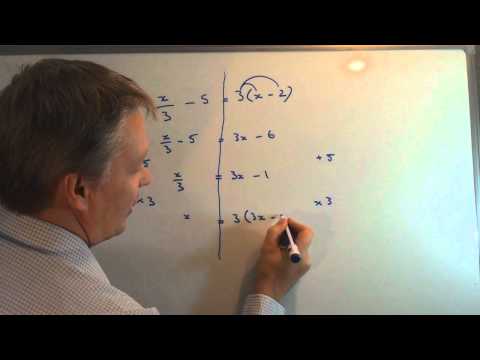
3minutemaths: How to solve linear equations with fractions and brackets. Watch how multiplying every term by the LCM clears the fractions in one step.
Practice
Try each one before opening the answers. They get harder as you go.
Key points
Sources and credits
Quick check