Equations and Inequalities
Senior 4 · Basic Mathematics
Equations and Inequalities
Lesson 4 of 5
25 min
At a market stall, Mutesi pays 5 700 Frw for 2 kg of beans and 3 kg of rice. Her neighbour pays 4 900 Frw for 4 kg of beans and 1 kg of rice from the same stall (illustrative prices). Neither receipt alone tells you the price of a kilogram of beans, , or of rice, : each gives one equation with two unknowns, and many pairs fit it. But only one pair fits both:
Two equations that must hold at the same time form a system of simultaneous equations. This lesson solves them in three ways, and then moves to systems of inequalities, which describe all the plans a business can afford.
Definition
System of two linear equations in two unknowns: . A solution is an ordered pair that satisfies both equations.
Each equation is a straight line, so a solution is a point where the two lines meet. Two lines can cross once (one solution), be parallel (no solution) or be the same line (infinitely many solutions).
Example: solves and , since and .
Worked example 1: substitution
Solve the market system , .
Solution
The second equation gives easily: . Substitute into the first:
Then . Beans cost 900 Frw per kg and rice 1 300 Frw per kg. Check: . ✓
Worked example 2: equating one variable (comparison)
Solve and by making the subject of both.
Solution
and . Both equal , so they equal each other: , , , and . The solution is .
Worked example 3: elimination
Solve and .
Solution
Make the -coefficients opposite: multiply the first equation by 3 and the second by 2.
Add: , so . Then gives . Check in the second equation: . ✓ .
Draw both lines on one grid (two points for each line are enough) and read the point where they cross. For use and ; for use and .
A graph shows the meaning of the solution at a glance, but it is only as accurate as the drawing, so confirm it algebraically. The graph also explains the special cases: and are parallel lines (no solution); and are the same line (infinitely many solutions).
Warning
Multiply the whole equation. When you multiply an equation to match coefficients, multiply every term, including the right-hand side: is , not . And always check your pair in the equation you did not use last.
A line cuts the plane into two half-planes: on one side , on the other . To draw : draw the boundary line (solid for or , dashed for or ), then test one point not on the line, usually . If the point satisfies the inequality, its side is the solution; if not, the other side is. The solution of several inequalities is the region where all their half-planes overlap.
Worked example 4: a tailor's possible weekly plans
A tailor makes shirts and dresses a week. A shirt needs 2 m of cloth and 2 hours; a dress needs 3 m of cloth and 1 hour. She has at most 24 m of cloth and 16 hours a week (illustrative). Write the conditions, draw the region of possible plans, and decide whether 5 shirts and 3 dresses, or 7 shirts and 3 dresses, are possible.
Solution
Testing : and are true, so both regions lie on the origin's side of their lines. The two boundary lines meet where and : subtracting gives , so and .
: and : possible. : but : not enough time, so not possible.
Tip
Choose the method by the coefficients. If one unknown already has coefficient 1 or , substitute. If not, eliminate. Use a graph when the question asks for one, or when you need to see a region rather than a single point.
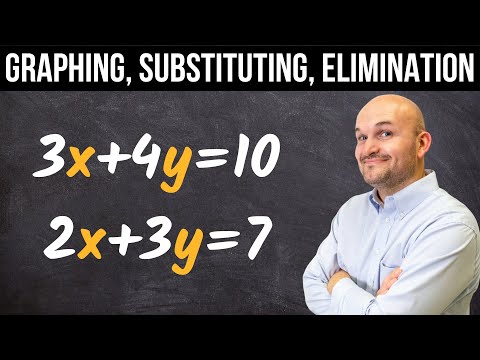
Brian McLogan: Solve a System by Graphing, Substitution, Elimination. Watch the same system solved three ways, giving the same point each time.
Practice
Try each one before opening the answers. They get harder as you go.
Key points
Sources and credits
Quick check
Which pair solves x + 2y = 8 and x − y = 2?