Equations and Inequalities
Senior 4 · Basic Mathematics
Equations and Inequalities
Lesson 3 of 5
25 min
A small bakery pays 20 000 Frw a day for rent and fuel, and each loaf costs 500 Frw in flour and labour. If it bakes loaves, the average cost of one loaf is
(illustrative figures). The owner wants this to be at most 700 Frw, so that a price of 700 Frw covers costs. That is an inequality with the unknown in a quotient, and it cannot be solved by the rules of the last lesson alone: you may not multiply both sides by until you know its sign. This lesson gives a method that handles any product or quotient of linear factors: the sign table.
Important
Signs of products and quotients. A product or a quotient of two numbers is
Sign of a linear factor: () is zero at , has the same sign as to the right of that point, and the opposite sign to the left. For example, is zero at 3, negative for (because ) and positive for .
Definition
Sign table: a table that records, on each interval between the zeros of the factors, the sign of every factor and of the whole product or quotient.
Method: (1) bring everything to one side so the other side is 0; (2) factorise; (3) find the zero of each factor (the critical values) and put them in order on the top row; (4) fill in the sign of each factor; (5) multiply the signs down each column; (6) read off the intervals that satisfy the inequality, deciding for each critical value whether it is included.
Worked example 1: a product
Solve .
Solution
The critical values are and .
| − | 0 | + | + | ||||
| − | − | 0 | + | ||||
| + | 0 | − | 0 | + |
We need "", strictly, so the zeros are excluded:
Worked example 2: a quadratic written as a product
Solve (a) (b) .
Solution
Worked example 3: a quotient
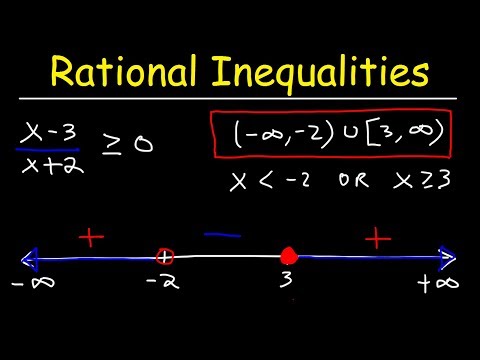
Solve .
Solution
Critical values: (numerator zero) and (denominator zero, so the quotient is undefined there, shown by ||).
| − | 0 | + | + | ||||
| − | − | 0 | + | ||||
| + | 0 | − | || | + |
The quotient is on : is included (the quotient equals 0 there), but 4 is excluded, whatever the inequality sign.
Worked example 4: the bakery
For which numbers of loaves is ?
Solution
Bring everything to one side over a common denominator:
Critical values: 100 (numerator) and 0 (denominator). For the denominator is positive, so we need , that is . The bakery must bake at least 100 loaves a day for the average cost to be 700 Frw or less. (At 100 loaves: . ✓)
Warning
Never multiply an inequality by an expression whose sign you do not know. To solve , do not multiply by : it is negative for , which would reverse the sign there. Instead subtract 2: , and use a sign table: .
Tip
With two linear factors whose -coefficients are both positive, the signs from left to right are always : the expression is positive outside the two zeros and negative between them. If one coefficient is negative, the pattern flips to . A sign table still settles every doubtful case.
The Organic Chemistry Tutor: Rational Inequalities. Watch how the critical values split the number line and why the zero of the denominator is never included.
Practice
Try each one before opening the answers. They get harder as you go.
Key points
Sources and credits
Quick check
What is the solution set of (x − 1)(x + 4) < 0?