Environmental Management and Sustainable Development
Senior 4 · General and Religious Studies
Environmental Management and Sustainable Development
Lesson 3 of 4
25 min
For years, factories, warehouses and paved roads in Kigali's Gikondo industrial park stood in a wetland. The park gave jobs and income: economic growth. But according to REMA, it destroyed the wetland's biodiversity, increased runoff and erosion downstream, and polluted ground and surface water; industrial waste is reported to have travelled through the Nyabugogo and Akagera wetlands to Lake Victoria. Using Law N° 48 of 2018 on environment and the land law, which treats wetlands as public land where building is forbidden, the government relocated the industries to a new industrial park, under a plan agreed in 2011, and began rehabilitating the wetland.
Was moving the factories a loss for the economy or a gain for the country? The answer depends on how far ahead you look, and that is the question of sustainable development.
Definition
Economic growth: an increase in a country's output of goods and services, usually measured by GDP.
Social development: improvement in people's well-being: health, education, fairness, security and participation.
Environmental protection: actions that prevent or limit damage to the environment.
Sustainable development: in the words of the United Nations Brundtland Commission (1987), "meeting the needs of the present without compromising the ability of future generations to meet their own needs". Rwanda's Law N° 48 of 2018 (Article 4) puts it this way: "The right to development must be achieved in consideration of the needs of present and future generations."
Green growth: economic growth that uses resources efficiently, limits pollution and builds resilience to climate change.
Natural capital: the stock of natural resources (soil, forests, water, biodiversity) that produces benefits for people, as machines and buildings do.
The three goals can conflict. A quarry creates jobs (growth) but scars a hillside (environment); a ban on charcoal protects forests (environment) but hurts poor families who cook with it (society). They can also support each other: terraces built by paid public works raise incomes, keep soil in place and feed families. Sustainable development looks for actions in the centre of Figure 3, and when trade-offs cannot be avoided, it compensates those who lose out, as at Rugezi.
Some economists, starting with Gene Grossman and Alan Krueger in the early 1990s, observed that some kinds of pollution rise as a poor country grows and later fall as it becomes rich: the "environmental Kuznets curve". Critics answer that the pattern holds only for some local pollutants, that richer countries often move polluting industries abroad, and that some damage cannot be undone: an extinct species or a destroyed wetland does not come back. Rugezi, where restoration took years and cost the country dearly, shows why "clean up later" can be the most expensive choice.
Warning
Sustainable does not mean "no development". A common mistake is to treat sustainable development as stopping growth to protect nature. The Brundtland definition starts with "meeting the needs of the present". Poor people need jobs, roads and energy now. The point is to meet these needs in ways that do not destroy what the next generation will need.
Tip
Who gains, who loses, now and later? To evaluate any project for sustainability, draw a small table: economic, social and environmental effects, each for today and for twenty years ahead. A project is sustainable if no column turns strongly negative, or if those who lose are compensated.
Important
Discuss. A company wants to open a mine in your district. It promises 500 jobs for ten years, but the mine is on a hillside above a river used by farmers. Using Figure 3 and the "now and later" table, what conditions would you set before agreeing?
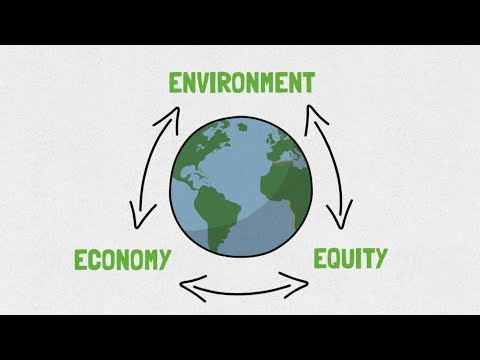
UCLA (University of California, Los Angeles): "What is Sustainability", about 3 minutes. Note the different ways the video defines sustainability and compare them with the Brundtland definition and Figure 3.
Practice
Key points
Sources and credits
Written by Ganzaa: Figure 3, the analysis and the exercises.
Quick check
Match each example to the goals it combines.
Tap one on the left, then its partner on the right.