Projectile and Uniform Circular Motion
Senior 4 · Physics
Projectile and Uniform Circular Motion
Lesson 3 of 5
25 min
Point a camera at the night sky, open the shutter for an hour, and every star draws an arc of a circle around one fixed point in the sky, the celestial pole. The stars are not moving: the camera is, carried round by the turning Earth. Measure the arcs and you find something striking. A star close to the pole draws a short arc and a star far from it a long one, but every arc covers the same angle, about for each hour of exposure. To describe motion like this, where different parts move at different speeds yet turn together, we measure angles instead of distances. In S3 you met period, frequency and angular speed for uniform circular motion. In this lesson you use radians throughout, add angular acceleration, and solve problems on wheels that speed up and slow down.
A body moves in a circle when its distance from a fixed point, the centre, stays constant. Its position is fixed by the angle its radius has turned through. In physics this angle is measured in radians: the arc length divided by the radius (Figure 3.1, left),
A whole turn has arc length , so and . Because the radian is a ratio of two lengths it has no dimensions, but writing "rad" makes clear that an angle is meant.
Figure 3.1: Left: one radian is the angle that cuts off an arc equal to the radius. Right: on a turning disc every point has the same angular velocity ω, but its speed v = ωr grows with its distance from the axis.
Definition
The angular displacement of a body moving in a circle is the angle, in radians, through which its radius turns. Its angular velocity is the rate of change of angular displacement, , in . For uniform circular motion with period (time for one turn) and frequency (turns per second, Hz),
Example: a wheel making 600 revolutions per minute has and .
Differentiating with respect to time, with constant, gives the speed along the circle, called the linear or tangential speed:
Its direction is along the tangent, at right angles to the radius. All points of a rigid turning body, such as a wheel or the Earth, share the same , but points further from the axis move faster (Figure 3.1, right). This is why the star trails share one angle but have different lengths.
Worked example 1: riding on the turning Earth
The Earth turns once relative to the stars in 23 h 56 min (86 164 s). Its equatorial radius is . Find (a) its angular velocity, (b) the speed of a point on the equator, (c) the angle the stars appear to turn through in one hour.
(a)
(b)
(c)
Kigali lies only about south of the equator, so a pupil there is carried round the Earth's axis at almost 465 m/s, faster than a passenger jet, without feeling it, because the motion is so nearly steady.
When a fan is switched on, a wheel brakes or a mill starts, changes. The angular acceleration is the rate of change of angular velocity:
A point at radius then speeds up along the circle with a tangential acceleration . If is constant, the motion is uniformly accelerated circular motion, and its equations are exactly those of uniformly accelerated linear motion with each linear quantity replaced by its angular partner (Table 3.1).
| Linear motion | Angular motion | Link (radius ) |
|---|---|---|
| displacement (m) | angular displacement (rad) | |
| velocity () | angular velocity () | |
| acceleration () | angular acceleration () | |
Table 3.1: Linear quantities and equations with their angular partners. The angular equations hold only for constant .
The same graphs work too. On a graph of against , the gradient is and the area under the line is the angle turned (Figure 3.2).
Figure 3.2: Angular velocity against time for uniform angular acceleration: the gradient is α and the area is θ.
Definition
The angular acceleration of a rotating body is the rate of change of its angular velocity, , in . A point at distance from the axis then has tangential acceleration . Example: a disc whose angular velocity rises from 0 to in 6.0 s has ; a point 0.20 m from its axis has .
Worked example 2: a maize mill starting up
The motor of a maize mill accelerates uniformly from rest to 3000 revolutions per minute in 4.0 s. Find (a) its final angular velocity, (b) its angular acceleration, (c) the number of revolutions it makes while starting, (d) the tangential acceleration of a point 0.10 m from the axis.
(a)
(b)
(c) , which is revolutions.
(d)
Worked example 3: a wheel coming to rest
A bicycle wheel spinning at is braked uniformly and stops after 25 revolutions. Find its angular acceleration and the time it takes to stop.
. Using with :
The negative sign shows the angular velocity is decreasing: an angular deceleration.

Warning
Common mistakes. (1) Using degrees or revolutions in or : these formulas need radians. Convert first: 1 rev rad, and rpm gives . (2) Thinking that points further from the axis turn faster: they all have the same ; they have a greater speed. (3) Using the angular equations when is not constant. (4) Confusing frequency (turns per second) with angular velocity: .
Tip
Swap and solve. Every angular problem is a linear problem in disguise: swap , , , , solve with the familiar equations, then use and to come back to a point on the rim.
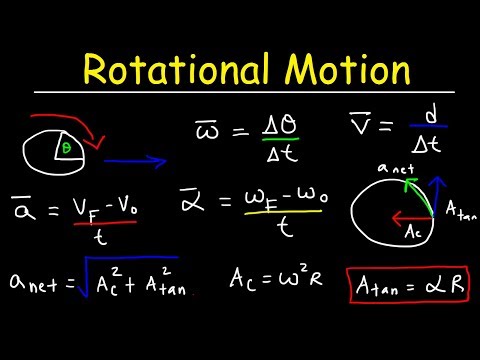
Rotational Motion Physics: Angular Velocity and Tangential Acceleration (The Organic Chemistry Tutor). Watch how angular displacement, angular velocity and angular acceleration are defined, and how v = rω and a = rα link them to the motion of a point on the rim.
Practice
Key points
Sources and credits
Written by Ganzaa: the lesson text, derivations, diagrams, table, worked examples and practice exercises.
Quick check