
Numbers up to 100
Primary 1 · Mathematics
Numbers up to 100
Lesson 5 of 7
12 min
Let's begin
Four friends count the avocados they picked.
Uwase has 49. Keza has 51. Gatete has 74. Niyonzima has 47.
They want to stand in a line, the smallest pile first.
Today you will put numbers in order.
To compare two numbers, count the bundles.
Worked example
49 and 51.
Step 1 49 has 4 tens. 51 has 5 tens.
Step 2 5 bundles beat 4 bundles.
Step 3 So 51 is bigger.
Careful! The 9 in 49 looks big. Loose ones can never beat a whole bundle.
Worked example
74 and 71.
Both have 7 tens. That is a tie.
Now look at the ones. 4 is more than 1.
So 74 is bigger.
> means is more than. We write 51 > 49.
< means is less than. We write 49 < 51.
= means is the same as. We write 60 = 60.
The wide open end always faces the bigger number.
Uwase 49, Keza 51, Gatete 74, Niyonzima 47.
47 and 49 both have 4 tens. 47 has fewer ones, so 47 comes first.
Smallest first: 47, 49, 51, 74.
Now turn the line around.
Biggest first: 74, 51, 49, 47.
Ten more means one more bundle.
51 with one more bundle is 61. The ones stay 1.
Ten less means one bundle goes away.
51 with one bundle taken is 41. The ones stay 1.
Careful! Ten less than 51 is not 50. That is one less.
Tip
Tens are the boss
Count bundles before you look at loose ones.
For ten less, say what stays: the ones stay the same.
One whole bundle walks away. Nothing else moves.
The open mouth eats the bigger number.
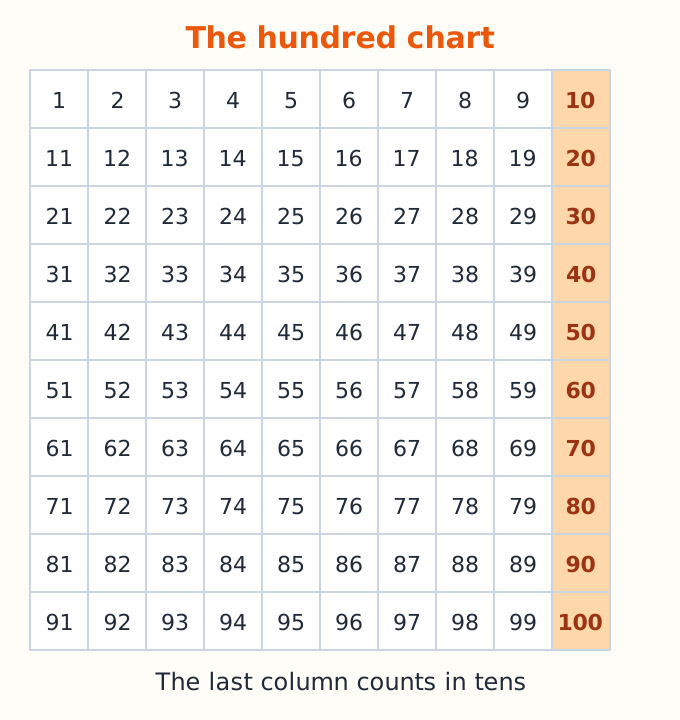
Do each one, then tap Show answer to check.
Which is bigger, 68 or 86?
Answer: 86. It has 8 bundles. 68 has only 6.
Put a sign between 35 and 53.
Answer: 35 < 53. 3 tens is less than 5 tens.
What is ten more than 62?
Answer: 72. One more bundle. The ones stay 2.
What is ten less than 90?
Answer: 80. One bundle goes away.
Put 81, 18, 80 in order. Smallest first, then the other way round.
Answer: 18, 80, 81. The other way: 81, 80, 18. 18 has only 1 ten.
What you learned today
Quick check
Which sign goes between 39 and 93?

