
Numbers up to 100
Primary 1 · Mathematics
Numbers up to 100
Lesson 4 of 7
12 min
Let's begin
Habimana and Mutesi each write a number on a slate.
Habimana writes 58. Mutesi writes 85.
“Same number!” says Habimana. “Same two digits.”
Today you will show him why he is wrong.
Every two-digit number has two jobs.
The left digit counts the tens. Those are the tied bundles.
The right digit counts the ones. Those stay loose.
Lay it out with sticks and look:
| Number | Bundles of ten | Loose ones |
|---|---|---|
| 58 | 5 | 8 |
| 85 | 8 | 5 |
85 has 8 whole bundles. 58 has only 5.
Careful! Same digits does not mean same number.
The place of a digit tells you its job.
Worked example
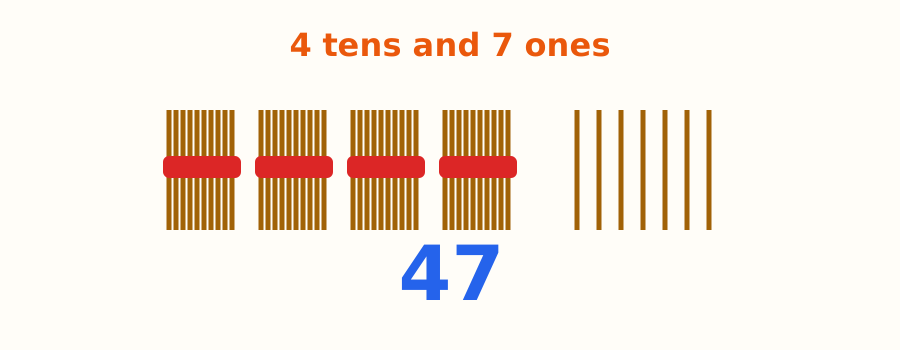
4 bundles and 7 loose sticks.
Step 1 4 tens is 40.
Step 2 7 ones is 7.
Step 3 40 and 7 make 47.
Careful! In 47 the 4 does not mean four. It means 4 whole bundles.
Worked example
73.
The 7 is on the left. That is 7 tens, which is 70.
The 3 is on the right. That is 3 loose ones.
So 73 is 70 and 3.
Say it the same way every time: “73 is 7 tens and 3 ones.”
Take 6 bundles. Take no loose sticks at all.
6 tens and 0 ones is 60.
The 0 does a job. It holds the ones place.
It keeps the 6 sitting in the tens place.
Tip
Left digit, bundles. Right digit, loose
Always read a number from the left. Bundles first.
Build both numbers with sticks when two look alike.
Then you can see that 85 is much bigger than 58.
Watch a number split into tens and ones.
Do each one, then tap Show answer to check.
How many tens and ones are in 62?
Answer: 6 tens and 2 ones.
3 bundles and 9 loose sticks. What number?
Answer: 39. 30 and 9 make 39.
Which is more, 5 tens or 9 ones?
Answer: 5 tens. 5 tens is 50. 9 ones is only 9.
Break 86 into tens and ones.
Answer: 80 and 6. The 8 means 8 bundles.
Ishimwe has 7 bundles of ten sticks and 1 loose stick.
Answer: 71 sticks. 70 and 1 make 71.
What you learned today
Quick check
Which is bigger, 58 or 85?

