Structure and Functions of the Human Gas Exchange System
Senior 1 · Biology
Structure and Functions of the Human Gas Exchange System
Lesson 4 of 5
25 min
By the last lesson of a hot afternoon, a closed classroom with fifty students in it feels stuffy and warm, and the windows may mist up. Fifty people have been breathing in the same air and breathing it out again. What have they changed in it?
In Lesson 1 you saw that in the alveoli oxygen leaves the air and carbon dioxide enters it. If that is true, the air you breathe out should contain less oxygen and more carbon dioxide than the air you breathe in. In this lesson you test that prediction.
Definition
Inhaled air: the air you breathe in, from your surroundings.
Exhaled air: the air you breathe out, after it has been in your lungs.
Limewater: a clear, colourless solution of calcium hydroxide, , in water. It turns milky when carbon dioxide is bubbled through it, so it is the standard test for .
Precipitate: an insoluble solid that forms in a solution during a reaction, making it cloudy. Example: the white calcium carbonate that makes limewater milky.
Aim: to find out whether exhaled air contains more carbon dioxide than inhaled air.
Figure 1: The apparatus. Blue arrows: the path of air when you breathe in. Orange arrows: the path of air when you breathe out.
Method
Warning
Safety
Table 1: Sample results (sample data, for illustration)
| Tube | Air bubbled through it | After 5 breaths | After 20 breaths |
|---|---|---|---|
| A | inhaled air (from the room) | clear | clear |
| B | exhaled air | milky | very milky |
Conclusion: exhaled air turns limewater milky far more quickly than inhaled air, so exhaled air contains much more carbon dioxide. Tube A is the control: it is set up in exactly the same way, so any difference between A and B must be caused by the air that passed through them.
Carbon dioxide reacts with the calcium hydroxide in the limewater to make calcium carbonate and water:
calcium hydroxide + carbon dioxide calcium carbonate + water
Calcium carbonate is insoluble in water. It forms as millions of tiny white particles, a precipitate, which make the liquid look milky. (It is the same compound as chalk and limestone.)

Table 2 brings the differences together. The figures are approximate: they vary from person to person and from breath to breath.
Table 2: The approximate composition of inhaled and exhaled air
| Component | Inhaled air | Exhaled air |
|---|---|---|
| Nitrogen | about 78% | about 78% (the body does not use it) |
| Oxygen, | about 21% | about 16% |
| Carbon dioxide, | about 0.04% | about 4% |
| Water vapour | varies with the weather | a lot, about 5 to 6%: the air is saturated |
| Temperature | the same as the surroundings | warmer, close to body temperature |
Warning
"We breathe in oxygen and breathe out carbon dioxide." This is only partly true. Both inhaled and exhaled air are mostly nitrogen. Exhaled air still contains about 16% oxygen: the body takes out only about a quarter of the oxygen in each breath. And inhaled air already contains a little carbon dioxide; exhaled air contains about 100 times as much.
Worked example 1: explaining the results
Uwase's tube B turned milky after 5 breaths, but tube A was still clear after 20. Explain the difference, and explain why tube A was needed.
Worked example 2: how much oxygen does one breath deliver?
A student breathes in of air and breathes out the same volume. Using Table 2, calculate (a) the volume of the body keeps from this breath and (b) how many times more is breathed out than in.
Note: the volumes breathed in and out are not exactly equal in real life, and Table 2 is approximate, so these answers are estimates.
Rescue breaths. Because exhaled air still contains about 16% oxygen, a trained first aider can breathe into the lungs of a person who has stopped breathing, and deliver enough oxygen to help keep them alive until help arrives. In Rwanda, call 912 for an ambulance (SAMU), as you learned in Unit 1.
Fresh air in classrooms. Every breath out adds carbon dioxide, water vapour and warmth to a room. In a crowded classroom with the windows shut, they build up, and the room feels stuffy. Opening windows on opposite sides of the room lets fresh air flow through.
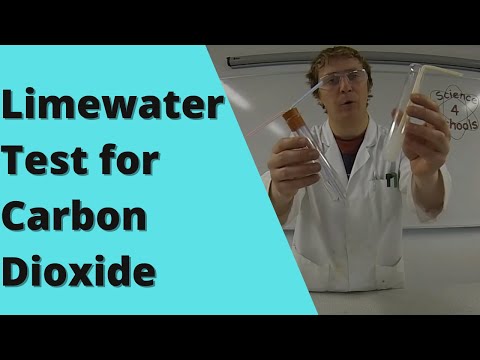
Science and Maths with Patrick Maye: "To Investigate the Carbon Dioxide Levels of Inhaled and Exhaled Air - Limewater Test". Watch which tube turns milky first, and check that the apparatus matches Figure 1.
Tip
Two numbers to remember: carbon dioxide goes up about 100 times (0.04% to 4%); oxygen goes down by about a quarter (21% to 16%). Nitrogen stays the same.
Practice: inhaled and exhaled air
Key points
Sources and credits
Figure 1, the experiment, Tables 1 and 2, the worked examples and the practice questions are written by Ganzaa.