Food and Nutrition
Senior 1 · English
Food and Nutrition
Lesson 4 of 5
25 min
Let's begin
Ask ten Rwandans to name their favourite dish and several will say isombe. In this lesson you read two texts about it: a recipe, which tells you how to cook it, and a student's description, which tells you why she loves it. The recipe uses imperatives and sequence words; the description uses the simple present and adjectives of taste. At the end you write about your own favourite meal.
Ingredients
- 1 kilo of fresh cassava leaves, or ready-ground leaves from the market
- 4 small aubergines (intoryi), chopped
- 2 onions and 1 green pepper, chopped
- 3 tablespoons of groundnut paste
- 2 tablespoons of palm oil or cooking oil
- salt and water
Method
- First, wash the cassava leaves well and remove the hard stems.
- Next, pound the leaves in a mortar until they are soft and fine.
- Then put the leaves in a large pot, cover them with water and boil them for about an hour. Stir them from time to time, and add a little water if the pot gets dry.
- After that, add the onions, the aubergines and the green pepper, and simmer for another thirty minutes.
- Mix the groundnut paste with a little warm water, stir it into the pot and cook for fifteen minutes more.
- Finally, add the oil and salt to taste, and stir well.
Serve hot with rice, ugali, sweet potatoes or boiled plantain.
Safety note: raw cassava leaves contain natural poisons. Pounding them and boiling them for a long time makes them safe, so don't shorten the cooking time.

My favourite meal is isombe with rice, and the best isombe in the world is my grandmother's. She lives in Nyanza, and every time we visit her, she cooks a huge pot of it on a charcoal stove behind the house.
Isombe is dark green and thick, almost like a soft paste. It smells of fresh leaves and roasted groundnuts. When you taste it, it is rich and a little salty, and the soft pieces of aubergine melt in your mouth. My grandmother adds a spoon of palm oil at the end, so the top shines red and gold.
I love isombe because it is healthy as well as delicious. The leaves and the aubergines are full of vitamins, and the groundnuts give it protein. But I also love it because of the time it takes: while the pot boils for more than an hour, my grandmother tells us stories about her childhood. For me, isombe tastes of family.
— Umutoni, S1 B
| Word | Meaning | Example sentence |
|---|---|---|
| ingredients | the foods you need to make a dish | Read the list of ingredients before you start. |
| pound | to hit something again and again to make it soft or into powder | Pound the leaves in a mortar. |
| mortar | a strong bowl in which food is pounded | Grandmother's mortar is made of wood. |
| chop | to cut into small pieces | Chop the onions finely. |
| boil | to cook in very hot, bubbling water | Boil the leaves for about an hour. |
| simmer | to cook gently, just below boiling | Simmer the stew for thirty minutes. |
| stir | to move a spoon round and round in food | Stir the pot from time to time. |
| to taste | in the amount you like | Add salt to taste. |
| delicious | tasting very good | Grandmother's isombe is delicious. |
| spicy, sour, bitter, salty | words for strong tastes: hot, like lemon, like strong coffee, full of salt | The pili pili sauce is very spicy. |
Definition
Imperative: the base form of a verb used to give an instruction, an order or advice. It usually has no subject: the "you" is understood. Wash the leaves. The negative is Don't + base verb: Don't shorten the cooking time.
Sequence words: words that show the order of steps: first, next, then, after that, finally.
| Form | Examples from the recipe | |
|---|---|---|
| Positive imperative | base verb + object | Wash the cassava leaves. Add the onions. |
| Negative imperative | Don't + base verb | Don't shorten the cooking time. |
| Two actions in one step | verb …, and verb … | Cover them with water and boil them. |
| How long | for + a length of time | boil them for about an hour |
| Until a result | until + a clause | pound them until they are soft |
| Only if needed | if + a clause | add water if the pot gets dry |
| Stage | Sequence words | Punctuation |
|---|---|---|
| The first step | First, To begin, | Put a comma after the word: First, wash… |
| The middle steps | Next, Then, After that, After ten minutes, | Then often has no comma: Then put… |
| The last step | Finally, Lastly, At the end, | Finally, add the oil. |
Worked example
Analyse step 5: Mix the groundnut paste with a little warm water, stir it into the pot and cook for fifteen minutes more.
Warning
Tip
Spelling -ed and -ing with short verbs: when a one-syllable verb ends in one vowel + one consonant, double the consonant: chop → chopped, chopping; stir → stirred, stirring; pour (two vowels) → poured. But boil → boiled, because oi is two vowels.
Pronunciation: pour rhymes with four, and the l in half and calm is silent.
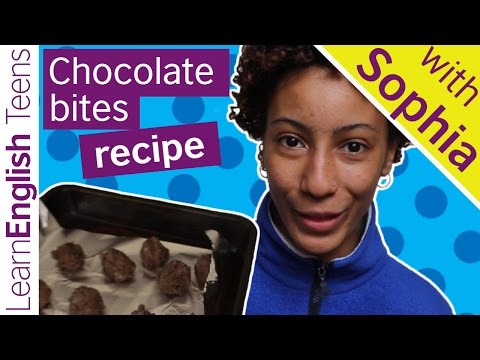
Chocolate bites recipe, British Council LearnEnglish Teens (2 minutes). Sophia makes a simple dessert. Count the imperatives she uses and note every sequence word.
Explain to a partner how to make a simple dish you know: tea with milk, a fruit salad, boiled eggs or chapati. Use at least five imperatives and four sequence words. Your partner mimes each step as you speak.
This is how to make African tea for four people. First, pour two cups of water and two cups of milk into a pan. Then add four teaspoons of tea leaves and a small piece of ginger. Next, bring it to the boil and stir it gently. After that, let it simmer for three minutes. Don't let it boil over! Finally, pour it through a strainer into the cups and add sugar to taste.
Write a description of your favourite meal (120–150 words). Use this plan and at least four taste or texture words.
| Paragraph | Content |
|---|---|
| 1 | Name the meal, who cooks it, where and when you eat it. |
| 2 | Describe it with your senses: how it looks, smells, tastes and feels in your mouth. |
| 3 | Say why you love it: health, memories, people. End with a strong sentence. |
My favourite meal is goat brochettes with grilled plantain. My uncle cooks them every New Year's Day in his yard in Rwamagana, and the whole family comes to eat together.
The brochettes are small pieces of goat meat on wooden sticks, grilled over hot charcoal. You can smell the smoke from the gate! The outside of the meat is brown and crispy, but the inside is soft and juicy. My uncle adds salt, onion and a little pili pili, so the first bite is salty and spicy at the same time. The plantain is sweet and soft, and it cools your tongue.
I love this meal because it means a holiday. Nobody is in a hurry, my cousins tell jokes, and my uncle always gives me the last stick. For me, brochettes taste of the new year.
Practice
Sources and credits