Food and Nutrition
Senior 1 · English
Food and Nutrition
Lesson 2 of 5
25 min
Let's begin
Five hundred students, five hundred plates and one hour: a school refectory at lunchtime is busy, and it is easy to take somebody else's cup. It is also a place where students with different eating needs share one table. Listen to this conversation and notice every word that shows who owns what: my, mine, his, Byiringiro's…
Listening: your teacher, or five classmates, read the conversation aloud while you listen with your book closed. Then answer questions 1 to 3 before you read it.
Mama Jeanne (the cook): Next! Plates up, please. Rice, beans and cabbage today, and there's groundnut sauce for anyone who wants it.
Keza: Thank you, Mama Jeanne. Mugisha, is this cup yours? It was on my tray.
Mugisha: No, mine is the green one. That blue cup is Byiringiro's. Look, his name is written on its handle.
Keza: Byiringiro! Here's your cup.
Byiringiro: Thanks, Keza. Mama Jeanne, please don't put any sauce on my plate. I'm allergic to groundnuts.
Mama Jeanne: I remember, my son. Your beans are in this small pot. I cooked them without groundnuts.
Mugisha: Where's Hassan? His plate is still on the shelf.
Keza: He's fasting. It's Ramadan, so he and the other Muslim students eat after sunset. Mama Jeanne keeps their food warm for them.
Mama Jeanne: That's right. Their dinner is in the kitchen. Hassan's portion is the big one. He's growing fast!
Mugisha: (laughing) Mine should be the big one! Can I have a second helping of rice?
Mama Jeanne: After everyone has eaten, dear. Keza, is that your sweater on the bench?
Keza: No, it isn't mine. Mine is in my locker. I think it's Uwera's: hers has a red stripe.
Byiringiro: Our table is free now. Let's sit down before the bell!
| Word | Meaning | Example sentence |
|---|---|---|
| supper | the evening meal | We have supper at seven o'clock. |
| portion | the amount of food served to one person | Hassan's portion is the big one. |
| second helping | another portion after you finish the first | Can I have a second helping of rice? |
| tray | a flat board for carrying plates and cups | Put your cup on your tray. |
| allergic (to) | becoming ill when you eat or touch a certain thing | Byiringiro is allergic to groundnuts. |
| fast | to eat no food for a time, often for religious reasons | Muslims fast from dawn to sunset during Ramadan. |
| vegetarian | a person who does not eat meat or fish | Uwera is a vegetarian, so she eats extra beans. |
| snack | a small amount of food eaten between meals | A banana is a healthy snack. |

Definition
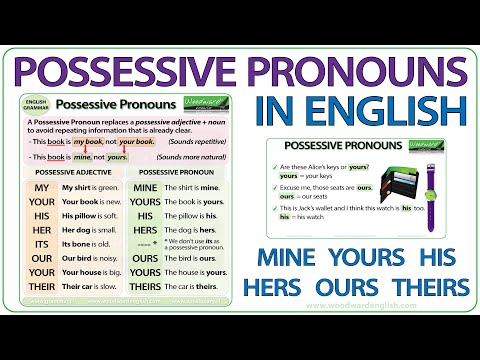
Possessive adjective: a word before a noun that shows who owns it: my, your, his, her, its, our, their. This is my cup.
Possessive pronoun: a word that stands alone, in place of a possessive adjective and its noun: mine, yours, his, hers, ours, theirs. This cup is mine (= my cup).
Possessive 's: an apostrophe and s added to a noun to show the owner. Byiringiro's cup, the cook's pot.
| Subject pronoun | Possessive adjective + noun | Possessive pronoun (no noun after it) |
|---|---|---|
| I | It's my cup. | It's mine. |
| you | Is this your plate? | Is this yours? |
| he | His plate is on the shelf. | The big portion is his. |
| she | Her sweater has a red stripe. | The sweater is hers. |
| it | The cup has a name on its handle. | (not used) |
| we | Our table is free. | The table by the window is ours. |
| they | Their dinner is in the kitchen. | The warm plates are theirs. |
| Owner | Rule | Example |
|---|---|---|
| One person or thing | add 's | Keza's tray, the cook's pot, Hassan's portion |
| A plural noun ending in -s | add only ' after the s | the students' plates (many students), the boys' dormitory |
| A plural noun not ending in -s | add 's | the children's food, the women's group |
Worked example
Analyse Keza's answer: No, it isn't mine. Mine is in my locker. I think it's Uwera's.
Warning
Tip
Spelling test for its and it's: read the sentence with it is. If it still makes sense, write it's; if not, write its. The cup has (it is?) name on its handle: no, so its.
Pronunciation: the possessive 's sounds like a plural -s: /z/ in Keza's, Uwera's, Hassan's; /s/ in the cook's; an extra syllable /ɪz/ in the nurse's, George's.
Possessive pronouns in English, Woodward English (10 minutes). The lesson starts from possessive adjectives and shows how mine, yours and theirs replace them; do the eight-sentence quiz at the end.
1. Lost property. In groups of four, each person puts one object (a pen, a ruler, a book) in a pile. One student picks up each object and asks. The others answer with possessive pronouns and 's.
2. Eating needs. Talk about the eating habits in your family or your religious community. Listen with respect and ask one polite question.
A: Whose ruler is this? Is it yours, Keza?
B: No, it isn't mine. Mine is shorter. I think it's Mugisha's.
C: Yes, it's mine, thanks. And this pen is Uwera's: her name is on its cap.
A: In my family we don't eat pork, because we are Adventists.
B: In ours, my father doesn't eat fish, but my brothers love sambaza. May I ask what you eat at Christmas?
A: Our big meal is chicken, rice and beans.
Write a paragraph (80–100 words) comparing meals at your home with meals at school. Use at least three possessive adjectives, two possessive pronouns and one possessive 's.
Meals at my home and at my school are quite different. At home, my mother cooks sweet potatoes, beans and dodo, and my father's favourite, isombe, every Sunday. Our kitchen is small, so we eat together in the sitting room. At school, the cooks prepare food for six hundred students, and their pots are as big as barrels! My friend Uwera is a vegetarian, so the cooks give her extra beans instead of meat. Her plate always looks greener than mine. I like both, but I think the best meals are ours at home.
Practice
Sources and credits
This lesson adapts CC BY-SA material and is shared under CC BY-SA 4.0.