Medieval and Modern Societies
Senior 4 · History
Medieval and Modern Societies
Lesson 1 of 4
25 min
Between 1412 and 1416 the Limbourg brothers, Paul, Johan and Herman, painted a prayer book for John, Duke of Berry, brother of King Charles V of France. It is called the Très Riches Heures ("very rich hours"), and each month has a painted calendar page. Study the page for October before you read on.

Read it as a historian. Three groups appear, and each matches a part of medieval society:
Ask also who made it and for whom. A duke paid for one of the most expensive books of his age. The peasants are painted for him, not by them: we see them as a nobleman wished to see them, tidy and hard-working. A source can be beautiful and still one-sided.
Definition
Middle Ages (medieval period): in European history, roughly the 5th to the late 15th century, between classical antiquity and the modern period. Historians divide it into the Early (c. 5th to 10th centuries), High (from about 1000) and Late Middle Ages.
Feudalism: the system of mutual obligations among the warrior nobility, in which a lord granted land, called a fief, to a vassal in return for loyalty and military service. Manorialism: the organisation of peasants into villages (manors) that owed rent and labour services to their lord.
Serf: a peasant bound to the lord's land, who owed labour on the lord's fields. Unlike an enslaved person, a serf could not be bought or sold individually. Tithe: one tenth of produce or income paid to the Church.
| Aspect | Main features |
|---|---|
| Political | Kings depended on great lords, who held land and commanded their own knights. From the 9th to the 15th centuries power was spread among many lords rather than held by one central government. Charlemagne, crowned emperor in 800, briefly united much of Western and Central Europe, but his empire broke up under civil wars and invasions. |
| Economic | Farming on manors was the base of everything. Serfs worked the lord's fields as well as their own plots, and also maintained roads and worked in his forests. Payment was first in labour or produce, later in cash as trade grew. |
| Social | Thinkers of the 11th and 12th centuries described three orders: those who pray (clergy), those who fight (nobles and knights) and those who labour (everyone else). Birth decided a person's place. |
| Religious and cultural | The Church collected tithes, ran monasteries and schools, and launched the Crusades (1095 to 1291) to win the Holy Land from Muslim rulers. Universities appeared: teaching at Bologna began around 1088. |
| Towns | After 1000, better farming and a warmer climate raised Europe's population; trade revived, towns grew, and craftsmen and merchants organised themselves in guilds, which controlled prices, hours and the number of apprentices. |
The plague pandemic called the Black Death killed around 30% to 60% of Europe's population, up to 50 million people. With so many workers dead, land was plentiful and labour scarce. In England the Statute of Labourers (1351) tried to hold wages at their 1346 level, but wages rose and serfdom had all but disappeared from western Europe within a few generations. In Eastern Europe, by contrast, lords tied the surviving peasants more tightly to the land. The same shock had opposite results in different places: a warning against simple generalisations.
The word "medieval" was invented for Europe, but other societies flourished in the same centuries. In the highlands of Ethiopia, King Gebre Meskel Lalibela of the Zagwe dynasty (ruled c. 1181 to 1221) is traditionally credited with eleven churches cut downwards into the solid rock. Most are thought to date from the 12th and 13th centuries. Their layout and names are widely held to represent Jerusalem, and some experts link the work to the year 1187, when Saladin captured Jerusalem and Christian pilgrimage there became harder. The churches became a UNESCO World Heritage Site in 1978, and Lalibela is still a centre of pilgrimage.
Lalibela shows two things. Like medieval Europe, medieval Ethiopia was a society in which kings and the Church worked together and religion shaped art, law and daily life. And Africa had its own great builders and Christian kingdoms in the very centuries when Europe built its cathedrals.

Warning
Two traps. First, the "feudal pyramid" is a teaching model, not a law that every kingdom followed; since the 1970s historians have argued over whether "feudalism" is a useful word at all, so write "historians use the term feudalism to describe…". Second, do not call the whole period "the Dark Ages" without qualification: it produced universities, cathedrals, Magna Carta and, outside Europe, Lalibela and the empires of West Africa (Unit 3).
Tip
Remember the medieval order with "Land for Loyalty, Labour for Living": lords gave land for loyalty and service; peasants gave labour in return for a plot to live on and the lord's protection. Then add the Church, which took its tenth from all.
Important
Discuss. In pre-colonial Rwanda (S1, Unit 5) there were ties of dependence such as ubuhake, in which a client received the use of cattle from a patron in return for services. Some writers have called this "feudal". Using the definitions above, how is it similar to European feudalism and how is it different? Is it helpful or misleading to use a European word for a Rwandan institution?
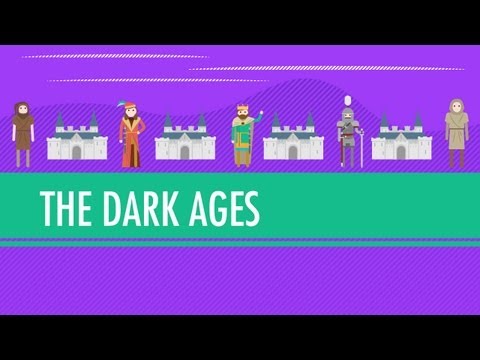
CrashCourse, "The Dark Ages...How Dark Were They, Really?: Crash Course World History #14". John Green questions the label "Dark Ages". Watch for what was happening in the Islamic world and the Eastern Roman Empire while western Europe was divided, and note one reason the label is unfair.
Practice
Key points
Sources and credits
Written by Ganzaa: the source analysis, the feudal pyramid diagram, the table, the case study and the exercises. This lesson adapts CC BY-SA material and is shared under CC BY-SA 4.0.
Quick check
Match each medieval term to its meaning.
Tap one on the left, then its partner on the right.