Numbers 1 to 5
Primary 1 · Mathematics
Numbers 1 to 5
Lesson 8 of 8
12 min
Let's begin
Habimana holds 5 groundnuts in his hand at break. His friend has none.
So Habimana gives 2 groundnuts away. He looks at his hand again.
Today you will take some away.
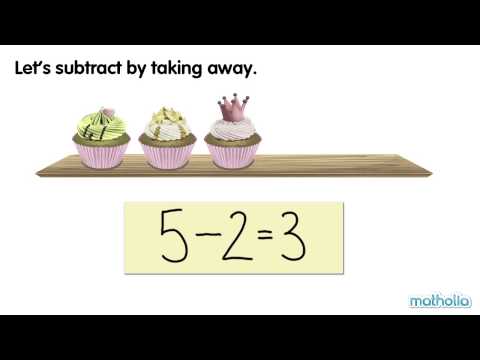
The - sign says: take some away. We also say subtract.
Worked example
5 - 2.
Step 1 Put 5 beans on the mat.
Step 2 Take 2 beans off the mat.
Step 3 Count what is left: one, two, three.
5 − 2 = 3
It is read: five take away two is the same as three.
So Habimana has 3 groundnuts left.
You can also jump back. Start on 5. Do not say 5.
Jump back two times: 4, 3. You land on 3.
Careful! Many children answer 4 here. They said 5 as their first jump.
Hold the start number in your head. Then jump.
Say it like this: the whole is 5. One part is 2. What is the other part?
Put out 5 beans. Cover 2 of them with your hand.
Count the beans you can still see: one, two, three.
The other part is 3. And 2 + 3 = 5, so it is right.
Careful! Do not add the two numbers you can see. 7 is bigger than the whole. That cannot be.
Mutesi had 4 eggs. She used 1 egg for supper.
4 − 1 = 3
Now put the 1 egg back with the 3 eggs.
3 + 1 = 4
You are back where you began. So your answer is right.
Tip
Whole, part, other part
Say it before you work: “The whole is 5. One part is 2.”
Cover one part with your hand. Count what your hand did not hide.
Take some away and count what is left
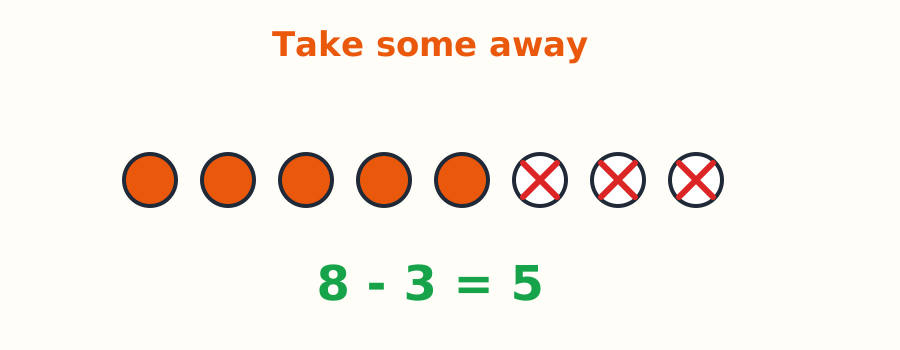
Take real beans off a mat. Then tap Show answer to check.
4 - 2 = ?
Answer: 2. Take 2 beans off 4 beans. Count what is left: 2.
5 - 3 = ?
Answer: 2. Take 3 beans off 5 beans. Only 2 are left.
3 - 2 = ?
Answer: 1. Start on 3. Jump back two times: 2, 1.
Mutesi has 5 maize cobs. She cooks 4 of them. How many cobs are left?
Answer: 1 cob. 5 − 4 = 1.
The whole is 4. One part is 1. What is the other part?
Answer: 3. Cover 1 bean of the 4. You can see 3.
What you learned today
Here are two counting books in Kinyarwanda. Read them at home with someone.
Ni zingahe? asks you to count the animals' things, one group at a time. It is the easiest level, from the Global Digital Library, free to read.
Injangwe za Sano counts Sano's cats: one cat, then two more, then three more. At the end the book asks you how many. It is from African Storybook, free to read.
Quick check