
Loading article…

89 free picture books in Kinyarwanda, English, French, Kiswahili and Kirundi: what's on the shelf, the licences, how to pick a level and read together.
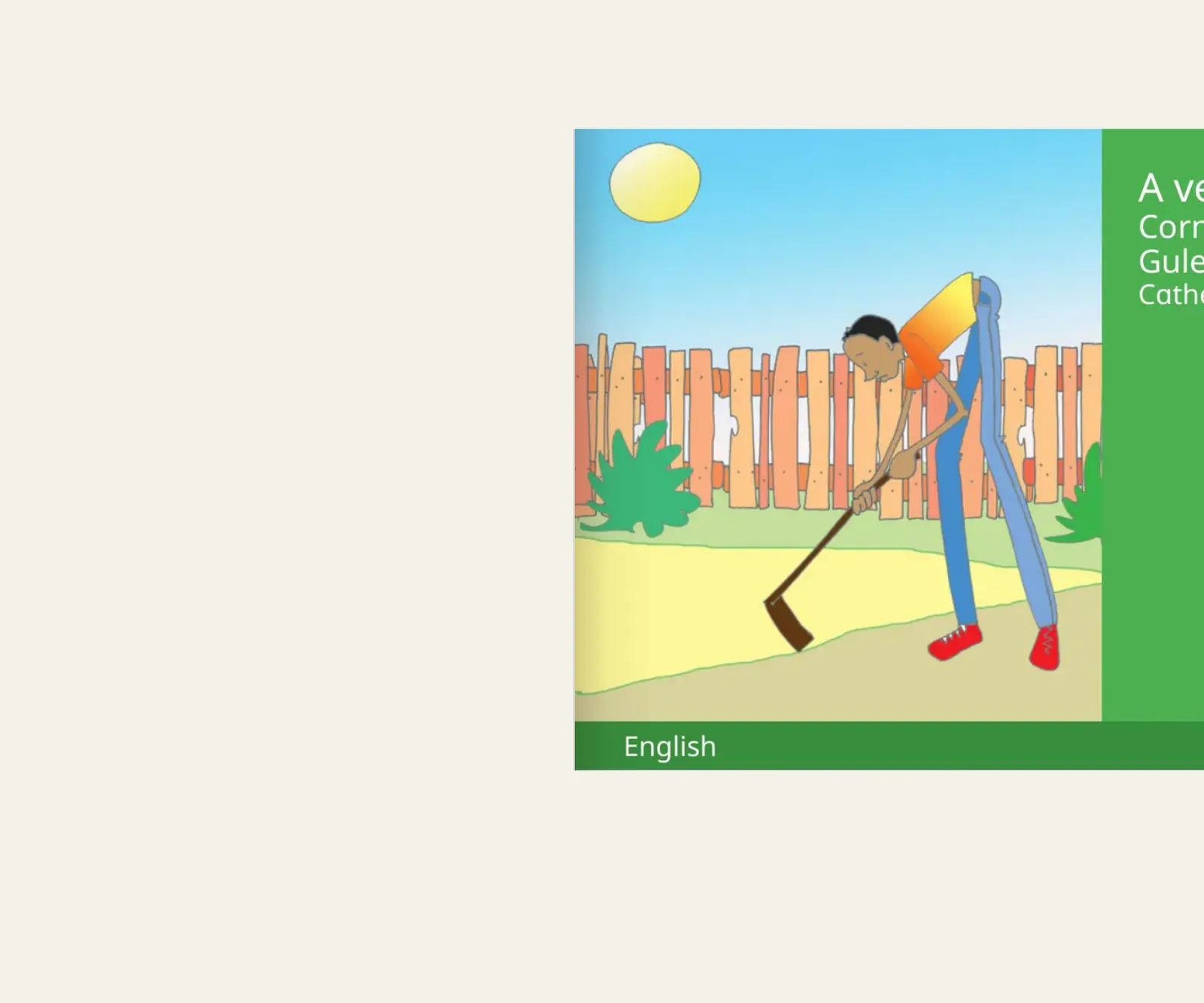
"His hoe was too short. His doorway was too low. His bed was too short. His bicycle was too short. This man was too tall!"
Those are the first five pages of A very tall man, a picture book by Cornelius Wambi Gulere with pictures by Catherine Groenewald. It has 11 short pages, with one or two sentences on each. The man solves his problems one by one: a longer hoe handle, higher door frames, a longer bed. The same book is on the shelf in Kinyarwanda as Umugabo muremure cyane, translated by Jean Paul Harelimana. It opens "Isuka ye yari ngufi cyane."
Both are free to read on Ganzaa, with no account. Here is what else is on the shelf, what the licences let you do, how to pick a level, and how to read so that your child does some of the talking.
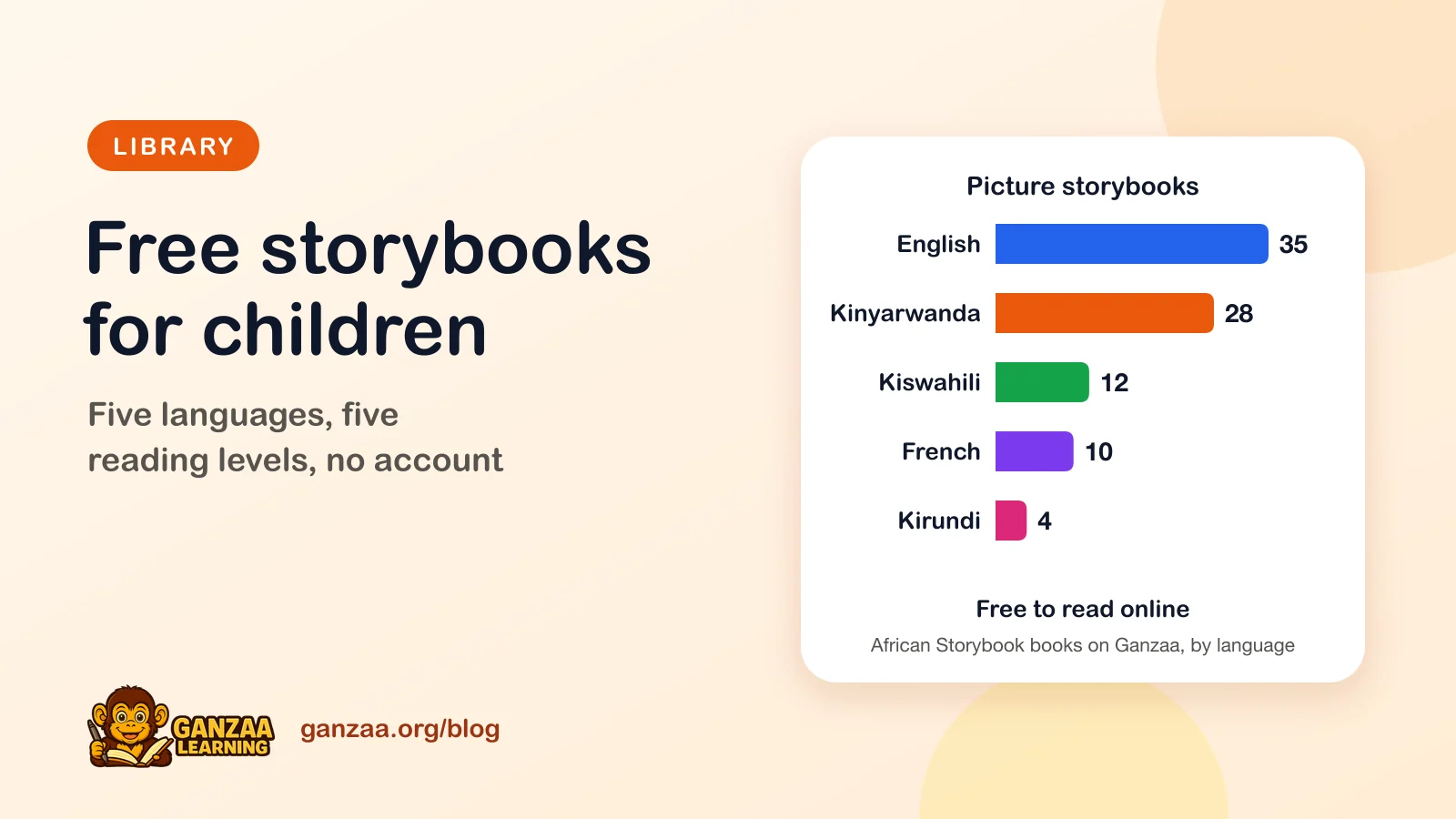
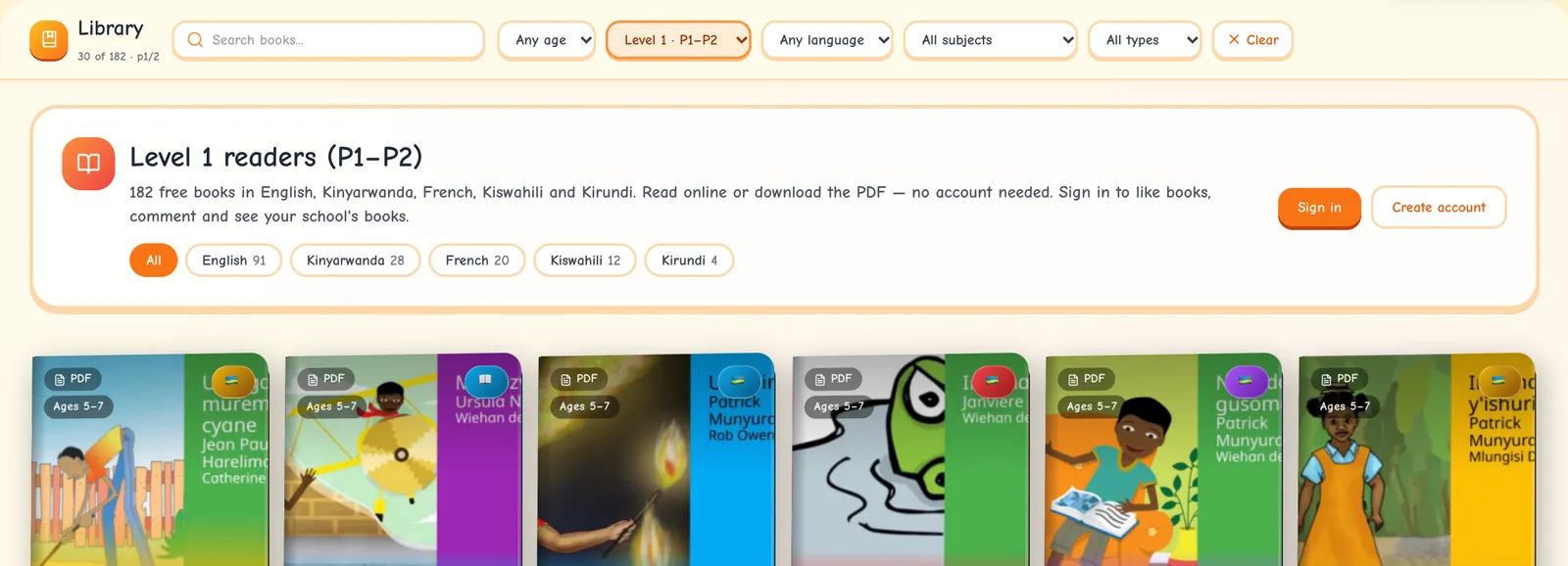
On 5 November 2026 the Ganzaa library held 182 books. 89 are picture storybooks from African Storybook, the subject of this post. The other 93 are mostly classics, from Grimms' Fairy Tales to Jane Eyre.
The 89 storybooks come in five languages and five reading levels:
| Language | Storybooks | Level 1 | Level 2 | Level 3 | Level 4 | Level 5 |
|---|---|---|---|---|---|---|
| English | 35 | 20 | 4 | 3 | 5 | 3 |
| Kinyarwanda | 28 | 7 | 7 | 8 | 4 | 2 |
| Kiswahili | 12 | 1 | 0 | 6 | 3 | 2 |
| French | 10 | 2 | 2 | 2 | 2 | 2 |
| Kirundi | 4 | 0 | 2 | 1 | 1 | 0 |
| All | 89 | 30 | 15 | 20 | 15 | 9 |
On mobile data, size matters. A very tall man is a 3.4 MB PDF, but its 13 page pictures in the online reader add up to about 0.3 MB, plus the website itself. Half of the 89 storybook PDFs are under 2 MB; the largest is about 10 MB.
Reading and downloading need no account. You only need to sign in to like a book, write a comment, or see your own school's books if your school uses Ganzaa.
African Storybook was launched in 2014 by Saide, a non-profit organisation based in Johannesburg. Its aim is "open access to picture storybooks in the languages of Africa", and Rwanda is among the countries it extended to after its first pilots. On 5 November 2026 its home page listed 5,517 storybooks in 262 languages.
Its terms of use say the stories are openly licensed: "you can read, download, print, copy, adapt and translate the stories without asking for permission, and without paying a fee." In return, you must credit the writers, illustrators, translators and copyright holders, and name African Storybook as the source. Almost every storybook on Ganzaa's shelf says CC BY 4.0 on its last page, a licence that allows sharing and adapting "for any purpose, even commercially", with credit.
Not every title is that open. The same terms explain that some contributors "ask for a non-commercial restriction", which means you agree not to make a profit from selling the stories. So follow the licence printed on the book's own last page. Every storybook PDF on Ganzaa keeps that page, with the credits, level and licence, and each book's Ganzaa page links to the original. So a teacher can print a class set or translate a story for pupils, as long as the credits go with it: keep the last page.
Every storybook carries one of African Storybook's five levels, and Ganzaa adds a rough class band and age range. The middle column is from African Storybook's guide for writers and translators.
| Level | What a page holds | Ganzaa's rough guide |
|---|---|---|
| 1, First words | Single words or a short simple sentence; up to 11 words | P1–P2, ages 5–7 |
| 2, First sentences | Two or three short sentences; 11–25 words | P1–P3, ages 6–8 |
| 3, First paragraphs | One or two short paragraphs; 26–51 words | P3–P4, ages 8–10 |
| 4, Longer paragraphs | Two or more paragraphs; 51–75 words | P4–P5, ages 9–11 |
| 5, Read aloud | Fewer pictures; more than 75 words | P5–P6, ages 10–12 |
Treat the class band as a starting point, not a rule. The guide says: "These levels are not linked to specific grades in school. It really depends on the child's reading ability in the language of the storybook." It adds that a child who reads two languages "may be at different reading levels for each one", and that the higher levels "can also be used with young children as read aloud storybooks".
My rule of thumb: ask your child to read one page aloud. If they get stuck on more than one or two words, that level is for reading together, and the level below is for reading on their own.
Which language to start with is a bigger question, covered in our post on studying in Kinyarwanda. For storybooks, the two English and Kinyarwanda pairs above make an easy start: read the story in one language, then again in the other.
One well-studied way to read picture books with young children is dialogic reading. The US Department of Education's What Works Clearinghouse describes it as shared reading in which "the adult and the child switch roles so that the child learns to become the storyteller", while the adult listens and asks questions. Its review of five studies, with over 300 preschool children, found "positive effects on oral language".
That evidence covers preschool children, reading in English. A 2008 meta-analysis of 16 studies found a moderate extra gain in expressive vocabulary over ordinary shared reading, but "the effect size reduced substantially when children were older (4 to 5 years old)". Ganzaa bands these storybooks for ages 5 to 12. In my view the habits are still worth using with a P2 or P4 child, because they keep the child talking about the story, but that is my judgement, not a research finding.
The WWC report lists five kinds of prompt, known as CROWD, shown here with A very tall man:
The prompts follow a pattern called PEER: prompt the child, evaluate the answer, expand it, then repeat the prompt. Your child says "Bed." You say "Yes, his bed was too short. What was too short?" As a child gets to know a book, the report says, "the adult reads less, listens more", so read the same book more than once.
Some books do part of the work. Colours asks a question on every other page, starting with "Why is the sky blue?", so let your child answer before you turn. Its last question, "Why is salt white?", gets the answer "I don't know!" That is a good place to stop and wonder together.
For a class, African Storybook's guide to using its books with children describes "the method most of our African Storybook teachers used". In short: talk about the cover and the title, ask what the story might be about, introduce new words, read it aloud, ask simple questions and let the children ask theirs, then retell it together and invite a child to retell it.
Open the Ganzaa library: 89 free picture storybooks in five languages, to read online or download, with no account.
Ganzaa is Rwanda's online learning platform — free for individual students, with REB-aligned practice and past papers. Schools get the first term free.
15 free games: what each one practises, the class it suits, which need no account, how to play a friend live, and how to make a round count.
Host a free live quiz on Ganzaa: students join on any phone with a PIN, points run from 500 to 1,000, and research shows why quizzing helps memory.