
Loading article…

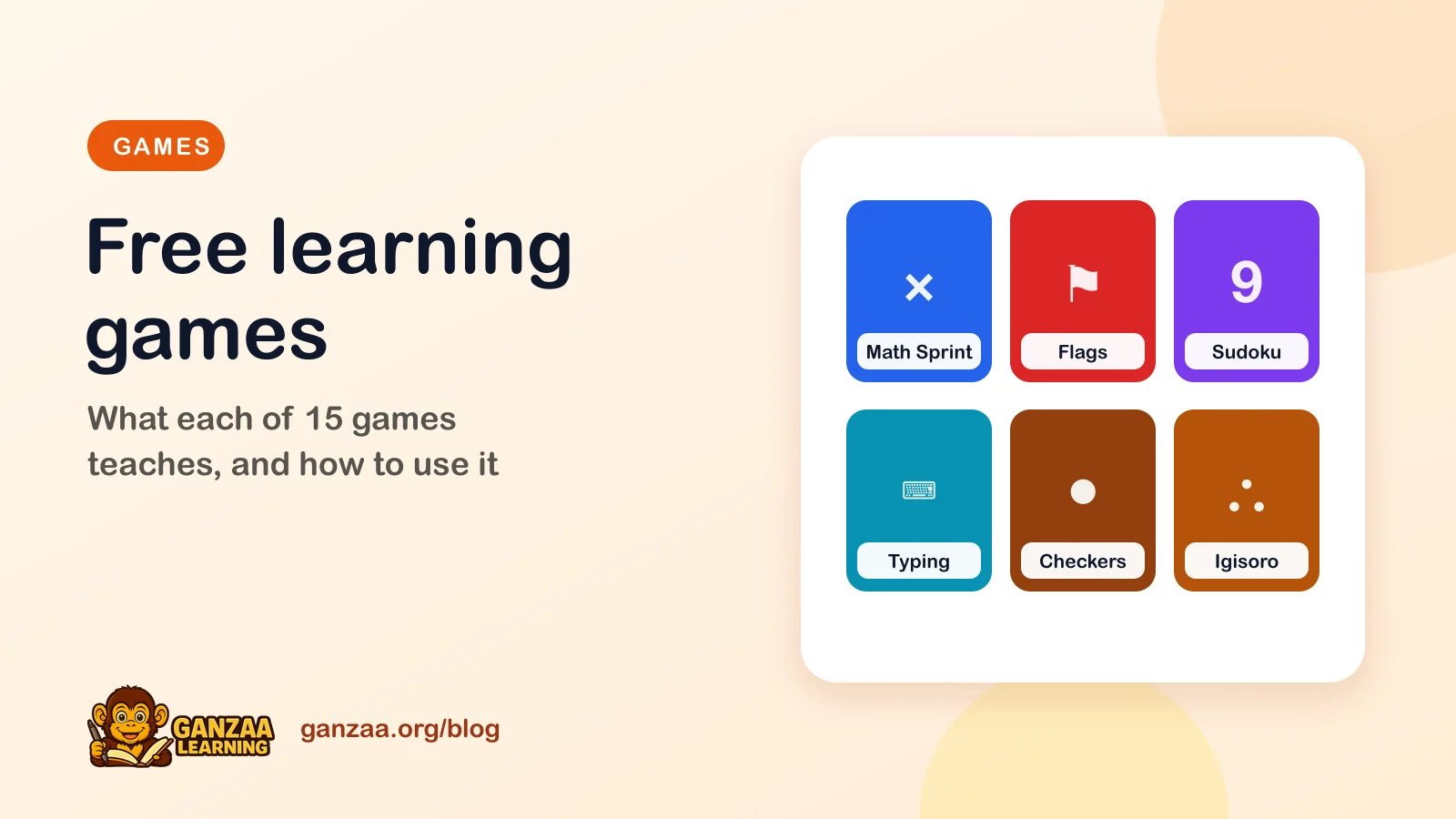
15 free games: what each one practises, the class it suits, which need no account, how to play a friend live, and how to make a round count.
Open Math Sprint, choose the S1+ level, and you may get this question: 3 + 4 × 5. There are four buttons: 23, 35, 12 and 17.
The three wrong answers are not random. 35 is what you get by working left to right (3 + 4 = 7, then 7 × 5). 12 adds all three numbers. 17 multiplies the wrong pair (3 × 4 + 5). The left-to-right answer is built into every order-of-operations question at this level, so a student who hasn't learnt "multiply before you add" meets their own mistake on the screen.
Tap 35 and the game says "The answer is 23", then shows the method: "Multiply first: 4 × 5 = 20, then add 3 → 23. (BODMAS)". The round clock stops while the explanation is up, and the game waits until you tap Next question. Reading why you were wrong costs you no points.
That is the idea behind the quiz games on Ganzaa's games page: a wrong answer should teach you something. Below is every game in the hub, which ones need an account, how to play a friend live, and how to make a few rounds count.
The hub lists 15 free games that run in the browser on a phone, tablet or computer. The class labels are the hub's own: a starting point, not a rule.
| Game | What you practise | Levels | Class |
|---|---|---|---|
| Math Sprint | Mental maths: adding and taking away, times tables and division, percentages and squares, order of operations | 4: P1–P3, P4–P5, P6, S1+ | P1–S2 |
| Colour Match | Colour names in English, reading colour words, mixing two colours | 3: First colours, Mixing, Every shade | P1–P3 |
| Picture Words | English words from real photos, spoken aloud when you get one right | 23 topics, 462 words | P1+ |
| Ikinyarwanda | Everyday Kinyarwanda words beside the English: flashcards, then a round | 10 topics, 105 words | P1+ |
| Melody Memory | Listening and memory: play back a tune that grows by one note each round | 3: Warm up, Melody, Maestro | P1+ |
| Flag Sprint | 59 national flags, with a fact about the country after every answer | 3: Africa, World, Expert | P3+ |
| Capital Quest | Capital cities of 38 countries, Africa first | 3: Africa, World, Expert | P4+ |
| Geo Quest | Finding Africa's countries and Rwanda's 30 districts on a map | 2 maps, 3 levels each | P4+ |
| Science Lab | Forces, energy, light, matter, space and the human body | 3: Starter, Explorer, Physicist | P4+ |
| Time Traveller | History of Rwanda, Africa and the world | 3: Rwanda, Africa, World | P4+ |
| TypeRush | Typing speed and accuracy in 60-second rounds | 5 stages, from home-row words to code | P4+ |
| Sudoku | Logical reasoning, with no arithmetic | 5: from 50 clues down to 26 | P5+ |
| Coding Quiz | JavaScript, React, PHP and SQL. One wrong answer ends the run | 3: Easy, Medium, Hard | S1+ |
| Checkers | Planning ahead | 6 levels in each of 3 rule sets | P3+ |
| Igisoro | Counting and planning ahead | 5 levels against the computer | P1+ |
Some levels have their own page to bookmark: the times tables game, the order of operations game, sudoku for beginners and the Rwanda districts map.
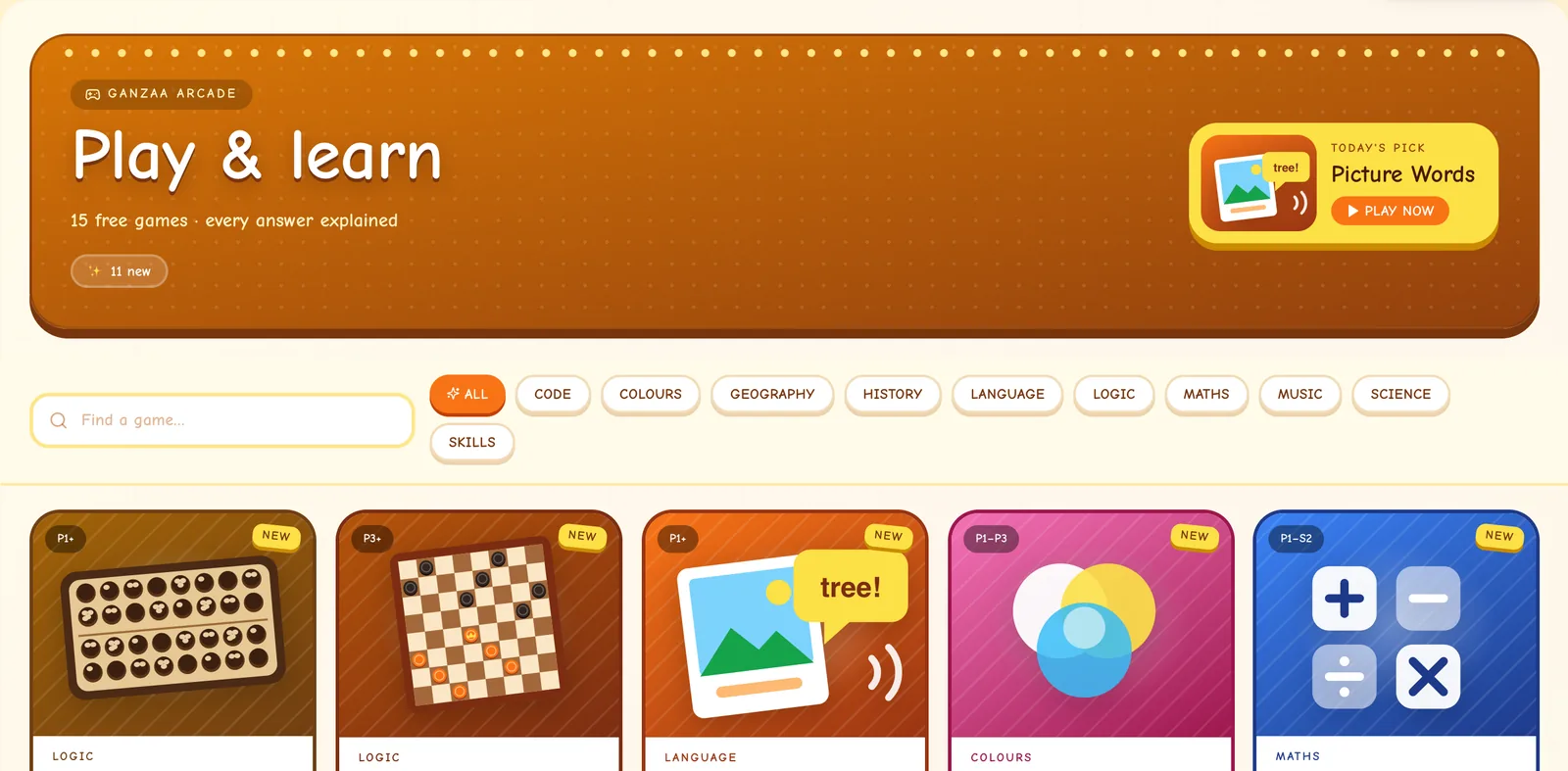
You can play 14 of the 15 without signing in. A guest's score can still go on the leaderboard: some games save it under a made-up name such as "Witty Wolf" until you type your own, and others ask for a name when the round ends. A free account keeps your scores together.
The exceptions are the ways of playing against other people:
Parents: leaderboards are public. My advice is to use a first name or a nickname there, never a full name.
Checkers, Igisoro and the quiz games can all be played live, each player on their own phone or computer.
Or tap Find a player to be paired with someone else who is looking for a game. In Checkers, that is someone who chose the same rules. If nobody is looking, the search gives up after 2 minutes. Once a game starts, each player has 3 minutes for each move. With a friend you invited, you can type messages to each other. With a player you don't know, you can only send ready-made ones such as "Good luck!" and "Good game!".
Seven quiz games have a Duel a friend box on their page: Math Sprint, Colour Match, Flag Sprint, Capital Quest, Science Lab, Time Traveller and every Picture Words topic. Choose a level, then Find a player, Invite a friend, or type a friend's code. You both get the same 10 questions, with 15 seconds for each. A right answer scores 100 points plus up to 100 more for speed. It is a race, so nobody waits for the other between questions.
Rwanda's Ministry of Local Government calls igisoro "Rwanda's traditional board game". Ganzaa's version has four rows of eight pits, and each player starts with 32 seeds. You sow seeds round your own two rows and capture from the pits that face yours, so every move starts with counting: where will the last seed land? You can play the computer at five levels, from Beginner to Master, or a friend on the same screen, with no account. The full rules, and the version Ganzaa plays, are on the Igisoro page.
Is a game a good use of study time? One large piece of evidence is a 2016 meta-analysis by Clark, Tanner-Smith and Killingsworth in the Review of Educational Research. It pooled studies of digital games and learning for students from kindergarten to university (K–16). Three findings matter here.
My advice, with that in mind:
Teachers: Math Sprint makes new questions every round, so a whole class can play at once without everyone getting the same sums. Given the finding on teacher support, I would start with one question on the board: ask the class why 35 is a tempting answer to 3 + 4 × 5, then let them play.
Open the games page and pick one game for your class. For maths, start Math Sprint at your level. For geography, try the Rwanda districts map. Play one round today, read every explanation, and play again tomorrow.
Ganzaa is Rwanda's online learning platform — free for individual students, with REB-aligned practice and past papers. Schools get the first term free.
Host a free live quiz on Ganzaa: students join on any phone with a PIN, points run from 500 to 1,000, and research shows why quizzing helps memory.
Igisoro rules as Ganzaa plays them, a first move and a capture counted seed by seed, and how to play the computer or a friend online with a code.