
Loading article…

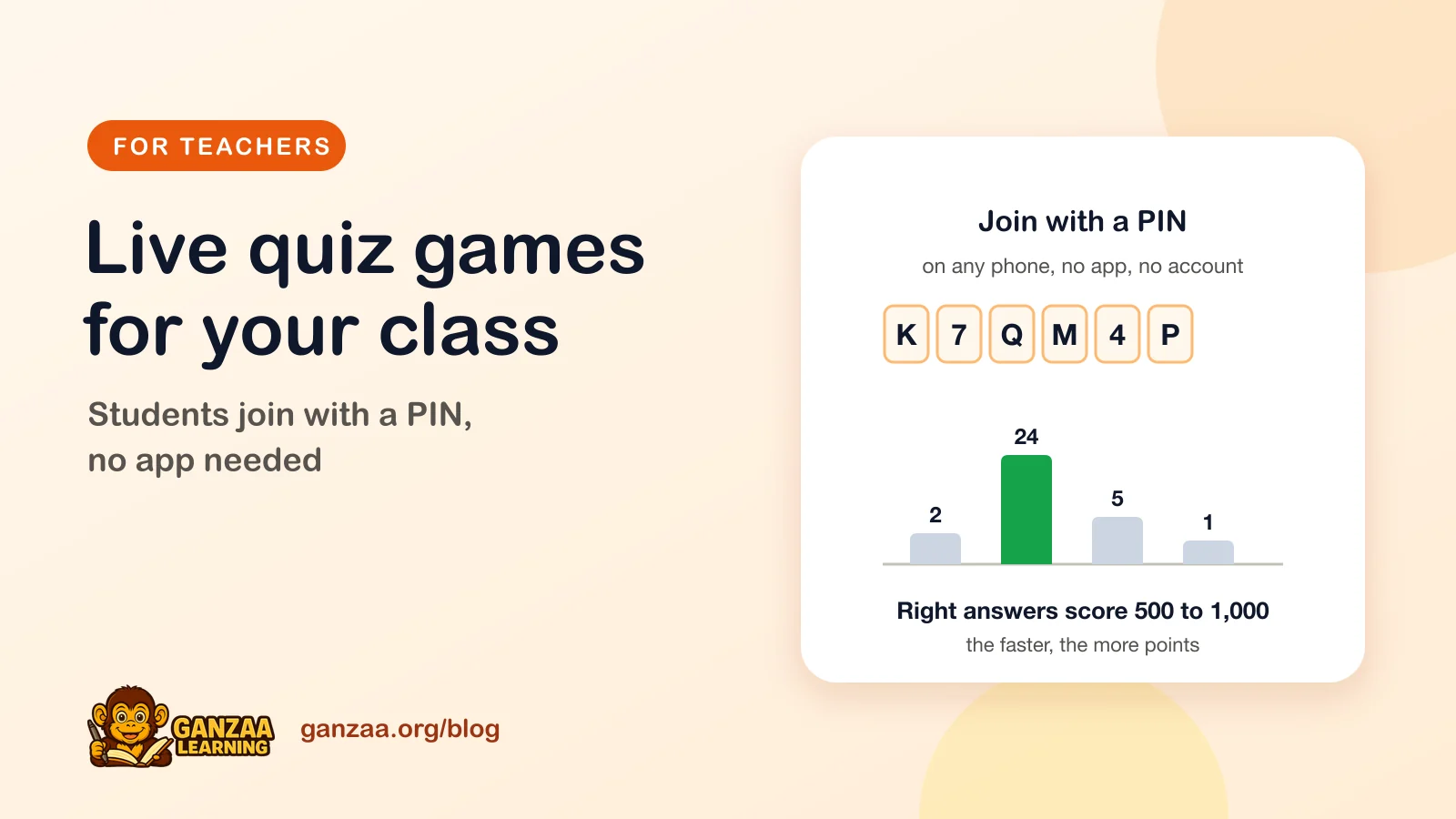
Host a free live quiz on Ganzaa: students join on any phone with a PIN, points run from 500 to 1,000, and research shows why quizzing helps memory.
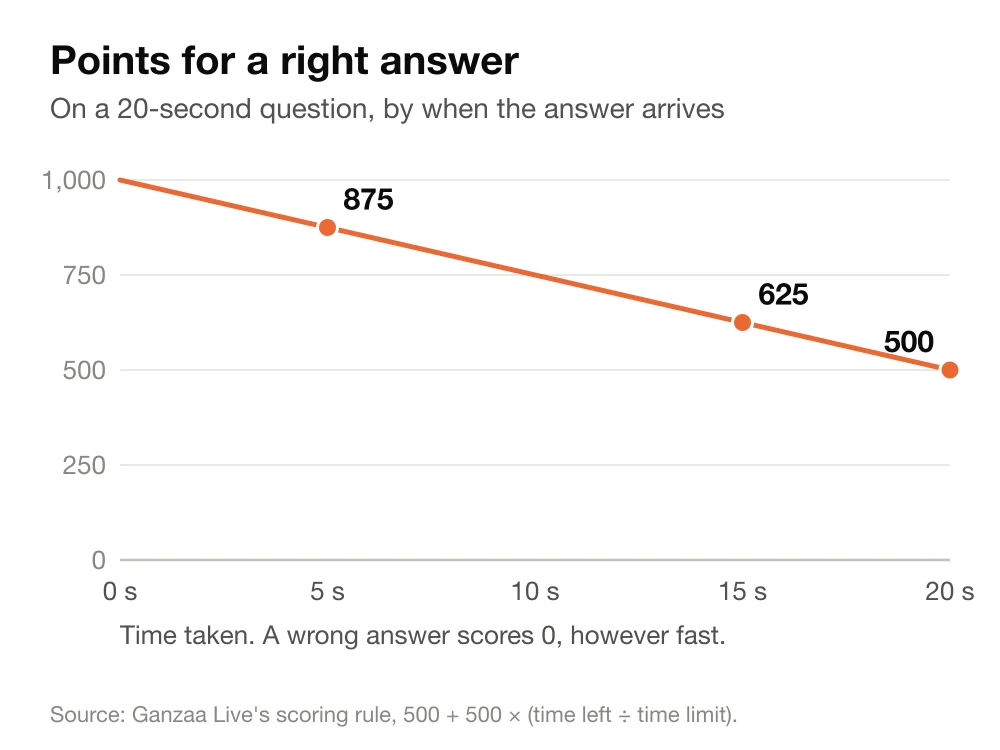
In a live quiz game on Ganzaa, a correct answer is worth between 500 and 1,000 points, by one rule: 500 + 500 × (time left ÷ time limit). On a 20-second question, a student who answers correctly after 5 seconds scores 875. One who answers correctly after 15 seconds scores 625. A correct answer as the clock reaches zero still earns 500. A wrong answer scores 0, however fast it was.
So speed earns a bonus, but being right always counts for more: the slowest correct answer beats the fastest wrong one by 500 points. Here is how to run a game, and what classroom research says about why quizzing helps.
Typed answers are marked leniently: capital letters, extra spaces and a full stop at the end don't matter. If an answer can be written two ways, add both with Add accepted answer.
If your account is a teacher's or a school admin's, you also see a From a lesson tab. Choose the grade, subject, unit and lesson, and the game is built from up to 30 of that lesson's practice questions. A lesson with none can't be hosted. You can check and change the questions in Edit Questions until you press Start Game.
PINs never use 0, O, 1, I or L, so nobody confuses a zero with the letter O. Two players in one game can't share a name, even with different capital letters. A latecomer can still join after you start, until the game ends. Each phone also shows the question, so students at the back can read it.
When a question closes, your screen shows how many got it right out of how many answered, and a bar chart with one bar per answer. The bars match the colours and shapes of the answer tiles, and the right answer is ringed in gold. A typed question gets two bars, right and wrong, with the right answer below.
Each student gets one answer per question, locked in once they tap. After the reveal, their phone shows Correct! with their points, Not quite, or Too slow!, then their total and rank. Press Show Scoreboard for the top five, then Next Question. After the last question, Winners! puts the top three on a podium.
A game ends on its own 30 minutes after you press Start Game. A room that is never started closes after an hour. The bottom-left corner of your screen shows when, and turns amber for the last five minutes. You can also stop at any time with End.
Thirty questions at 20 seconds each can take 10 minutes of answering, before any reveals, scoreboards or discussion. My advice: 10 to 15 questions fit comfortably, with time to talk about the hard ones.
The History tab on ganzaa.org/live lists your last 50 games with the date, the number of questions and the number of players. Open one to see each player's rank, name, correct answers and points. Players without an account are marked guest. Only you, the host, can open the results. Press Play again to run the same questions with a new PIN, after editing them if you like.
Answering a question makes students pull the answer from memory, which psychologists call retrieval practice or the testing effect. In a 2006 study by Henry Roediger and Jeffrey Karpicke, university students learned prose passages. A week later, students who had studied a passage once and then taken three recall tests remembered 61% of it. Students who had studied it four times remembered 40%. Yet, the authors write, "repeated studying increased students' confidence in their ability to remember the material."
That was a laboratory. Agarwal, Bain and Chamberlain (2012) review a 5-year project at a middle school in Illinois, USA, with nine teachers and more than 1,400 students in grades 6 to 8. The quizzes ran on a clicker response system. In sixth-grade social studies, students took three short, low-stakes quizzes with feedback. At the end of the semester they scored 79% on material they had been quizzed on, against 67% on material they had not.
Two findings matter for a live game:
One phone is one player. If there isn't a phone for every student, my advice is to put students in pairs or small groups around one phone, each group with a team name. In my view, that helps: to agree before the timer runs out, a group has to talk through its thinking. If a student closes the page by mistake, opening the same link on the same phone brings them back as the same player, with their points.
Phones keep retrying when the signal drops, with a "Slow connection" notice while they wait. An answer that fails to send is sent again while the question is open, and only the first one counts.
But the clock is on the server. Speed is measured from when the question opens to when the answer arrives, so a slow network costs points. On a 20-second question, a 2-second delay costs about 50 points; on a 40-second question, about 25. An answer that arrives more than a second after time is up isn't counted. If your signal is weak, my advice is:
My advice: build each multiple-choice question around a mistake you have seen students make, then use the bar chart to talk about it. If many students chose the same wrong answer, ask one of them why it looked right. Keep it low-stakes, too. Points reward speed as well as knowledge, so I wouldn't turn them into marks. The correct-answer counts in History are a fairer guide to who needs help.
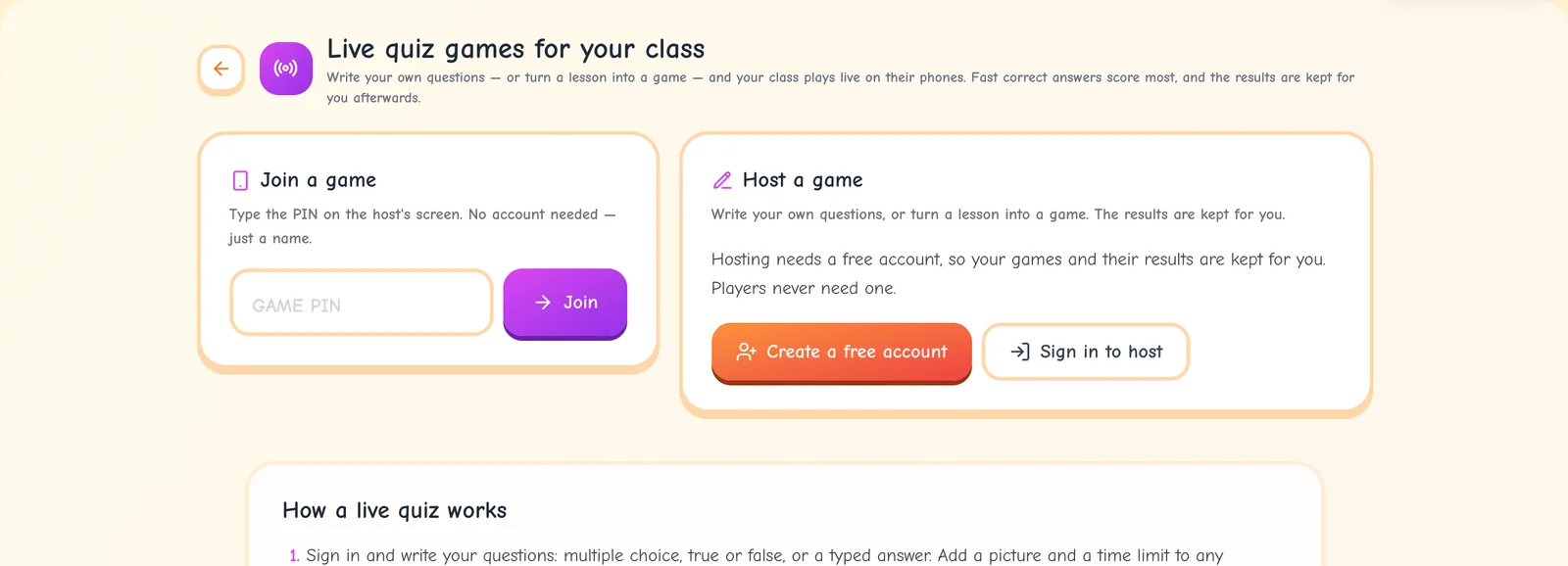
Open ganzaa.org/live, sign in or create a free account, and write five questions on what your class learned this week. Play it tomorrow, then press Play again a few days later. For every button, see the help pages on hosting a live quiz, writing questions, joining a game and seeing results.
Ganzaa is Rwanda's online learning platform — free for individual students, with REB-aligned practice and past papers. Schools get the first term free.
15 free games: what each one practises, the class it suits, which need no account, how to play a friend live, and how to make a round count.
Igisoro rules as Ganzaa plays them, a first move and a capture counted seed by seed, and how to play the computer or a friend online with a code.