

Loading article…
GamesNovember 4, 20267 min read
How to Play Igisoro Online: Rwanda's Board Game, Step by Step
Igisoro rules as Ganzaa plays them, a first move and a capture counted seed by seed, and how to play the computer or a friend online with a code.
Eric Tuyishimire
Ganzaa Editorial
You pick up 2 seeds. The first drops into an empty pit. The second lands in a pit of your inner row that already holds 3. Straight across the board, your opponent has 3 seeds in the facing pit and 2 in the pit behind it. You take all 5 and sow them round your own side. That is a capture in Igisoro, and you only see it coming if you count first.
Below are the rules exactly as Ganzaa's free Igisoro game plays them, two moves counted seed by seed, and how to play the computer or a friend. Ganzaa's rules are one common set; accounts differ, as shown near the end.
The board, in words
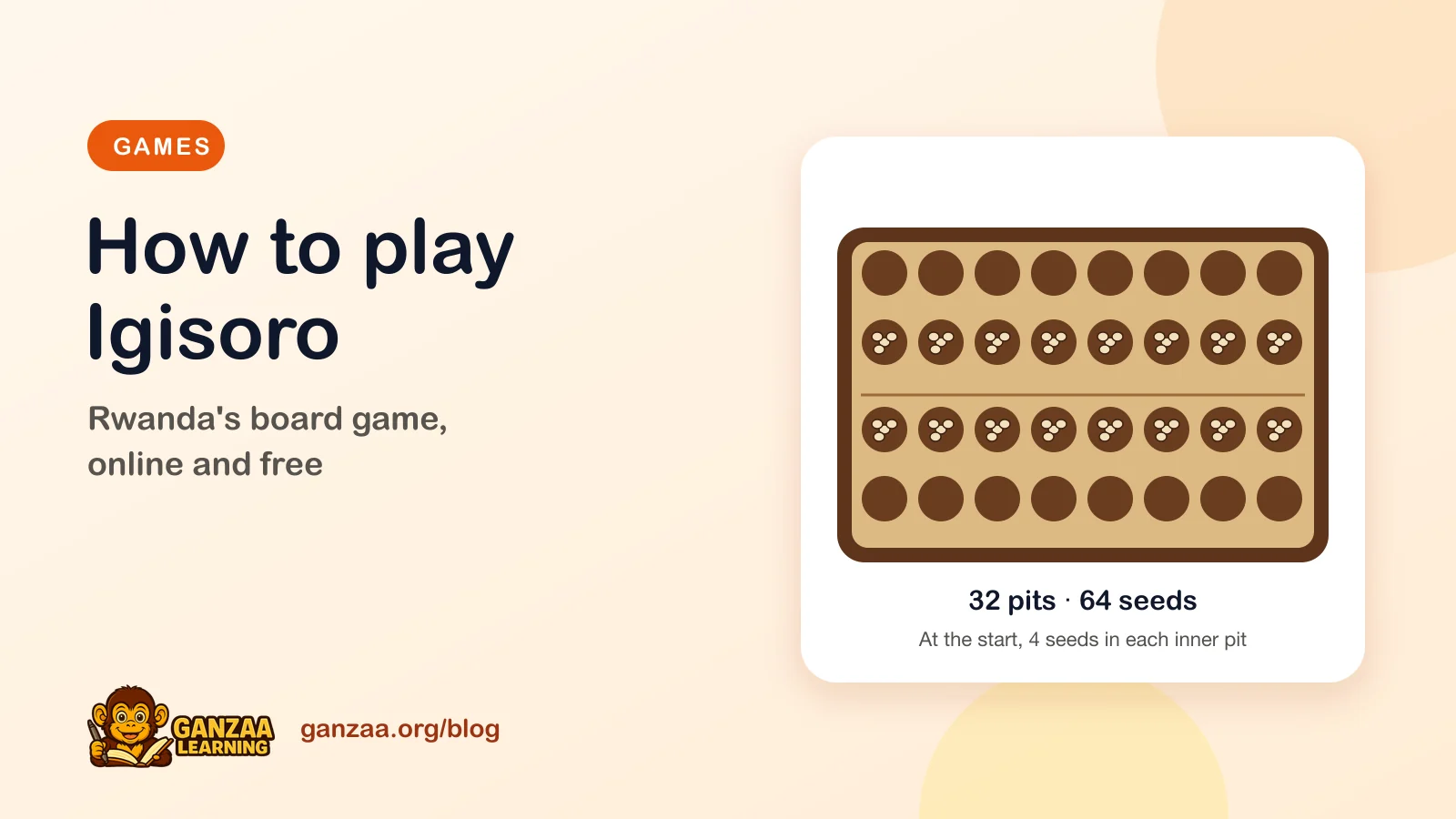
The Rwanda Cultural Heritage Academy (Inteko y'Umuco) describes a wooden table with "32 pits arranged in four rows of eight", played with 64 small pebbles or large seeds, called agasoro and also "cows", inka.
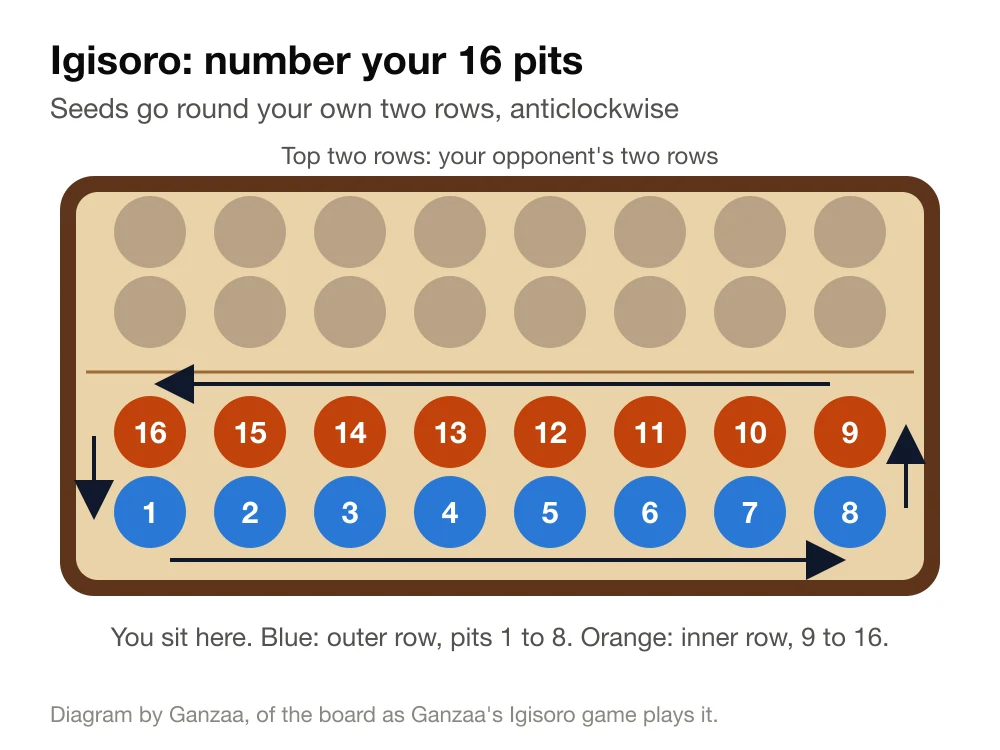
You own the two rows nearest you: your inner row in the middle and your outer row at the edge. Your 16 pits form one loop. Seeds travel round it anticlockwise and never cross to your opponent's side. Number your pits 1 to 16 in that direction:
- Pits 1 to 8 are your outer row, from left to right.
- Pits 9 to 16 are your inner row, from right to left. Pit 9 sits just above pit 8, and pit 16 just above pit 1.
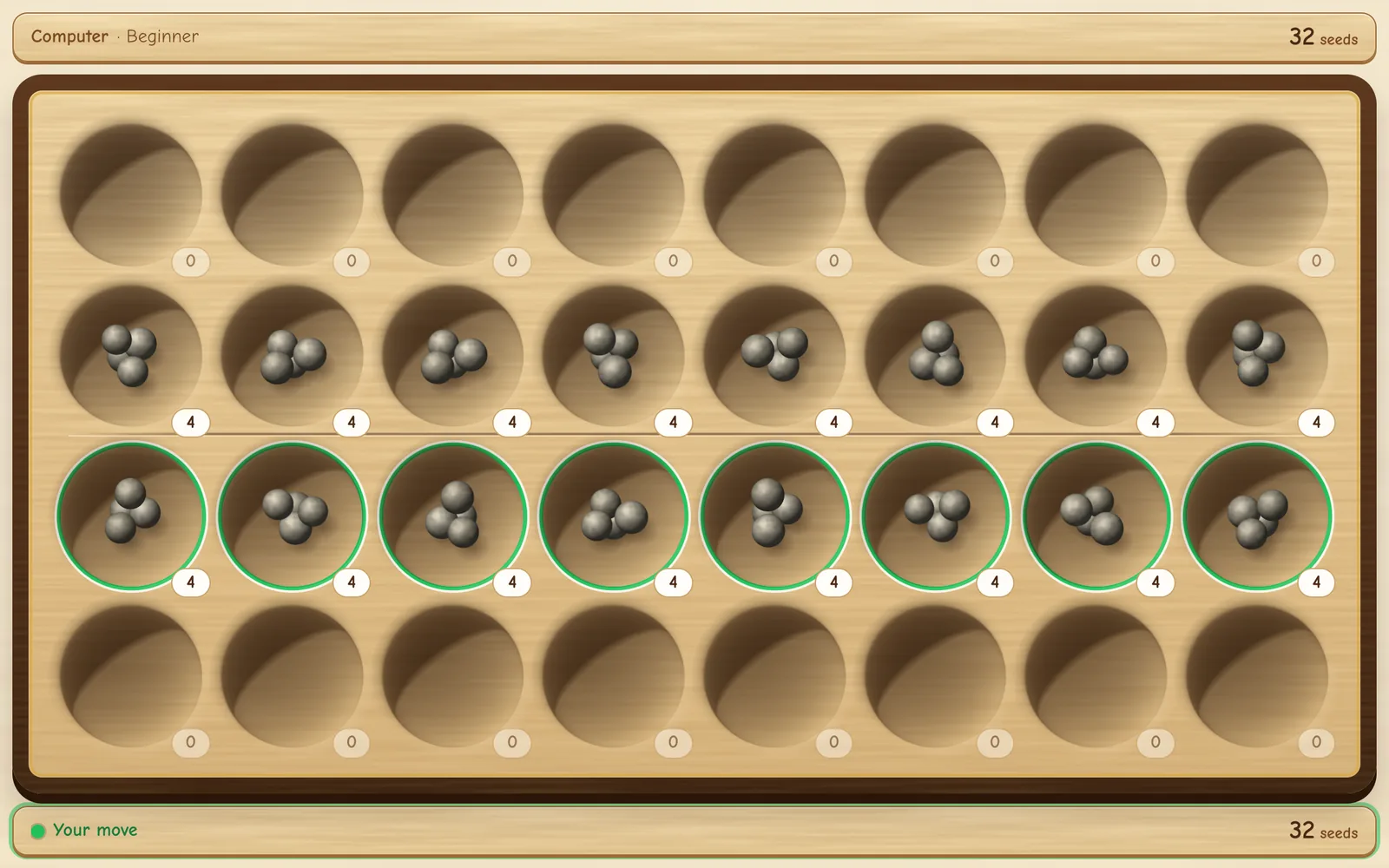
After pit 16 comes pit 1 again. At the start, pits 9 to 16 hold 4 seeds each and your outer row is empty: 32 seeds each.
The rules, step by step
- Choose a pit of yours with 2 seeds or more.
- Sow. Lift every seed and drop one into each next pit along your loop.
- Look where the last seed lands.
- An empty pit: your turn ends.
- A pit that already had seeds: lift everything in it and keep sowing. This can repeat many times.
- A pit of your inner row that already had seeds, when both of your opponent's pits straight across (their inner pit and the outer pit behind it) hold seeds: you capture both. Ganzaa calls this eating (kurya). Sow the captured seeds from the pit after the one your turn began from. Where the last of them lands, the same checks apply.
- The opening. Each player's first 2 moves can't capture. Where one would, you keep sowing instead.
- Winning. If it's your turn and none of your pits holds 2 seeds, you lose. Ganzaa adds a limit of its own: at 300 moves the game ends, and the player with more seeds wins (equal is a draw).
The counting trick
Add the seeds to the pit's number, and take away 16 if the answer is more than 16 (twice if it's more than 32). That is where the last seed lands. Pit 14 with 5 seeds: 14 + 5 = 19, and 19 − 16 = 3. If that pit already had seeds, count again from there.
A first move, seed by seed
From the start, take the 4 seeds in pit 9, the right-hand end of your inner row.
- They drop into pits 10 to 13 (9 + 4 = 13).
- Pit 13 had 4, so now it has 5. It wasn't empty, so lift all 5 and go on. There's no capture in the opening.
- The 5 seeds drop into pits 14, 15, 16, 1 and 2 (13 + 5 = 18, and 18 − 16 = 2).
- Pit 2 was empty. Your turn ends.
Reading left to right, your inner row is now 5 5 5 0 5 5 5 0 and your outer row 1 1 0 0 0 0 0 0. Check it on a two-player board, where no computer replies.
A capture, seed by seed
A made-up position after the opening (only the pits that matter): pit 11 holds 2 seeds, pit 12 is empty, pit 13 holds 3 and pit 16 is empty. Across from pit 13, your opponent has 3 seeds in their inner pit and 2 in the outer pit behind it.
- Play pit 11. One seed goes into pit 12, the last into pit 13.
- Pit 13 had seeds, it's in your inner row, and both pits across hold seeds. You capture 3 + 2 = 5. The 4 seeds in pit 13 stay put.
- Sow the 5 from the pit after pit 11: pits 12, 13, 14, 15 and 16.
- Pit 16 was empty, so your turn ends. You have 5 more seeds; your opponent has 5 fewer.
In the opening, the same move eats nothing: you lift the 4 seeds in pit 13 and keep sowing.
The rule also gives you a defence. A capture needs both of your pits in a column to hold seeds, and your opponent's sowing never adds seeds to your side. So a column where one of your two pits is empty can't be eaten on their next turn.
What Igisoro makes you practise
Every decision is a count: one seed more or less decides whether a move stops, keeps going or captures. It is also a planning game, because each move changes which of your columns your opponent can eat next.
Mancala World, a wiki about mancala games, says Igisoro masters never visibly count the seeds in a pit while planning, and that a player who counts with a finger "would be the subject of much ridicule".
Ganzaa's computer levels differ in how far ahead they look. At Beginner it looks one turn ahead and plays a random move 60% of the time. At Master it looks up to nine turns ahead, counting both players' turns.
For teachers: a 2020 article in the Brazilian journal Luminária sets out a plan for teaching first-degree equations with Igisoro. It is a proposal from a degree project, not a trial with measured results.
My advice: before every move, say the sum out loud, then say what will happen in that pit: stop, keep sowing, or eat.
Play the computer
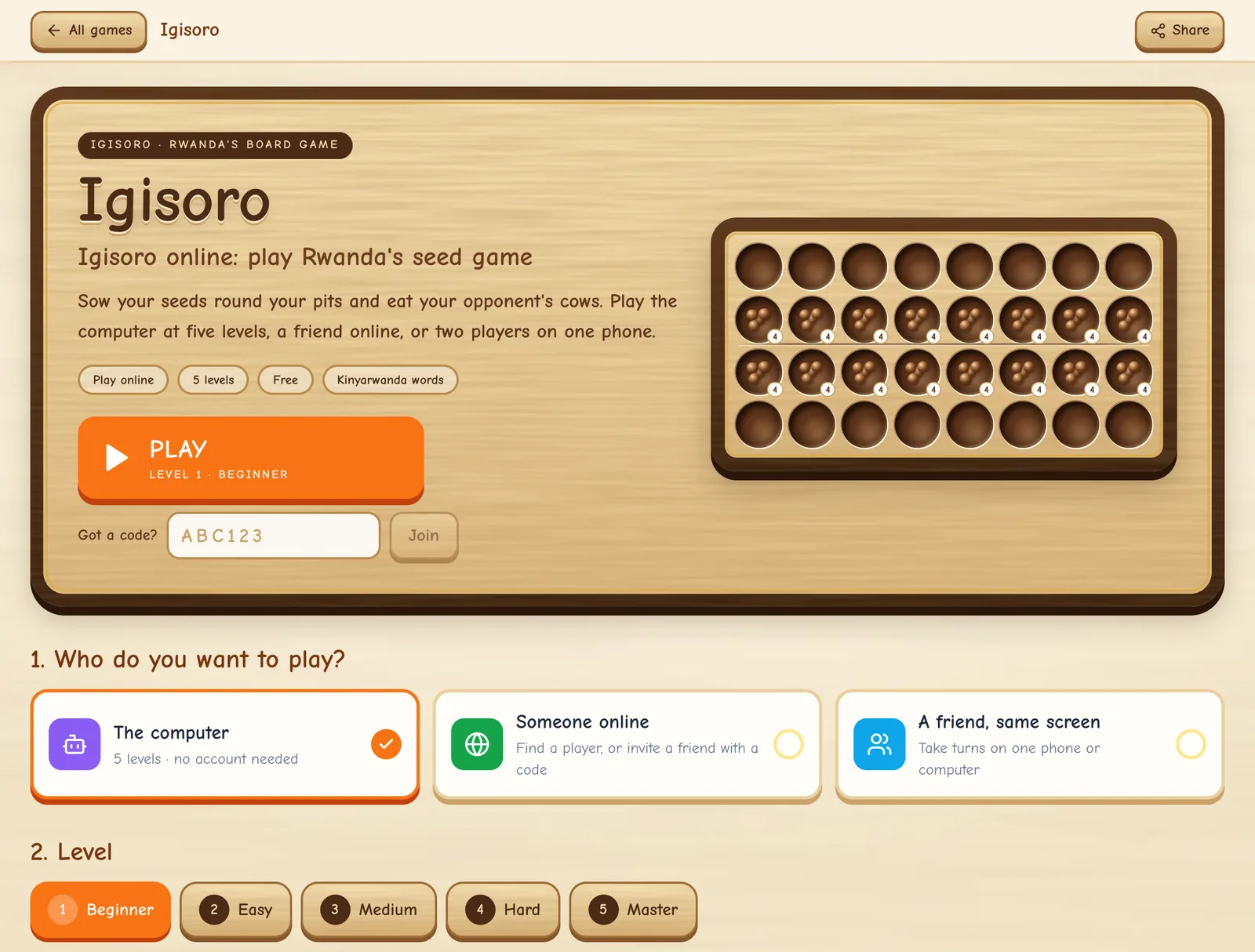
Open Igisoro on Ganzaa, choose The computer, pick a level (Beginner, Easy, Medium, Hard or Master), choose who goes first and tap PLAY. No account is needed.
Pits you can play have a green ring, and each pit shows its number of seeds. Undo takes back your last move and the computer's reply. To play someone beside you, choose A friend, same screen.
Play a friend online with a code
Online games need a free Ganzaa account, for both players.
- On the Igisoro page, choose Someone online, then Invite a friend.
- You get a 6-character code. It never uses I, O, 0 or 1, so it's easy to read out. Send it with the WhatsApp button, or copy the link.
- Your friend opens the link, or types the code into Got a code? and taps Join.
- The game starts by itself. Who moves first is random, and each of you sees your own rows at the bottom.
With a friend you invited, you can type messages, but not links, phone numbers, emails or usernames. If your school has turned chat off, you get quick messages only. Find a player pairs you with whoever has waited longest; with strangers, chat is quick messages such as "Good luck!". If your opponent is gone for a minute, you can claim the win. Each player has 3 minutes for each move, and a player whose time runs out loses. Find a player gives up after 2 minutes if nobody else is looking. An unused invite closes after 24 hours.
Where the accounts differ
- The start. Ganzaa fills the inner rows, as Mancala World does. The Heritage Academy says "the first row holds 4 seeds in each pit", and that play starts when "each player places the seeds in the back or fore rows of their territory".
- Must you capture? The Academy and Mancala World both say a player "may" take the seeds. Mancala World describes refusing with "I pass" (ndahise), and adds: "In some areas players are obliged to capture." Ganzaa always captures, as in those areas.
- The opening. Mancala World says it "may consist of 2-4 moves", made by both players at once, though taking turns is allowed online. Ganzaa takes turns.
- Sowing backwards. Mancala World describes sowing clockwise (kugarama) from certain pits, only to capture. Ganzaa leaves this out.
A little history
The Heritage Academy says the game, called mankala elsewhere in Africa, "is one of the oldest games on earth", and that Igisoro boards engraved on rocks in Rwanda "are mystically attributed to King Ruganzu (1510-1543)". It adds that "the Rwandan version is counted among the most elaborate and difficult", and that it is called ikibuguzo or igisoro depending on the region. Mancala World lists more names, including kubuguza, and dates the first written description to J. M. M. van der Burgt in 1903.
Next step
Open Igisoro on Ganzaa and start at Beginner. Before each move, say where the last seed will land. When you call it right every time, move up a level, or send a friend a code.
#how to play igisoro#igisoro rules#igisoro online#play igisoro#igisoro game#Rwanda board game#kubuguza#4 row mancala rules
Want help with this for your school or child?
Ganzaa is Rwanda's online learning platform — free for individual students, with REB-aligned practice and past papers. Schools get the first term free.
Keep reading
Games
Free Learning Games for Rwandan Students: What Each Game Teaches
15 free games: what each one practises, the class it suits, which need no account, how to play a friend live, and how to make a round count.
For Teachers
Live Quiz Game for the Classroom: Free, and Students Join by PIN
Host a free live quiz on Ganzaa: students join on any phone with a PIN, points run from 500 to 1,000, and research shows why quizzing helps memory.