
Numbers up to 9
Primary 1 · Mathematics
Numbers up to 9
Lesson 6 of 8
13 min
Let's begin
Mutesi holds 7 beans in her hand.
She drops some on the mat. Some stay in her hand.
Now she has two small heaps.
She still has 7 beans. Today you will break numbers into parts.
7 is the whole.
The 3 beans on the mat are one part.
The 4 beans in her hand are the other part.
Put them back together: 3 + 4 = 7.
The two parts always make the whole.
Take 6 beans. Split them into two heaps.
Now take 7 beans and do the same.
Read each row. One part grows, the other part shrinks.
| Whole | One part | Other part |
|---|---|---|
| 8 | 1 | 7 |
| 8 | 2 | 6 |
| 8 | 3 | 5 |
| 8 | 4 | 4 |
| 9 | 1 | 8 |
| 9 | 2 | 7 |
| 9 | 3 | 6 |
| 9 | 4 | 5 |
The whole is 9. One part is 5. What is the other part?
Take the part away from the whole.
9 − 5 = 4. The other part is 4.
Check it: 5 + 4 = 9. It works.
Careful! Do not add 5 and 9. That gives 14.
The 9 is the whole. It is not a part.
Tip
Whole on top, parts below
Say it every time: the whole is 9, one part is 5.
Then take the part away to find the other part.
Break a number into two parts with real fruit
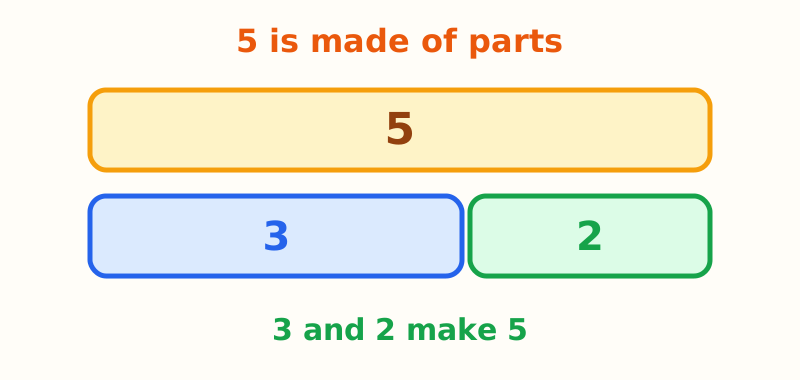
Say the whole and the part out loud first. Then answer.
The whole is 6. One part is 2. What is the other part?
Answer: 4. Take the part away: 6 − 2 = 4.
The whole is 8. One part is 3. What is the other part?
Answer: 5. 8 − 3 = 5. Check: 3 + 5 = 8.
4 + ___ = 7
Answer: 3. The whole is 7, one part is 4, so 7 − 4 = 3.
The whole is 9. One part is 6. What is the other part?
Answer: 3. 9 − 6 = 3. Check: 6 + 3 = 9.
Split 8 beans into two heaps. Then do it a different way.
Answer: 5 and 3 works. So does 4 and 4. Both make 8.
What you learned today
Quick check

