
Loading article…

What research says about stars, streaks and leaderboards, which ones Ganzaa uses, which need an account, and how to stop points replacing learning.
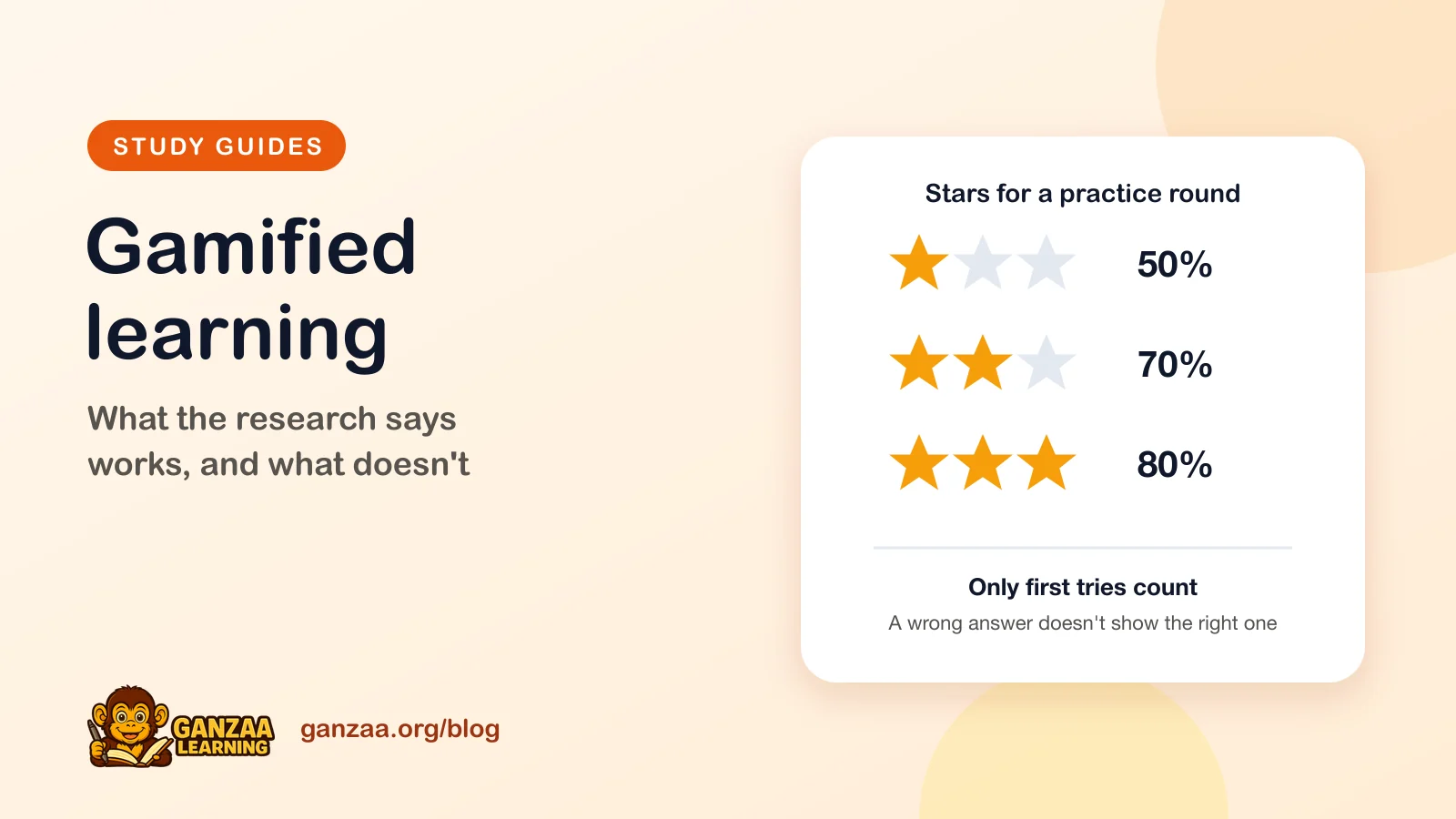
Finish a practice round on Ganzaa and you earn up to three stars: one for 50%, two for 70% and three for 80%. The rule that matters comes next. Only your first try on each question counts. If you get a question wrong, the screen says "Not quite" and lets you try again. It doesn't show you the answer, and the second try adds nothing to your score.
So a star reports what you knew before you got help. Whether game elements help you learn depends on details like this. Here is what the research says, which ones a Ganzaa student meets, and how to use them without letting the score take over.
In a 2020 meta-analysis, Michael Sailer and Lisa Homner use the definition by Deterding and colleagues: gamification is "the use of game design elements in non-game contexts". Your lessons are the non-game context. The elements are things like points, badges, levels, streaks and leaderboards. In a review of 24 studies by Hamari, Koivisto and Sarsa (2014), points, leaderboards and badges were "clearly the most commonly found variants".
This is different from a learning game, which is a whole game built to teach. A 60-second times tables race is a game. Stars at the end of a maths exercise are gamification.
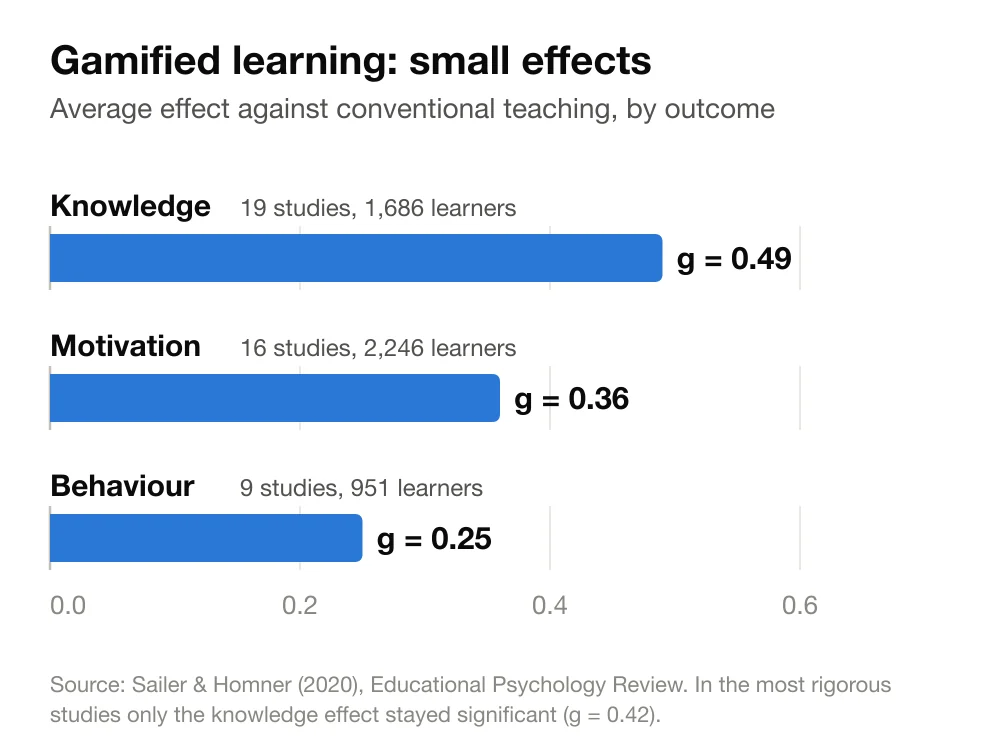
Sailer and Homner's meta-analysis, in Educational Psychology Review, pooled experiments that compared gamified learning with conventional teaching. They found "significant small effects" on three kinds of outcome:
The number g is the gap between the gamified group and the comparison group, in standard deviations. So 0.49 means the gamified groups did about half a standard deviation better on knowledge tests, on average.
Three warnings come with those numbers. When the authors kept only the most rigorous studies, the knowledge effect held (g = 0.42), but the effects on motivation and behaviour were no longer significant. Only one study "reported a delayed posttest", so nobody can yet say how long the gains last. And the authors describe their own sample as "rather small".
Hamari's team concluded that gamification "provides positive effects, however, the effects are greatly dependent on the context in which the gamification is being implemented, as well as on the users using it." Nine of their 24 studies were in education. All of those saw mostly positive learning outcomes, such as more motivation and engagement. They also "pointed to negative outcomes", including "the effects of increased competition". Across the whole review, some studies suggested the gains "may not be long-term" and could be a novelty effect.
Sailer and Homner found that combining competition with collaboration worked well for behaviour, and in the strictest studies it beat competition by itself. They suggest that "mere competition might be problematic", "at least for some learners under certain circumstances", and add: "Competition may be problematic if it occurs between learners with widely different skill levels because succeeding can be unattainable for learners with lower skill levels."
Research on rewards adds a caution. Edward Deci, Richard Koestner and Richard Ryan pooled 128 experiments in 1999, then summarised them for educators in 2001. In their analysis, tangible rewards included money and prizes, and also symbolic rewards "such as trophies and good player awards". What they found:
Not everyone agrees on the size of this effect. An earlier analysis by Cameron and Pierce (1994) concluded it was "minimal". Deci's team reanalysed the studies and argued that analysis was "seriously flawed".
| Element | How it works | Account? |
|---|---|---|
| Stars in practice | Practise one lesson, or play a unit's practice levels (200 per unit, all open from the start). 50% gets 1 star, 70% gets 2 and 80% gets 3, on first tries only. The results screen says what the next star needs. | Free account |
| Unit test | The last item in every unit that has questions: 30 questions from across its lessons (fewer in a small unit), a new set each time, no clock. Score 70% or more to pass and complete the unit. You can take it as many times as you need. | Free account |
| Today page | A list of things to do today: your teacher's picks, or up to five chosen at random from your grade's lessons, practice and books. Your stars, lessons done and learning time. "Fix your mistakes", which replays only the questions you got wrong recently. | Free account |
| Streak and badges | Your streak counts the days in a row on which you finished a lesson or a practice round, with a flame on each active day this week. Badges on your profile at 3, 7 and 30 days in a row, and at 50, 250 and 1,000 stars. | Free account |
| Quiz games | In games such as Math Sprint: points, a streak bonus for right answers in a row, stars, and a leaderboard for each level. The clock stops while you read an explanation. | No account |
| Live quizzes | Correct answers score up to 1,000 points, more the faster they come, and the game ends with a leaderboard. | Only the host |
Two limits are worth knowing. Games from the games page and unit tests don't add to your star total or your streak. And students don't see a class leaderboard. Ganzaa can rank a class by lessons, stars, time and accuracy, but that table is only on staff pages.
Sailer and Homner, drawing on earlier work by Landers, note that "effective instructional content is a prerequisite for successful gamification". The game layer helps only if the learning underneath is good. The advice below is my opinion, built on that research.
My advice: praise what your child did ("you got every fractions question right first time"), not the number of stars, and don't pay for stars. In the studies above, expected tangible rewards and controlling praise both lowered motivation. Ask which unit tests your child has passed, and ask them to explain one question they got wrong and then fixed.
In a live quiz, players join with just a name, so try putting two or three students on one phone. Each team then has to agree on an answer. That mixes competition with collaboration, the combination that beat competition by itself in Sailer and Homner's strictest studies. It also gives weaker students a team they can win with.
Pick a unit from the free lessons and read a lesson. Then press Practice This Lesson (you'll need a free account) and write down which questions you missed. When you have finished the lessons, take the unit test. The full rules are in Earn stars, keep a streak and collect badges. For quick drills, try the times tables game or the other games. To run a class quiz, start at Live quizzes.
Ganzaa is Rwanda's online learning platform — free for individual students, with REB-aligned practice and past papers. Schools get the first term free.
15 free games: what each one practises, the class it suits, which need no account, how to play a friend live, and how to make a round count.
Host a free live quiz on Ganzaa: students join on any phone with a PIN, points run from 500 to 1,000, and research shows why quizzing helps memory.