Loading article…


See a real photo, pick the English word, hear it said: 1,339 words in 26 topics, free in the browser. How Picture Words works, at home and in class.
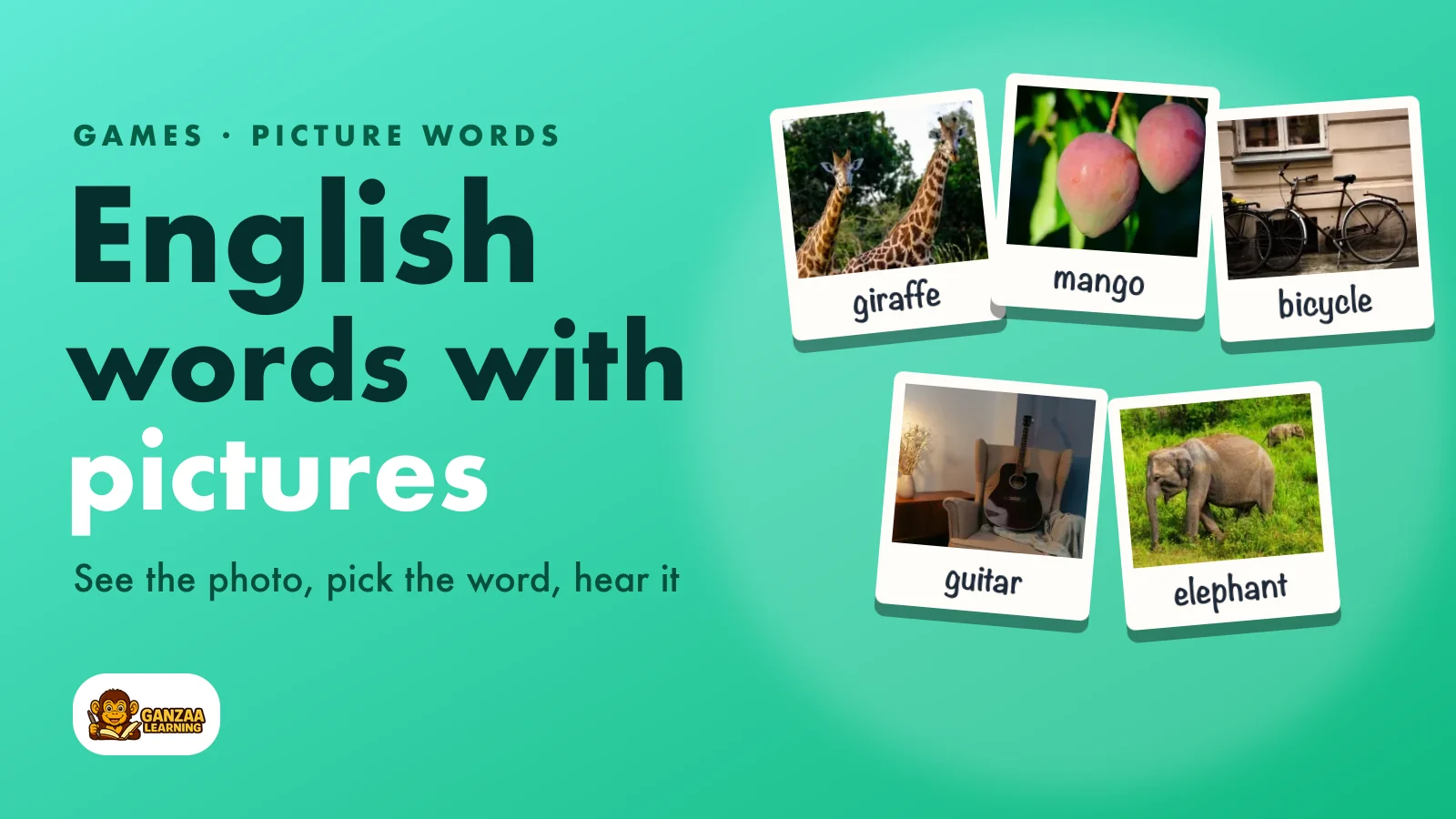
Picture Words is a free game on Ganzaa for learning English words from real photographs. You see a photo and choose the English word for it, or see a word and find its photo. When you get it right, you hear the word said aloud. It has 1,339 words in 26 topics, from animals and fruits to jobs and things in the kitchen, and it runs in any web browser on a phone, tablet or computer at ganzaa.org/games/english-words. There is nothing to download, and you can play without an account.
This guide explains how a round works, how the points and stars are counted, what each topic page offers besides the game, and how to use it with a child at home or with a class.
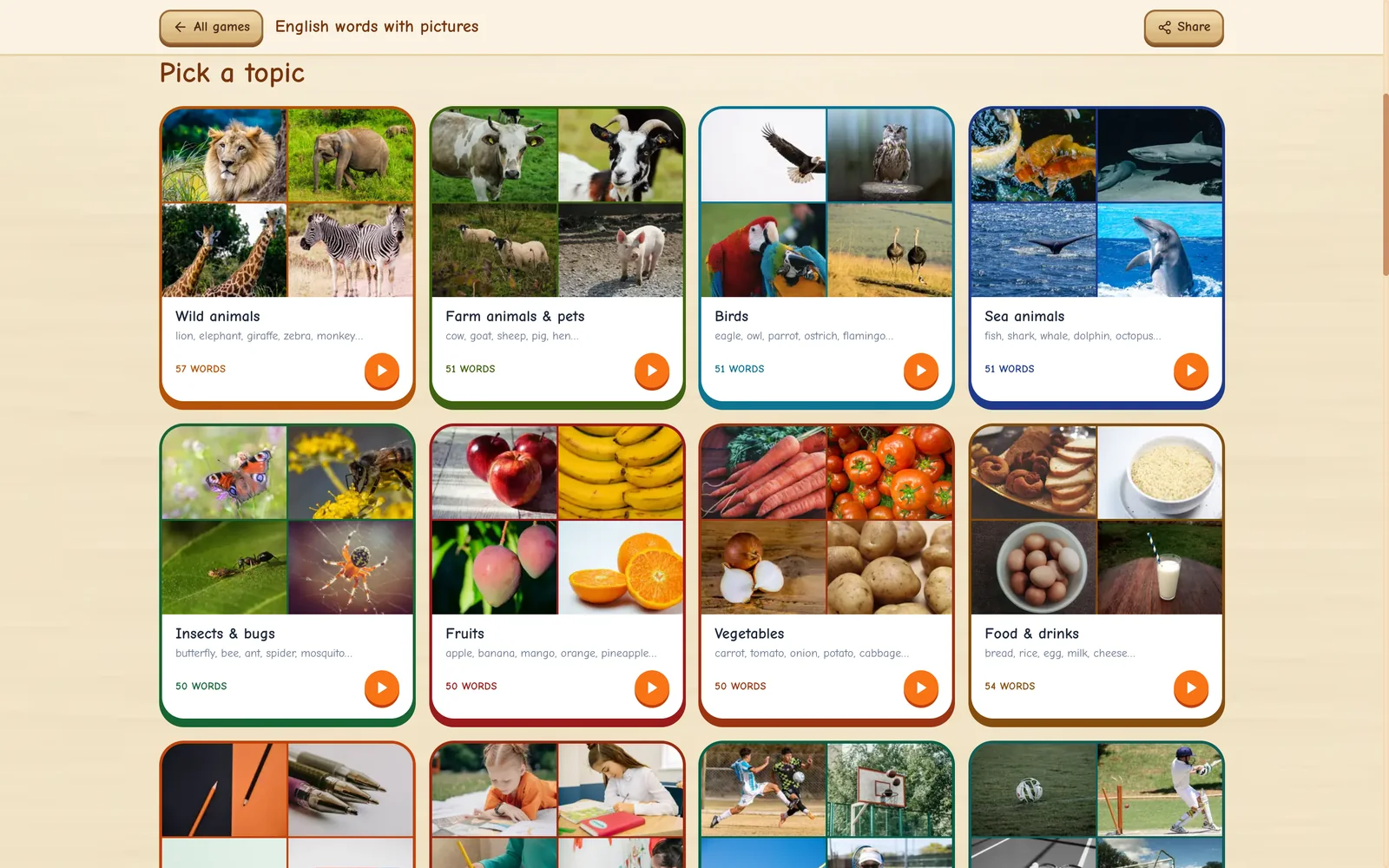
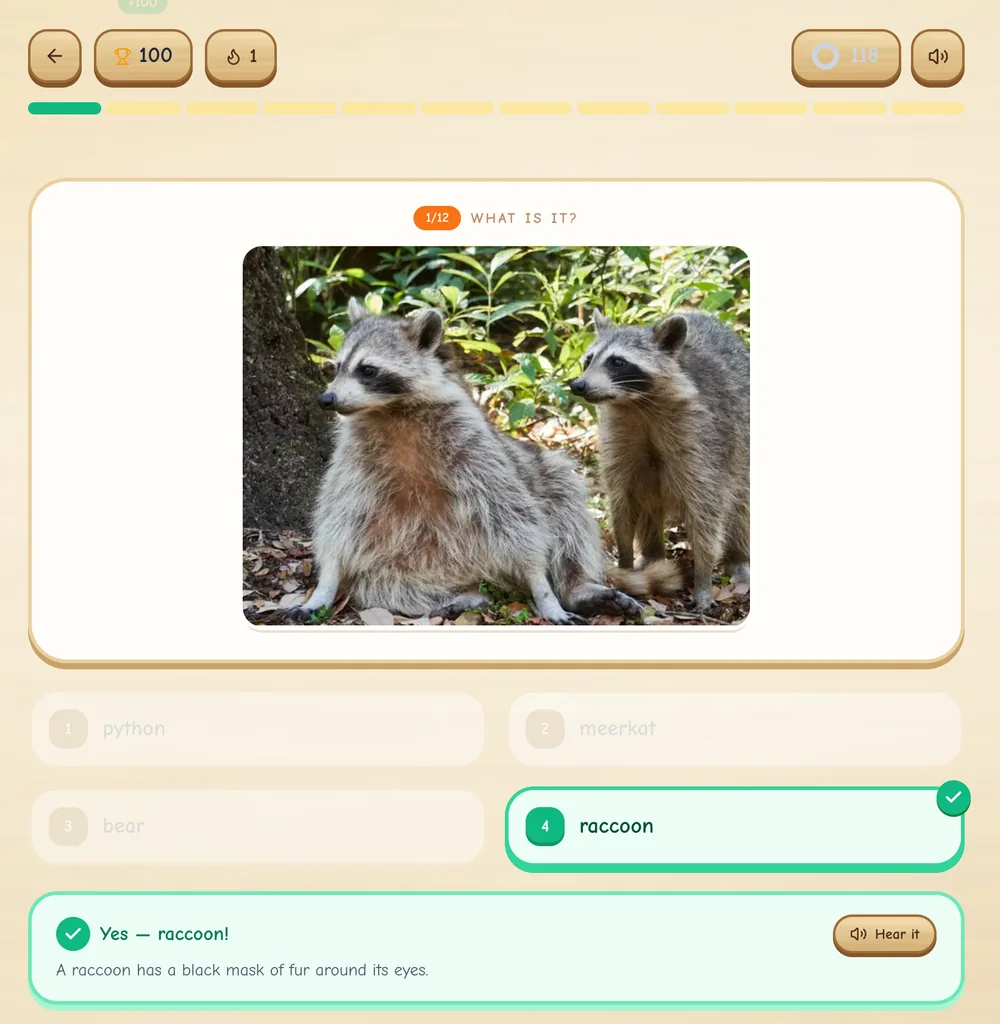
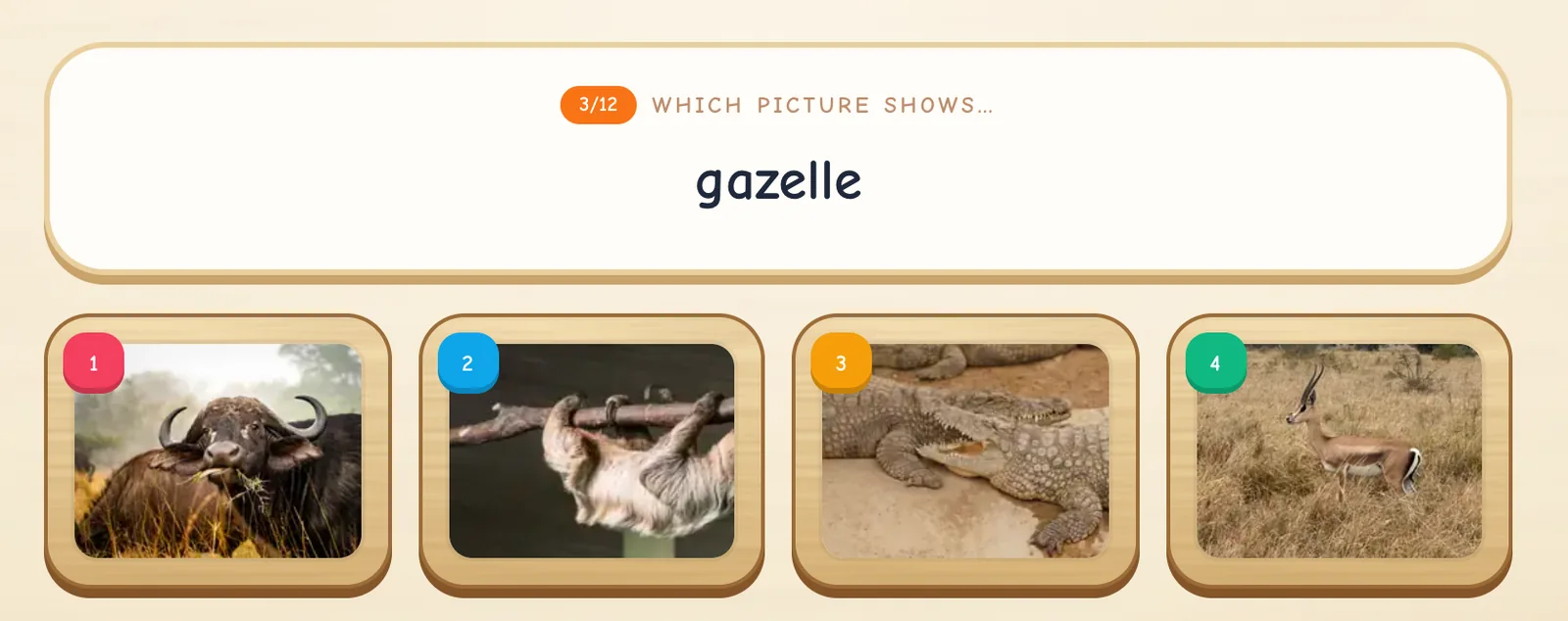
Pick a topic, and a round gives you 12 of its words, with 2 minutes on the clock. Two kinds of question are mixed in every round, because recognising a word and recalling it are different skills:
The wrong answers always come from the same topic: a giraffe is offered beside a zebra, a lion and an elephant, not beside a spoon. That is what makes you look at the photo. And words of one family are never offered together, so a photo of a clownfish never has "fish" as a wrong answer, and a right answer is never marked wrong.
Get it right and the game ticks your answer, says the word aloud, shows a short example sentence using it, and moves on by itself. Get it wrong and it shows the right word and the same sentence, then waits for you to tap before the next question, so there is time to read. A Hear it button plays the word again as often as you like, even with the game's sound turned off.
Two rules protect a slow connection. The clock doesn't start a question until its photos have loaded, and the next two questions' photos load in the background while you answer. And the clock stops while the answer is on the screen, so stopping to read why you were wrong costs nothing.
A right answer scores 100 points, plus 10 for every right answer in a row before it: the second in a row scores 110, the third 120, and so on. A wrong answer scores nothing and starts the run again. At the end, the stars count how many you got right, not how fast you were: 3 stars for 90% or more, 2 for 65%, 1 for 35%.
Every topic has its own leaderboard, so a child who knows animals well can top that board while still learning the words for tools. If you play without an account, your score is saved under a made-up name, which you can change at the end of the round. A free account keeps all your scores together.
The topics are wild animals, farm animals and pets, birds, sea animals, insects and bugs, fruits, vegetables, food and drinks, classroom objects, actions, sports, sports equipment, toys and games, body parts, clothes, transport, things at home, the kitchen, nature and weather, plants and flowers, jobs, musical instruments, technology, tools, everyday objects and places in town. Each one has at least 50 words, and a round picks 12 of them at random, so every round is a different mix.
The spelling is British English (aeroplane, not airplane), and every word is said by a recorded British English voice. If a word has no recording, the game uses your device's own voice instead.
Below the game, every topic page lists all of its words as a picture dictionary: the photo, the word, an example sentence, and a speaker button that plays the word. It is a page you can read through with a child before playing, or look back at after a round to find the words you missed. For example, the animals page lists every animal in the game. Every topic page also links to the same topic in French, in Mots en images, the French version of the game, with French recordings and its own leaderboards.
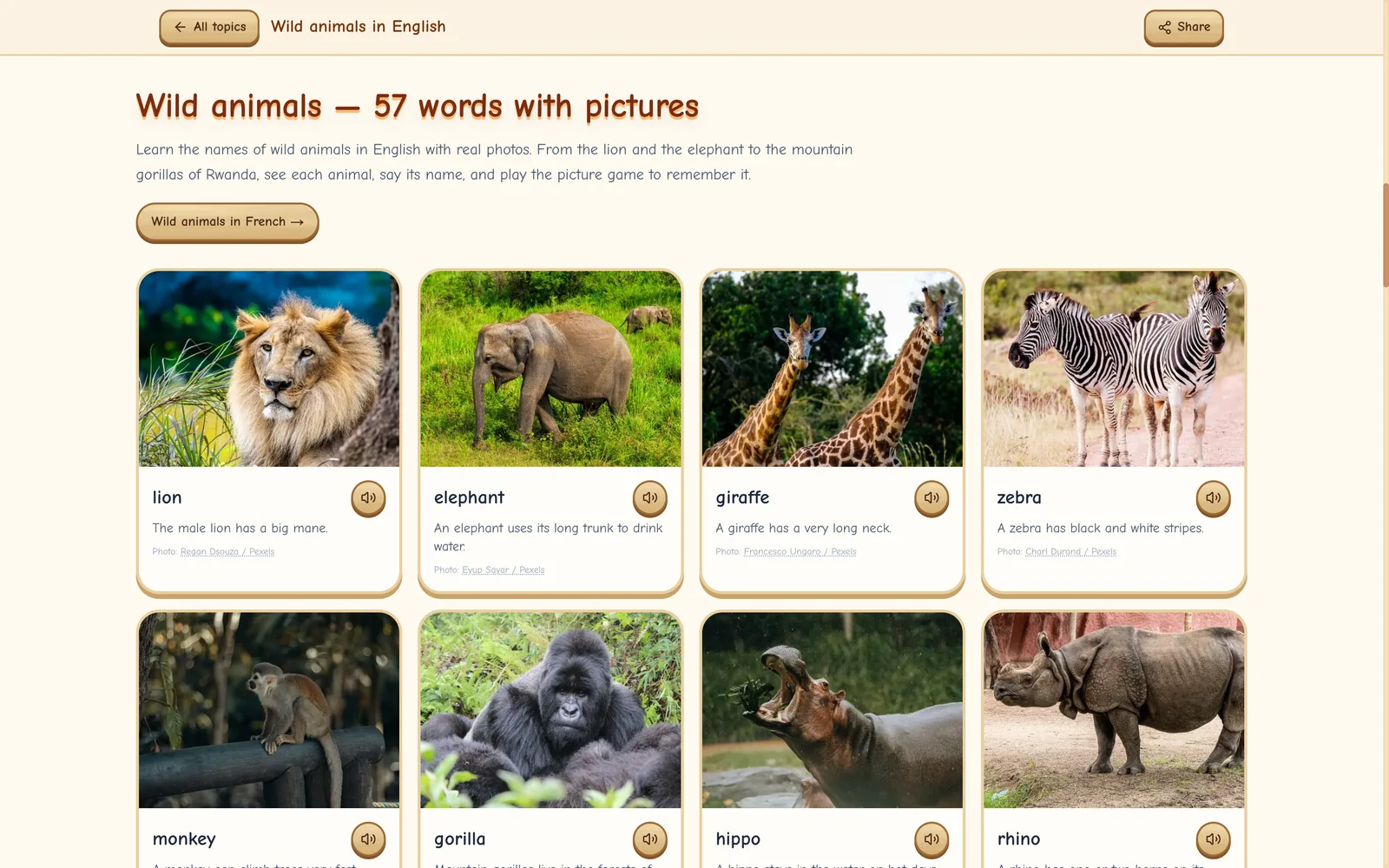
The photos are real photographs from Pexels, which allows them to be used for free, and each card names the photographer who took it.
Pictures alone are not magic. In a 2012 study, students learning Swahili words did not learn them better from pictures than from English translations, even though they felt more sure of the words they had seen with a picture. The pictures only helped once that overconfidence was removed, for example by making the students test themselves on the words (Carpenter and Olson, 2012, Journal of Experimental Psychology: Learning, Memory, and Cognition).
Testing yourself is the part that matters. In another well-known study, students learned 40 Swahili–English word pairs. A week later, those who had kept being tested on the words remembered about 80% of them. Those who stopped being tested on a word once they knew it remembered 33–36%, whether or not they went on studying it (Karpicke and Roediger, 2008, Science).
Picture Words is built that way: every word is a question you have to answer, not a card you look at. A wrong answer shows you the right one and a sentence that uses it, and the word can come up again in your next round. For more on what games can and can't do for learning, see gamified learning: what the research says.
On a projector, Picture Words works as a whole-class game: show the photo, let the class call out the word, then tap the answer the class agrees on. The clock gives about 10 seconds a word, so keep it quick, or let one student at a time answer for the class. Pick the topic that matches the lesson, such as classroom objects, body parts or jobs, and use the topic's picture dictionary to introduce the words before you play.
Two students can also race each other on their own phones. Duel a friend on the game's page gives both players the same 10 questions from the topic you choose. Each question has 15 seconds, and a right answer scores 100 points plus up to 100 more for speed. You can find another player, or send a friend a code to join. Duels need a free account for both players; the solo game doesn't.
Picture Words is one of the free games on Ganzaa. For what the others teach, from maths to Igisoro, see free learning games for Rwandan students, or start a round of Picture Words now.
15 free games: what each one practises, the class it suits, which need no account, how to play a friend live, and how to make a round count.
Igisoro rules as Ganzaa plays them, a first move and a capture counted seed by seed, and how to play the computer or a friend online with a code.
Ganzaa is Rwanda's online learning platform — free for individual students, with REB-aligned practice and past papers. Schools get the first term free.